Where Toronto Turns to Stone and Light
Toronto moves fast—until you climb toward Casa Loma after dark. In winter, blue light turns stone into theatre and warm windows pull the castle back into human scale. This travel feature follows the atmosphere of a night visit and why this hilltop landmark still feels like a portal inside a modern city.
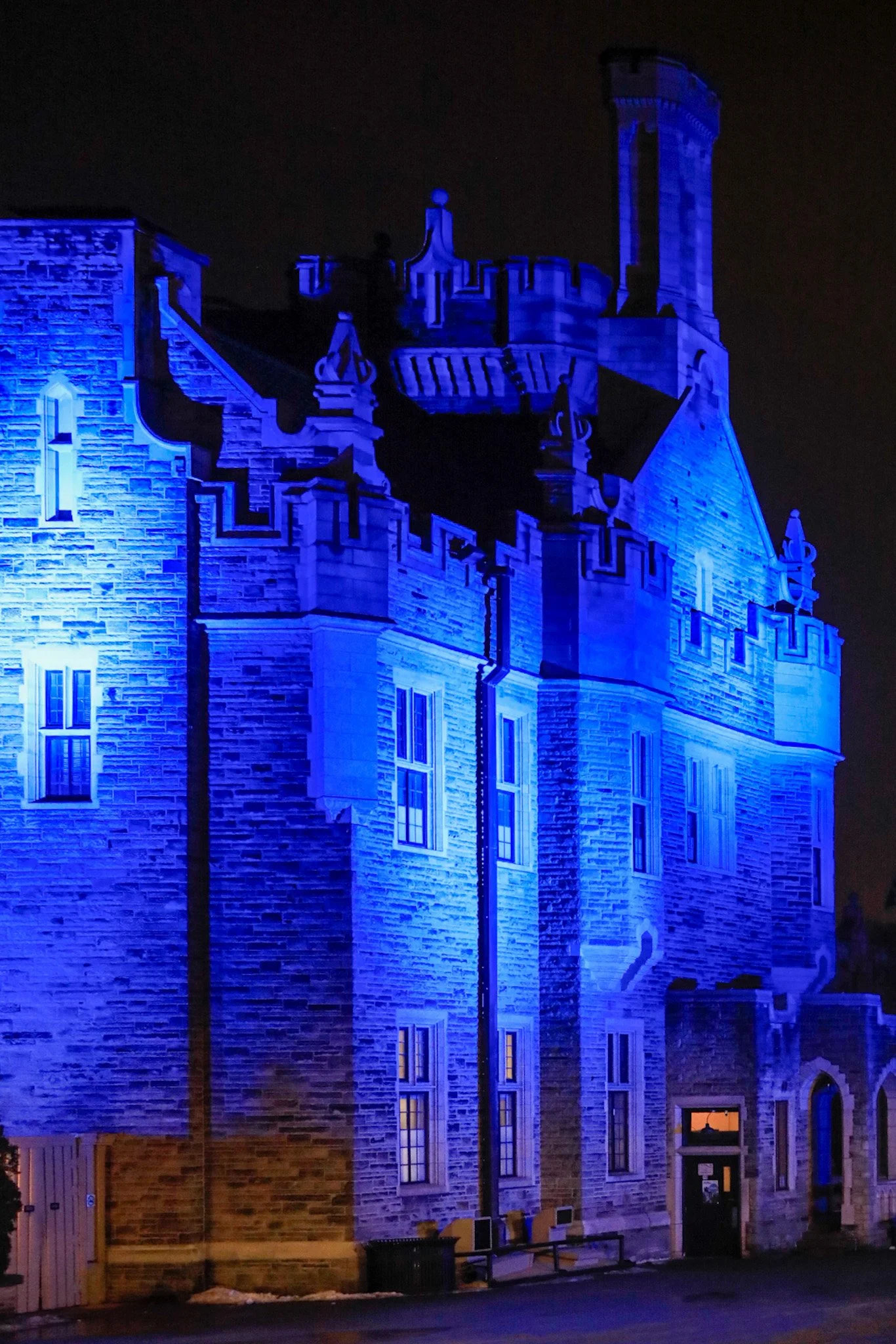
A Castle Built for a Photograph @Solomon D Crowe
Casa Loma illuminated in blue light on a winter night in Toronto, Ontario, Canada. A Gothic Revival landmark overlooking the city’s modern skyline.
A Winter Night at Casa Loma
Toronto is a city that rarely pauses. Even in winter, when the cold tightens the sidewalks and the wind scrapes between towers, the city keeps its pace—streetcars sliding through intersections, headlights cutting across wet asphalt, office windows glowing late as if the day never truly ends. In the downtown core, the rhythm is constant: movement, commerce, and the subtle pressure to keep up. That’s why Casa Loma works so powerfully as a night destination. It doesn’t compete with Toronto’s speed; it interrupts it. It stands above the grid like a different chapter—stone and silhouette, romance and restraint—offering a version of the city that feels less transactional and more cinematic.
On a winter night, the approach to Casa Loma becomes part of the story. Toronto’s streets, polished by snowmelt and salt, reflect streetlights in long, wavering ribbons. Footsteps sound sharper, and breath appears like a small, temporary cloud. Winter reduces the city to essentials: light, shadow, and surface. As the climb begins toward the castle, the urban noise doesn’t disappear, but it changes. The higher the elevation, the more the city’s sound becomes background—like a distant engine rather than an immediate demand. That gradual shift is the first hint that Casa Loma isn’t just a landmark to see; it’s an atmosphere to enter.
Then the castle comes into view, and the contrast lands instantly. Toronto’s modern skyline is glass, steel, and geometry—clean lines, reflective planes, a language of contemporary ambition. Casa Loma answers with crenellations, turrets, and heavy stone walls that feel designed not for efficiency but for permanence. In winter, that permanence becomes emotional. Snow banks at the edges of stairs and railings emphasize the castle’s verticality, and the cold makes the stone feel even more serious. Under night lighting—especially when the façade is washed in saturated blues—the building becomes theatrical without being artificial. It doesn’t look like a set; it looks like the city’s imagination hardened into architecture.
There’s a reason a castle in Toronto still surprises first-time visitors. Canada’s global imagery often leans toward wilderness, lakes, and mountain landscapes, not Gothic silhouettes on a hilltop. Casa Loma disrupts that expectation in the best way. It offers an “elsewhere” feeling without requiring anyone to leave the city. That’s travel magic in its purest form: the sensation of stepping into a different world while remaining inside the same postal code. The castle gives Toronto a second face—one that feels older, moodier, and more story-ready than the city’s usual modern sheen.
At night, the building’s lighting becomes the narrator. Blue is the most transformative color on stone because it deepens texture rather than flattening it. Where warm floodlights can make old buildings look cozy or museum-like, blue lighting makes Casa Loma look dramatic and slightly unreal. It sharpens edges, deepens shadow pockets, and turns the façade into a sculptural surface. Against a winter sky, the blue doesn’t feel trendy—it feels elemental, like moonlight intensified. The castle’s profile becomes more pronounced, and even familiar architectural details start reading like symbols: battlements as protection, towers as watchfulness, narrow windows as secrecy.
Those cool tones would risk making the castle feel distant if not for the warm windows. When amber light glows from within, it introduces the human counterpoint. Warm windows are not merely pretty; they imply life. They suggest interior warmth against exterior cold, intimacy against scale, story against structure. In winter, that warm/cool contrast hits deeper because it mirrors the lived experience of the season. Toronto winters are full of thresholds: stepping from street into lobby, from wind into warmth, from dark into light. Casa Loma compresses that winter psychology into a single frame—stone bathed in blue, windows burning soft gold—inviting viewers to feel both the chill and the shelter at once.
To understand why Casa Loma reads so cinematically, it helps to remember what it was built to be: a statement. In the early 20th century, Sir Henry Pellatt envisioned a home that carried European grandeur into a city that was still defining itself. The result wasn’t a practical mansion; it was a spectacle—Gothic Revival architecture on a scale that still feels improbable for Toronto. That origin matters, not because visitors need a history lecture to enjoy the place, but because the castle’s mood is inseparable from its intent. Casa Loma was built to impress, to endure, to be remembered. That intention lives in the building’s posture. It stands the way an ambitious idea stands: unapologetically.
And yet Casa Loma’s most interesting evolution is that it became bigger than its founder. Over time, it shifted from private dream to public landmark—an interior world that visitors could enter and claim as part of Toronto’s identity. That transition is why Casa Loma doesn’t feel like a relic of wealth so much as a piece of the city’s imagination made accessible. It’s one thing to pass a grand building on the street and admire it at a distance; it’s another thing to step into it, walk its corridors, and feel its scale in your body. Casa Loma’s power is physical. The stone has weight, and that weight changes the way a visitor moves.
Inside, the experience is less about checking off rooms and more about letting the building shape attention. Some spaces open wide and grand, engineered to make visitors look up and pause. Others narrow, funneling movement into corridors where texture becomes the main event. Stone, wood, iron—materials that feel durable, tactile, and honest—replace the modern city’s glossy surfaces. In a world where so much is designed to be replaced, a building like this carries a different message: the beauty of something meant to last. Even without saying it out loud, Casa Loma suggests an idea that resonates deeply right now—permanence is a luxury.
At night, those interior impressions echo back into the exterior view. The castle doesn’t feel like a façade when you’ve been inside it. It feels like a container of space and story. That’s one reason the photos hold attention: viewers can sense depth. The castle isn’t a flat subject; it’s dimensional. The lighting reveals roughness in the stone, the outlines of windows, the geometry of turrets, and the way the building catches shadow along its edges. In winter, shadows look heavier. Light looks cleaner. The air itself seems to sharpen the scene. Casa Loma doesn’t just sit in winter; it wears it well.
What elevates Casa Loma from “nice landmark” to feature-story destination is its relationship to the modern skyline behind it. Toronto’s towers—lit office grids, reflective high-rises, and contemporary silhouettes—often appear in the same visual conversation as the castle. That juxtaposition tells a Toronto story that doesn’t require words: this is a city of layers. One era chasing height and efficiency. Another era chasing romance and legacy. Both are real. Both coexist. The skyline doesn’t diminish Casa Loma; it intensifies it. The castle becomes a punctuation mark against the city’s continuous sentence of development.
That tension—old and new in one frame—also speaks to why people travel the way they do now. Increasingly, travelers are looking for specificity. They want places that don’t feel like they could be anywhere. Modern cities can blur together if the experience is limited to the same brands, the same condos, the same glass geometry. Casa Loma refuses to blur. It offers a visual identity that cannot be copied and pasted into another city. A castle in Toronto is inherently distinctive. That uniqueness isn’t a gimmick; it’s a competitive advantage in the attention economy. It gives travelers a reason to choose a moment here over a moment elsewhere.
Winter amplifies the distinctiveness because it strips the scene down. Summer brings greenery, crowds, and softness. Winter brings clarity. Trees go bare. Colors mute. Snow piles at edges and corners, carving the environment into shape. The castle’s blue lighting becomes more pronounced against a quieter palette, and warm windows feel warmer because the cold is more present. Winter also changes the human behavior around the site. People move with purpose, but they also linger for photos because the scene feels rare. There’s something about a winter-lit castle that makes even locals behave like visitors. It invites the “stop and look” instinct that city life usually trains out of people.
That invitation matters, because the best travel moments aren’t the ones where you simply arrive and consume. They’re the ones where your pace changes. Casa Loma slows people down. The incline toward the castle, the scale of the structure, the way light falls across stone—everything works against rush. And that’s not just aesthetically pleasing; it’s psychologically restorative. Travelers remember destinations that change their internal tempo. They remember places where attention returns. Casa Loma, on a winter night, does exactly that. It takes a city built for movement and offers a scene built for stillness.
It’s also why Casa Loma feels naturally cinematic without relying on hype. “Cinematic” is often used too loosely, but here it’s accurate in a technical sense. The castle has strong lines and shapes that read clearly in low light. The lighting creates contrast and depth. The stone texture catches highlights and holds shadow. Warm windows provide focal points. And the surrounding city glow adds ambient context. The scene has layers—foreground, midground, background—built into it. This is the language of strong visual storytelling, which is why Casa Loma repeatedly shows up in film and TV uses and why it consistently performs as a travel editorial subject. A viewer doesn’t need to be told it’s dramatic; the image communicates that immediately.
Yet the most compelling way to write about Casa Loma isn’t to over-romanticize it into fantasy. The stronger move is to treat it as a real place in a real city that can still surprise people. Toronto has a reputation for practical energy—business, finance, growth, and hustle. Casa Loma is the counterbalance: proof that Toronto also has room for spectacle, mood, and architectural storytelling. It reminds visitors that cities are not just marketplaces; they are emotional landscapes. They shape how people feel, and landmarks like this shape that feeling more powerfully than we often admit.
Casa Loma also works as a feature travel destination because it can hold multiple stories at once. It can be a history story: early-20th-century ambition, changing ownership, the castle’s transition into public space. It can be an architecture story: Gothic Revival lines, textured stone, the physical drama of vertical design. It can be a winter story: light against snow, warmth against cold, the seasonal mood that makes urban landmarks feel new again. It can even be a city-identity story: what Toronto chooses to preserve and what Toronto chooses to rebuild. The castle doesn’t force one reading; it offers many. That flexibility is exactly what makes it magazine-friendly. It can anchor a feature without being exhausted by a single angle.
In the current travel landscape, that matters more than ever. Readers are saturated with “top 10 things to do” lists that feel interchangeable. Feature travel writing wins when it offers meaning, not just itinerary. Casa Loma offers meaning because it embodies something people crave: the tangible. The solid. The non-digital. It’s not a screen. It’s not a pop-up. It’s not a trend. It’s stone, light, and time. It sits there whether anyone is watching or not. And that’s precisely why it’s worth watching.
A winter night at Casa Loma can also become a quiet reminder of what cities are for. Toronto is often framed as a place to work, build, and compete. But cities are also for wonder—for moments when the environment makes you feel something beyond the schedule. Casa Loma supplies that wonder without needing to be “exciting” in a loud way. Its excitement is atmospheric. It’s the thrill of standing beneath architecture that feels out of scale with ordinary life. It’s the pleasure of seeing a building transformed by light. It’s the almost-childlike sensation of realizing that yes, there is a castle here, and yes, it looks like this at night.
The moment that tends to stay with people isn’t necessarily the most “informative” moment; it’s the most sensory one. The cold on your face. The light on the stone. The hush that settles when you step back far enough to take the whole façade in. The warm windows that look like small hearths behind thick walls. The skyline behind it all—proof that this isn’t a remote European hillside, but a living, modern Toronto neighborhood where the city continues even as the castle holds its posture. That layered sensation is exactly what feature travel editorials are built to capture: a place that lives in more than one time at once.
There’s also a subtle emotional truth Casa Loma reveals about winter travel. Winter often gets treated as something to endure rather than something to experience. People plan trips around escaping cold, not embracing it. But winter can be a powerful lens for travel because it strips away noise and forces mood to the surface. A castle in summer can feel like a tourist attraction. A castle in winter can feel like a story. The cold gives it stakes. The light becomes more dramatic. The scene becomes more intimate even when the building is enormous. Winter invites reflection, and Casa Loma rewards it.
For visitors who want to experience the castle beyond a quick photo, timing matters. The best night moments happen when the sky hasn’t fully collapsed into black, when there’s still a trace of blue in the air and the lighting feels like it’s emerging rather than simply on. That transition—between day and night—is when the castle looks most alive. It holds detail without losing mood. It separates from the background without becoming a silhouette. Winter skies often deliver that rich, in-between color for longer than expected, and that extended “blue hour” effect is part of why winter photographs of Casa Loma can feel so striking.
Still, even in full darkness, the castle holds the frame. Blue lighting on stone reads as bold and modern while still honoring the building’s old-world shape. It’s a visual language that feels contemporary without erasing heritage. That’s also part of Casa Loma’s relevance today: it adapts. It can host events, light displays, seasonal programming, and special evenings without losing its identity. The castle is not trapped in the past; it’s a historic structure that continues to participate in the present. That balance—preserved but active—is what separates living landmarks from static museums.
When you leave Casa Loma and return to Toronto’s streets, the city often looks slightly different. That’s the mark of a meaningful destination. It doesn’t just give you a memory; it re-frames what surrounds it. After standing beneath the castle’s towers, Toronto’s glass buildings feel younger and more temporary. The city’s pace feels louder. Streetlights feel harsher. And yet there’s also a quiet satisfaction in that contrast, because it makes Toronto feel deeper—more layered, more complex, less one-note. Casa Loma adds dimension to the city’s identity. It proves Toronto can hold both the practical and the poetic.
That’s why Casa Loma belongs in a feature travel editorial, especially in winter. It’s not merely “a place to go.” It’s an experience that changes pace, sharpens attention, and offers an urban form of escape. It gives Toronto a scene that feels almost impossible—a castle lit in blue, windows glowing warm, snow holding light on the ground—while still being unmistakably Toronto. It’s a reminder that wonder doesn’t always require a plane ticket to another continent. Sometimes wonder is waiting above the city, built in stone, wearing winter like a crown.
In the end, Casa Loma at night is less about the building’s facts than about the feeling it produces. It is a place where architecture becomes emotion, where light becomes narrative, and where winter becomes an ally rather than an obstacle. For travelers, it offers a destination that is iconic without being generic, dramatic without being artificial, and memorable without being loud. It is Toronto’s castle—not because it is the oldest thing, but because it is one of the rare things that still feels like a daring dream made real. On a winter night, under blue light and warm windows, that dream still holds.
The City That Eats Late
In downtown Toronto, snowfall doesn’t close the city—it concentrates it. This editorial explores how late-night food culture, immigration stories, and winter weather intersect near Sankofa Square, where warmth behind glass becomes the truest sign of urban life.
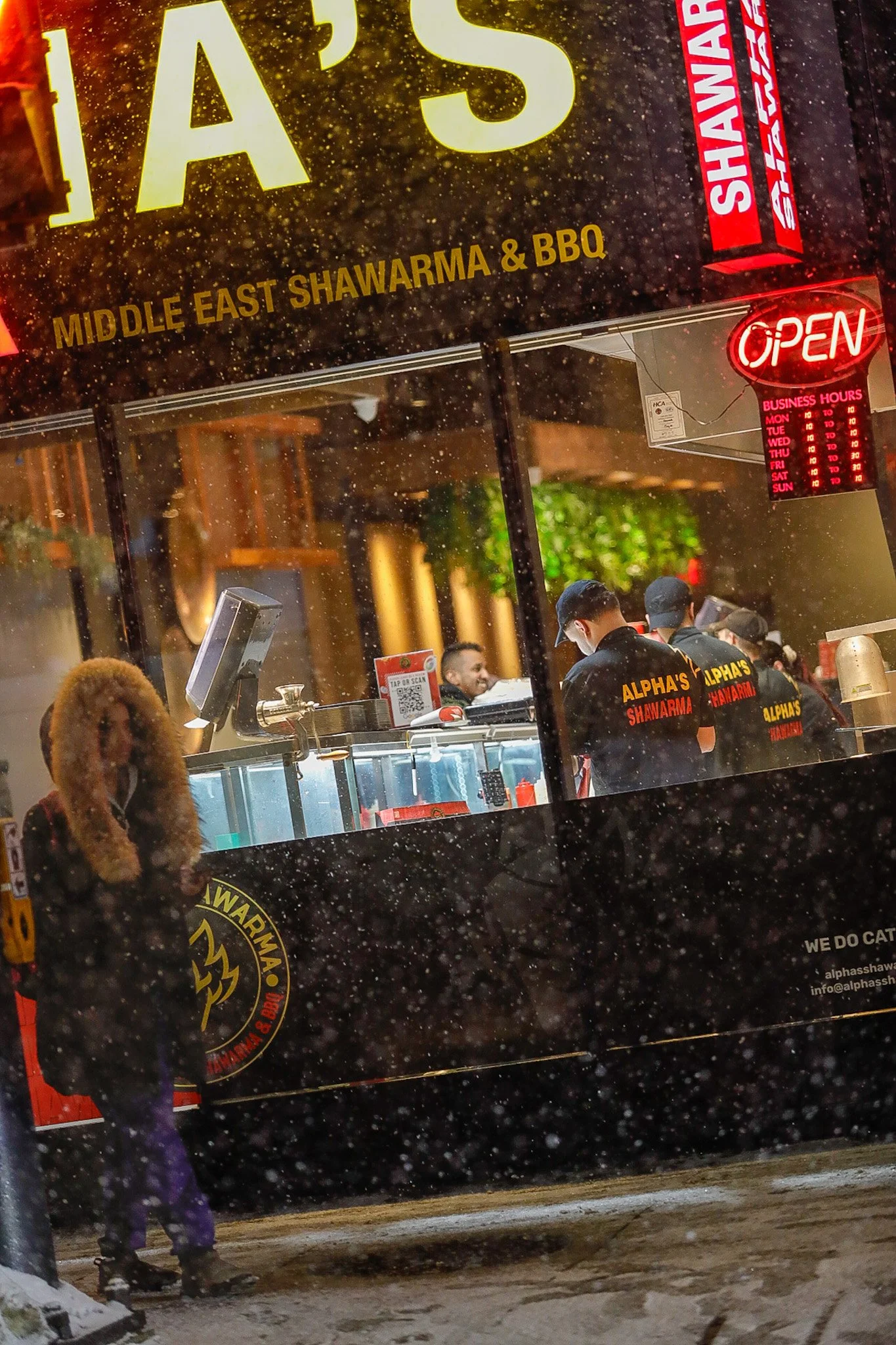
The City That Eats Late — Downtown Toronto in Snow
Snow falls outside a Middle Eastern shawarma shop near Sankofa Square as staff work behind glass—an everyday winter moment that reveals how Toronto feeds itself after dark.
A winter-night editorial from downtown Toronto
Snow has a way of rearranging a city without moving a single building. It softens angles, slows traffic, and forces the eye to narrow its focus to what’s closest: the light in a window, the breath in the air, the movement of hands working behind glass. In downtown Toronto, when the flakes start to fall in earnest, the skyline fades into suggestion and the sidewalk becomes a corridor of instinct. People walk faster, shoulders tucked, collars up. Headlights blur. Steam curls from vents and grates, proof that the city has a circulatory system most of us only notice in winter. And in the middle of that atmosphere, a red “OPEN” sign glows like a declaration.
The city doesn’t stop because it’s snowing. It eats late.
There is something uniquely revealing about the food windows that stay lit after nine o’clock in the core. Office towers may go dark, but the restaurants that operate at street level shift gears instead of shutting down. The crowd changes shape. The early diners thin out, replaced by night walkers, gig workers, transit riders between transfers, shoppers who stayed longer than planned, and residents from glass condos whose kitchens feel too quiet for the hour. In that ecosystem, the shawarma counter becomes more than a place to order dinner. It becomes a node in the after-hours circuitry of Toronto—a small, heated engine that keeps the street alive.
From outside, you see it as choreography. Staff in black shirts pivot between grill and counter. One person shaves meat from the rotating spit in clean, confident strokes. Another assembles plates with the kind of muscle memory that only repetition can build. Someone else calls out numbers, checks receipts, reaches for sauce bottles with the efficiency of a pilot reaching for switches. Snow collects on jackets outside; inside, hands move fast and precise, steam rising not from the sidewalk but from hot metal and seasoned meat. The contrast is almost theatrical: cold and warm separated by glass, hurry and routine sharing the same square footage.
Toronto’s late-night food culture is not accidental. It is the natural result of density and diversity colliding in a city that has grown up fast. Over the last two decades, the downtown core has filled in vertically. Condominiums have replaced parking lots. Office workers have become residents. The distance between “work district” and “living district” has collapsed into a handful of blocks. That compression changes appetite. When thousands of people live within a ten-minute walk of one another, demand doesn’t shut off at dinnertime. It pulses. It shifts. It reappears at eleven o’clock, at midnight, at one in the morning when someone decides that cooking is more effort than the walk downstairs.
Food, in that context, becomes the most honest expression of a city’s identity. It’s where immigration ceases to be an abstract debate and becomes a plate handed across a counter. Middle Eastern shawarma, Caribbean patties, Korean fried chicken, late-night pizza, sushi spots tucked between banks and pharmacies—Toronto’s culinary map is a record of arrival. Every storefront tells a story of someone who came here with a recipe and a plan. Some came for safety. Some came for opportunity. Some came because Toronto promised space to build something without apology. Whatever the reason, the result is visible on winter nights in the glow of a grill: the city eats in multiple languages at once.
The temptation is to romanticize that scene. To treat it like proof that multiculturalism is simple and harmonious and always delicious. But the late-night economy is more complicated than a tidy narrative. It is built on long hours and tight margins. It is sustained by labor that often goes unnoticed because it blends into the street’s background noise. The person shaving meat from the spit is not just performing tradition; they are meeting a demand that peaks precisely when the weather is least forgiving. The person taking orders isn’t just smiling at customers; they are translating between systems—delivery apps, in-person orders, phone calls, cash and card—while the line outside grows restless.
Snow amplifies that tension. Weather doesn’t cancel orders; it multiplies them. When sidewalks turn slick and wind cuts through coats, fewer people want to cook or linger in grocery aisles. The app becomes more appealing. The “just one more block” decision shifts in favor of convenience. And convenience, in a dense downtown, becomes a collective habit. What used to be a special indulgence—food delivered to your door—is now routine. That routine reshapes how restaurants operate. Some counters serve as both dining rooms and dispatch hubs. Riders cluster near entrances. Orders are stacked in paper bags like a small assembly line. The restaurant isn’t just feeding the people who walk in; it’s feeding a network that stretches into every condo tower within range.
That network changes the street’s personality. You can see it in the rhythm of arrivals and departures. A rider checks a phone, steps inside, collects a bag, disappears into snowfall. Another pulls up moments later. Pedestrians adjust their path without thinking about it. The choreography tightens, but it rarely stops. In this way, the shawarma window becomes a case study in how Toronto balances speed and coexistence. It’s not always graceful. There are moments of impatience, moments of friction. But there is also a surprising amount of unspoken cooperation. The person waiting for a pickup holds the door open. The couple stepping aside for a rider doesn’t glare; they nod. The worker behind the counter moves faster, sensing the shift in energy.
This is what makes the city that eats late feel alive rather than chaotic. There is pressure, but there is also adaptation. Toronto has always been a city of adaptation. Its population growth has forced neighborhoods to evolve quickly. What was once an office-only corridor now houses thousands of residents. What was once a lunchtime-only strip now competes for midnight loyalty. The businesses that survive are the ones that understand that eating late isn’t just about hunger—it’s about atmosphere. It’s about offering warmth in a place where winter can feel relentless. It’s about providing a small ritual at the end of a long shift, a quick comfort for someone walking home through snow.
Food is often described as culture, but in a winter downtown it feels more like infrastructure. It supports people physically and emotionally. It keeps foot traffic moving. It keeps lights on. It provides the kind of predictable comfort that makes a big city manageable. In the absence of a late-night café or diner, the core can feel stark. With them, it feels human. The glow from the shawarma shop doesn’t just illuminate the sidewalk; it signals continuity. It says: this neighborhood does not collapse when offices close. It has its own metabolism.
There is an intimacy to ordering food through a glass window in winter. You stand there with snow collecting on your shoulders, your breath visible, watching hands assemble your meal. You can see the process. You can smell it. You can hear the sizzle beneath the hum of traffic. It is transactional, yes, but it is also sensory in a way that app-only interactions can never be. That’s part of the reason these places endure. They offer not just sustenance but evidence—proof that someone is cooking, that someone is present, that the city’s pulse is not purely digital.
For visitors, that intimacy is often the most memorable part of a trip. Landmarks impress; food connects. You might forget the exact dimensions of a building, but you remember the taste of something hot in the cold. You remember the warmth of a small dining room when the sidewalk was frozen. You remember the feeling of stepping back outside with a wrapped sandwich in your hands, the steam rising from the paper as you walk. Those memories anchor a city in the body. They make it more than a skyline.
Toronto’s late-night appetite is also a marker of confidence. A city that eats late believes in its own safety and stability. It believes enough people will walk the streets after dark to justify staying open. It trusts that light will attract, not repel. In a winter storm, that confidence becomes visible. The restaurants that close early retreat from the weather; the ones that stay open claim it. They treat snowfall not as an obstacle but as atmosphere. They understand that some customers will arrive precisely because of the weather, drawn by the idea of warmth against the cold.
None of this is accidental. It is the product of decades of demographic layering. Toronto’s identity has been shaped by waves of immigration that brought not just new languages and traditions, but new hours. Different cultures eat at different times. Some gather late by default. Some treat dinner as an extended social event. When those habits overlap in a dense downtown, they create a culinary clock that stretches beyond the nine-to-five template. The result is a core that feels less like a business district and more like a neighborhood, even in winter.
Of course, that neighborhood feeling comes with trade-offs. Noise complaints. Delivery congestion. The constant presence of riders and drivers competing for curb space. The tension between residents who crave quiet and businesses that rely on volume. The late-night food culture is not purely romantic; it is economic and sometimes messy. But messiness is often the price of vitality. A sterile street might be quiet, but it rarely feels alive.
On a snow night near Sankofa Square, the vitality is undeniable. Even through a lens blurred by flakes, you can see it: the steady flow of customers, the disciplined pace behind the counter, the glow that cuts through the cold. The shawarma shop is not the only one open, but it is emblematic. It represents the shift from spectacle to sustenance, from headline to habit. It is where Toronto reveals itself not as a performance, but as a lived-in place.
The city that eats late is not chasing trendiness. It is responding to density. It is adapting to the way people actually live in the core. It is proof that downtown Toronto has crossed a threshold—from a place people commute into, to a place people inhabit around the clock. That transformation is visible in the smallest details: a line at eleven p.m., a grill that doesn’t shut off at ten, a red “OPEN” sign that glows against falling snow.
Winter will pass. The snow will melt. The sidewalks will widen again. But the memory of nights like this lingers. It’s the memory of a city that refused to dim just because the weather demanded it. It’s the memory of warmth found behind glass when the air felt unforgiving. It’s the memory of watching a street feed itself long after office lights went dark.
Toronto doesn’t stop when it snows. It doesn’t stop when it’s late. It doesn’t stop when the day is over. It eats late, because it lives late. And in that simple, practical fact—one shawarma at a time—you can see the shape of the modern city: layered, restless, and always a little warmer than it first appears.