Faces in the Alley: Why Portrait Murals Stop People Cold
In Graffiti Alley, lettering can be ignored—but faces don’t let you pass so easily. On a winter night, portrait murals turn Toronto’s most famous laneway into a public encounter: eye contact in paint, emotion on brick, and the strange intimacy of being “seen” in a place built for back doors and shortcuts.
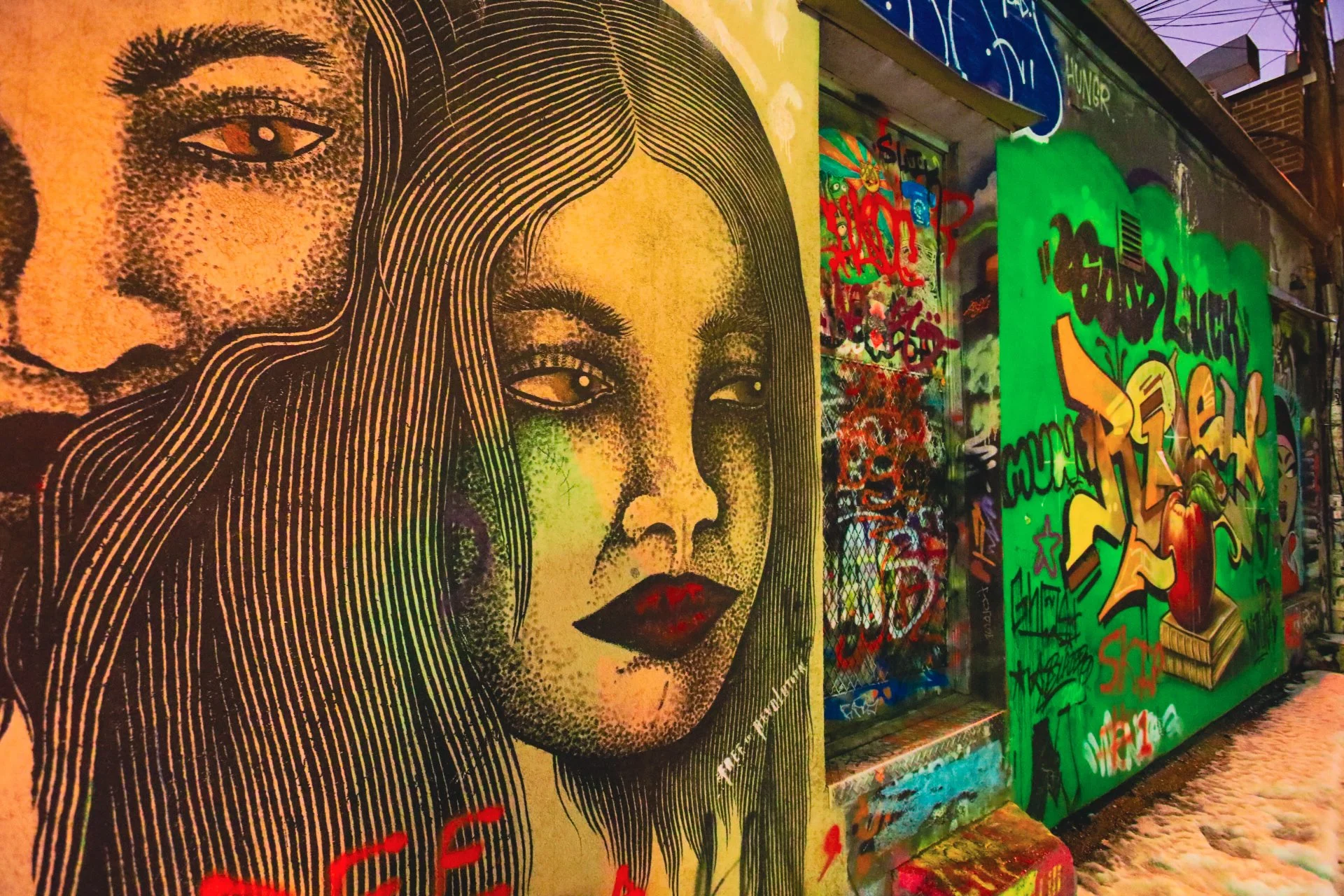
During Toronto's winter months, the city is reduced to its basic components. Sound is muffled as snow absorbs it, and colour becomes muted due to the amount of salt that has been spread throughout the city. Street corners become more useful in nature versus serving as entertainment, so that people are moving along with specific purposes; with their shoulders raised and looking ahead to where the next patch of cleared sidewalk is located. However, if you look just off of Queen Street West and the Fashion District, you'll find that Graffiti Alley (which is also known as Rush Lane), has retained its colour through the winter months like an unyielding flame.
The walkway does not have an extravagant feel to it nor does it attempt to be ostentatious. From its inception it served as a service road, where trash receptacles, deliveries and locked doors made up most of the landscape (along with forgetting some of the doors after the fact). Once artists started to see the blank walls as no longer blank, but rather blank canvases awaiting their claim, the lane began to take on a different meaning. Over time, as more layers of paint were added to this space by different artists, Graffiti Alley became a living record rather than an exhibit behind glass. The records were not arranged in any particular order nor did they receive the blessings of curatorial committees. They continued to evolve through the hands of ordinary people who believe that public spaces still possess a greater purpose than just their aesthetic appearance.
Another aspect of the alley becomes clear during winter. In winter, the ground is pale, and the sky has a heavy feel about it. The alley is not only colour but also faces, faces looking at you from the brick, and faces that do not blink. These faces remain with the same expression for every night the city passes by — usually not quite paying attention and usually missing the point. The portrait murals do something in addition to what abstract tags and letters do; they stop people. With these types of faces, a viewer can recognise the subject more than with abstract tags and letters; it is more challenging to dismiss as a simple background. A viewer will want to question themselves about who belongs in that area (of the city) and will be able to do so easily because of the use of a face in the image. The question about who belongs and who gets seen and who gets ignored is the question of street photography and urban living.
The portrait photo is the correct starting point for this article. This mural’s gaze isn’t friendly; rather, it’s real. This mural has the emotional heaviness of someone physically standing in an alley; however, it will also be there the next day, and the following day, and when it snows again. In a city that has an extremely high level of impermanence—leases, pop-ups, condos climbing higher into yesterday’s skyline—this painted face will serve as a sort of groundwork for future segments of the city. It is not permanent in a museum-type way; but it has longevity in the only way that street art can have longevity: it is being constantly re-invitalized, challenged, replaced, and answered.
The Alley of Graffiti is frequently termed “the” destination; an urban landmark, it is also regarded as a must-stop location for visitors wanting to see texture and authenticity. However, tourism is not what provides the value for an editorial on Graffiti Alley—rather, it is because of its function as an outdoor gallery of portraits with no entry fee, no hours of operation, and no assurance that what is there will still be there next month. The uncertainty is not baggage; it is the source of the engine that keeps the alley alive—because each time a new piece appears there, it acts as both a statement and an invitation to respond, remix, repaint, or outdo that piece.
The winter photographs capture how creativity constantly reinvents itself through an old Toronto experience of extreme winter coldness; snow accumulates at the edges of the street, while ice covers the ruts left behind by both cars and pedestrians as they leave their marks and then return. Thus, the alley becomes a chaotic record—of who walked in, slipped over, or turned around, of each person's passage through. Against the backdrop of snow and ice, the murals seem more pronounced; colours used in the murals become methods to combat the washing out of colours that occur during the winter months due to the lack of sunlight. The overall result of how these murals are utilized is as if we are witnessing a film; the narrow lane illuminated in a golden hue from the streetlight and the walls emitting brightly-hued paint create a visual representation of the breath of the city at wintertime.
There is also a more profound conflict in this place that provides so much exposure on social media – is it legal? Is it permitted? Is it ‘vandalism’ or ‘art’? Graffiti Alley lies in the ambiguous middle area of this discussion: there is recognition of it as graffiti, even within its own right, however it isn’t a fully recognised illegal graffiti wall; rather, its existence is based on a level of tolerance that feels unformalised like there is just an understanding and not an actual law or statute. This ambiguity of legality and its equals is the character of this space; it is essentially the place where the rules of the city and the realities of the city are played out every day in private.
Toronto is attempting to formalize the negotiation with various programs offered by the city to support mural and street art in public areas. One of these programs is StreetARToronto (StART), managed by the City of Toronto and utilized as part of the City’s overall approach to graffiti management. One component of this program is to establish initiatives and provide opportunities for artists to create art in an effort to enhance the attractiveness and vibrancy of urban spaces. In many cases, the context in which a wall exists will help define whether that wall falls under a formal program or not; however, in general, the shift that has taken place has changed the conversation between the city and the public. "How do we remove the marks?" is no longer the only question that officials are asking themselves. There now exists the need to ask, "What are we going to replace them with, and how will that replacement impact the street?"
This is when the art moves beyond 'cool' aesthetics and instead become a statement of humanity in a building designed to conceal the human labor of a city. The laneways are the lungs of buildings: they exhale (through vents), the backs of buildings (through back doors), and the loading bays of buildings (as well as being the underside of cities). Once an artist paints a face, particularly one with emotion, complexity, and authenticity, the laneway no longer serves a purely functional purpose and starts to have psychological implications for the viewer. The laneway now becomes one of the few places where cities acknowledge their avoidance of the fact that human stories do not only take place on major streets.
Then there's the audience—there's a multitude of different eyes on this spot as it attracts many types of viewers. For example, locals use the alley like an everyday shortcut (because it is familiar). There will also be photographers that use it for its colour & texture. Couples will also use it for their engagement photos. And lastly, there will be a multitude of visitors that find it via travel lists or social media. The combination of groups makes the alley an attractive place to be; e.g., within a ten-minute period, you will see one person walking through the alley without looking up from their staring at their phone; then you may see someone else standing in the same location filming themselves as the curator is just out of the camera's line of sight whilst taking a picture of themselves with their guests present.
This coexistence of dashes and ticking clocks is the modern city in microcosm but the modern world moves at warp speed and the spaces in which we inhabit are designed to accommodate that speed. Graffiti Alley disrupts that rhythm with its narrowness, texture and density of visuals; it compels one to slow down while viewing a wall. The walls themselves are not easily understood with a single glance; they require multiple scans to understand the pattern of the original paint, the layering of the tags, and where painted areas reveal older paint. The weathering effects left by the environment on these walls also contribute to the story. In winter, the effects of weathering are exaggerated by salt mist dulling the lower parts and the snow accumulating at the base of the wall. In essence, the city acts as an editor of the art that exists within it.
Thus we arrive at the kernel of the good editorial on street art: how long does the public space have for any given message? With a billboard, it simply purchases visibility. A mural earns visibility and then must continually earn to stay visible. While a billboard will be kept maintained, a mural remains visible by embracing change — having it painted over, written over, or responded to in some way. This is part of the reason why Graffiti Alley in Toronto is one of the most photographed streets in the entire city. It provides an established position consistently with constantly changing surfaces and therefore creates an evolving relationship between the setting and its occupants through these changes to surface and thus to content.
Street art has a way of bringing with it the pain and imperfections that are inherent in the medium itself. Unlike the polished and commercialized styles of many other types of visual content, street art isn’t meant to be neutral. Rather, it communicates a mood and attitude, and is open for interpretation. With so many other types of visual media being produced today with a clean look, street art is refreshing and authentic in nature, which is why it is becoming such an important aspect of Toronto at this time.
From the viewpoint of a winter scene, the alley can also be viewed as a study of contrast, with opposite colours, feelings and temperature. The snow creates more light but also creates a harsher environment. In the cold weather, people usually will not stay very long unless they have a purpose. One of those purposes could be to view artwork. When you look at a painted face, it represents a small fire - not in the physical sense because of no heat but from the perspective of where it draws your attention. Focus has become an uncommon occurrence. Most people perceive urban images while in motion. Graffiti Alley creates a need for someone to be still in order to truly perceive what they are viewing.
In addition to its travel writing component, the editorial angle has a life outside of travel writing. By relating to larger themes—without lecturing—such as: Public Space; Identity; The Need for Humans to be Seen; The Difference Between Decorating and Expressing Yourself; and how Cities Deal With Or Resist Creating Uncontrolled Creative Spaces, these themes resonate with readers because of "real-life" experiences. For example, if you walk through a North American city in the wintertime, most of us would appreciate something visually stimulating. If you have ever felt anonymous in a crowd, you know the impact of coming face-to-face with a stranger, even if they are painted. All of these thoughts connect with one another through shared experiences.
Lastly, we must speak of the impermanence of Graffiti Alley: The honest truth regarding Graffiti Alley as it relates to this series of events will continue to evolve as long as the year 2023 exists. The portrait that serves as the foundation for this narrative could change or no longer be maintained in the future. This aspect of graffitied alleyways can therefore be perceived as an unfortunate loss by someone who sees this artistic style as a "museum artefact"; however, it should be understood that alleyways do not serve as museums; they serve as an ongoing and fluid dialogue between those people leaving pieces of art and those who appreciate or have yet to appreciate these forms of expression found throughout the city.
There’s no better way to leave this alley than knowing what you have actually experienced is not simply ‘visiting’ attraction(s), but actually experiencing an ongoing ‘living’ process that continues to operate through Toronto’s street art, living through the ‘cold’ of winter and keeping alive through memory, continuing to remain present. You will have experienced this ‘living’ part of Toronto while experiencing different aspects of the city’s art, but you won’t have experienced its ‘living’ aspect unless you have had a visual memory of one of the city’s many faces as you will undoubtedly remember them all.
And that is the power of Graffiti Alley in winter. The cold strips the city down. The alley builds it back up—one wall at a time.
Where Toronto Turns to Stone and Light
Toronto moves fast—until you climb toward Casa Loma after dark. In winter, blue light turns stone into theatre and warm windows pull the castle back into human scale. This travel feature follows the atmosphere of a night visit and why this hilltop landmark still feels like a portal inside a modern city.
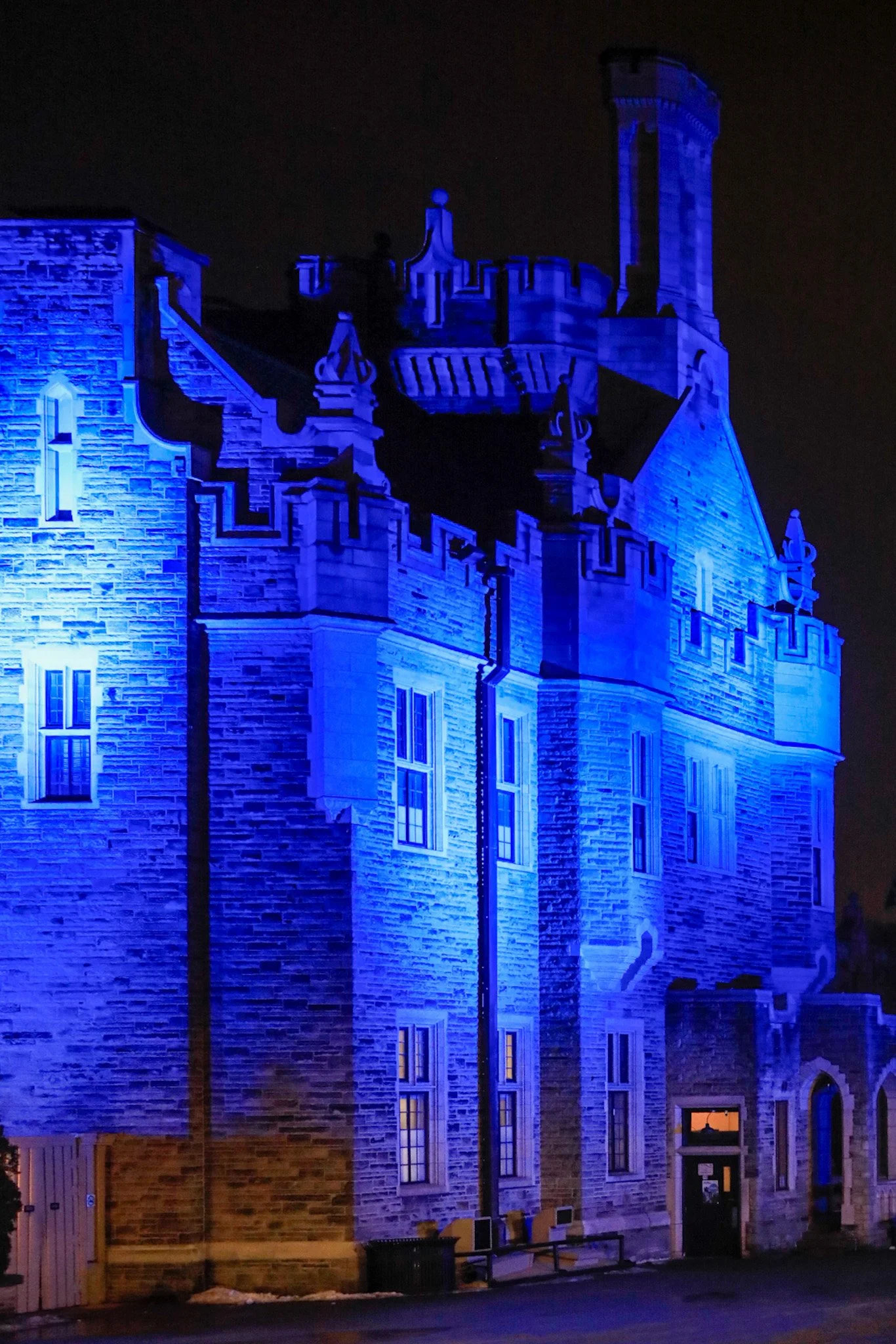
A Castle Built for a Photograph @Solomon D Crowe
Casa Loma illuminated in blue light on a winter night in Toronto, Ontario, Canada. A Gothic Revival landmark overlooking the city’s modern skyline.
A Winter Night at Casa Loma
Toronto is a city that rarely pauses. Even in winter, when the cold tightens the sidewalks and the wind scrapes between towers, the city keeps its pace—streetcars sliding through intersections, headlights cutting across wet asphalt, office windows glowing late as if the day never truly ends. In the downtown core, the rhythm is constant: movement, commerce, and the subtle pressure to keep up. That’s why Casa Loma works so powerfully as a night destination. It doesn’t compete with Toronto’s speed; it interrupts it. It stands above the grid like a different chapter—stone and silhouette, romance and restraint—offering a version of the city that feels less transactional and more cinematic.
On a winter night, the approach to Casa Loma becomes part of the story. Toronto’s streets, polished by snowmelt and salt, reflect streetlights in long, wavering ribbons. Footsteps sound sharper, and breath appears like a small, temporary cloud. Winter reduces the city to essentials: light, shadow, and surface. As the climb begins toward the castle, the urban noise doesn’t disappear, but it changes. The higher the elevation, the more the city’s sound becomes background—like a distant engine rather than an immediate demand. That gradual shift is the first hint that Casa Loma isn’t just a landmark to see; it’s an atmosphere to enter.
Then the castle comes into view, and the contrast lands instantly. Toronto’s modern skyline is glass, steel, and geometry—clean lines, reflective planes, a language of contemporary ambition. Casa Loma answers with crenellations, turrets, and heavy stone walls that feel designed not for efficiency but for permanence. In winter, that permanence becomes emotional. Snow banks at the edges of stairs and railings emphasize the castle’s verticality, and the cold makes the stone feel even more serious. Under night lighting—especially when the façade is washed in saturated blues—the building becomes theatrical without being artificial. It doesn’t look like a set; it looks like the city’s imagination hardened into architecture.
There’s a reason a castle in Toronto still surprises first-time visitors. Canada’s global imagery often leans toward wilderness, lakes, and mountain landscapes, not Gothic silhouettes on a hilltop. Casa Loma disrupts that expectation in the best way. It offers an “elsewhere” feeling without requiring anyone to leave the city. That’s travel magic in its purest form: the sensation of stepping into a different world while remaining inside the same postal code. The castle gives Toronto a second face—one that feels older, moodier, and more story-ready than the city’s usual modern sheen.
At night, the building’s lighting becomes the narrator. Blue is the most transformative color on stone because it deepens texture rather than flattening it. Where warm floodlights can make old buildings look cozy or museum-like, blue lighting makes Casa Loma look dramatic and slightly unreal. It sharpens edges, deepens shadow pockets, and turns the façade into a sculptural surface. Against a winter sky, the blue doesn’t feel trendy—it feels elemental, like moonlight intensified. The castle’s profile becomes more pronounced, and even familiar architectural details start reading like symbols: battlements as protection, towers as watchfulness, narrow windows as secrecy.
Those cool tones would risk making the castle feel distant if not for the warm windows. When amber light glows from within, it introduces the human counterpoint. Warm windows are not merely pretty; they imply life. They suggest interior warmth against exterior cold, intimacy against scale, story against structure. In winter, that warm/cool contrast hits deeper because it mirrors the lived experience of the season. Toronto winters are full of thresholds: stepping from street into lobby, from wind into warmth, from dark into light. Casa Loma compresses that winter psychology into a single frame—stone bathed in blue, windows burning soft gold—inviting viewers to feel both the chill and the shelter at once.
To understand why Casa Loma reads so cinematically, it helps to remember what it was built to be: a statement. In the early 20th century, Sir Henry Pellatt envisioned a home that carried European grandeur into a city that was still defining itself. The result wasn’t a practical mansion; it was a spectacle—Gothic Revival architecture on a scale that still feels improbable for Toronto. That origin matters, not because visitors need a history lecture to enjoy the place, but because the castle’s mood is inseparable from its intent. Casa Loma was built to impress, to endure, to be remembered. That intention lives in the building’s posture. It stands the way an ambitious idea stands: unapologetically.
And yet Casa Loma’s most interesting evolution is that it became bigger than its founder. Over time, it shifted from private dream to public landmark—an interior world that visitors could enter and claim as part of Toronto’s identity. That transition is why Casa Loma doesn’t feel like a relic of wealth so much as a piece of the city’s imagination made accessible. It’s one thing to pass a grand building on the street and admire it at a distance; it’s another thing to step into it, walk its corridors, and feel its scale in your body. Casa Loma’s power is physical. The stone has weight, and that weight changes the way a visitor moves.
Inside, the experience is less about checking off rooms and more about letting the building shape attention. Some spaces open wide and grand, engineered to make visitors look up and pause. Others narrow, funneling movement into corridors where texture becomes the main event. Stone, wood, iron—materials that feel durable, tactile, and honest—replace the modern city’s glossy surfaces. In a world where so much is designed to be replaced, a building like this carries a different message: the beauty of something meant to last. Even without saying it out loud, Casa Loma suggests an idea that resonates deeply right now—permanence is a luxury.
At night, those interior impressions echo back into the exterior view. The castle doesn’t feel like a façade when you’ve been inside it. It feels like a container of space and story. That’s one reason the photos hold attention: viewers can sense depth. The castle isn’t a flat subject; it’s dimensional. The lighting reveals roughness in the stone, the outlines of windows, the geometry of turrets, and the way the building catches shadow along its edges. In winter, shadows look heavier. Light looks cleaner. The air itself seems to sharpen the scene. Casa Loma doesn’t just sit in winter; it wears it well.
What elevates Casa Loma from “nice landmark” to feature-story destination is its relationship to the modern skyline behind it. Toronto’s towers—lit office grids, reflective high-rises, and contemporary silhouettes—often appear in the same visual conversation as the castle. That juxtaposition tells a Toronto story that doesn’t require words: this is a city of layers. One era chasing height and efficiency. Another era chasing romance and legacy. Both are real. Both coexist. The skyline doesn’t diminish Casa Loma; it intensifies it. The castle becomes a punctuation mark against the city’s continuous sentence of development.
That tension—old and new in one frame—also speaks to why people travel the way they do now. Increasingly, travelers are looking for specificity. They want places that don’t feel like they could be anywhere. Modern cities can blur together if the experience is limited to the same brands, the same condos, the same glass geometry. Casa Loma refuses to blur. It offers a visual identity that cannot be copied and pasted into another city. A castle in Toronto is inherently distinctive. That uniqueness isn’t a gimmick; it’s a competitive advantage in the attention economy. It gives travelers a reason to choose a moment here over a moment elsewhere.
Winter amplifies the distinctiveness because it strips the scene down. Summer brings greenery, crowds, and softness. Winter brings clarity. Trees go bare. Colors mute. Snow piles at edges and corners, carving the environment into shape. The castle’s blue lighting becomes more pronounced against a quieter palette, and warm windows feel warmer because the cold is more present. Winter also changes the human behavior around the site. People move with purpose, but they also linger for photos because the scene feels rare. There’s something about a winter-lit castle that makes even locals behave like visitors. It invites the “stop and look” instinct that city life usually trains out of people.
That invitation matters, because the best travel moments aren’t the ones where you simply arrive and consume. They’re the ones where your pace changes. Casa Loma slows people down. The incline toward the castle, the scale of the structure, the way light falls across stone—everything works against rush. And that’s not just aesthetically pleasing; it’s psychologically restorative. Travelers remember destinations that change their internal tempo. They remember places where attention returns. Casa Loma, on a winter night, does exactly that. It takes a city built for movement and offers a scene built for stillness.
It’s also why Casa Loma feels naturally cinematic without relying on hype. “Cinematic” is often used too loosely, but here it’s accurate in a technical sense. The castle has strong lines and shapes that read clearly in low light. The lighting creates contrast and depth. The stone texture catches highlights and holds shadow. Warm windows provide focal points. And the surrounding city glow adds ambient context. The scene has layers—foreground, midground, background—built into it. This is the language of strong visual storytelling, which is why Casa Loma repeatedly shows up in film and TV uses and why it consistently performs as a travel editorial subject. A viewer doesn’t need to be told it’s dramatic; the image communicates that immediately.
Yet the most compelling way to write about Casa Loma isn’t to over-romanticize it into fantasy. The stronger move is to treat it as a real place in a real city that can still surprise people. Toronto has a reputation for practical energy—business, finance, growth, and hustle. Casa Loma is the counterbalance: proof that Toronto also has room for spectacle, mood, and architectural storytelling. It reminds visitors that cities are not just marketplaces; they are emotional landscapes. They shape how people feel, and landmarks like this shape that feeling more powerfully than we often admit.
Casa Loma also works as a feature travel destination because it can hold multiple stories at once. It can be a history story: early-20th-century ambition, changing ownership, the castle’s transition into public space. It can be an architecture story: Gothic Revival lines, textured stone, the physical drama of vertical design. It can be a winter story: light against snow, warmth against cold, the seasonal mood that makes urban landmarks feel new again. It can even be a city-identity story: what Toronto chooses to preserve and what Toronto chooses to rebuild. The castle doesn’t force one reading; it offers many. That flexibility is exactly what makes it magazine-friendly. It can anchor a feature without being exhausted by a single angle.
In the current travel landscape, that matters more than ever. Readers are saturated with “top 10 things to do” lists that feel interchangeable. Feature travel writing wins when it offers meaning, not just itinerary. Casa Loma offers meaning because it embodies something people crave: the tangible. The solid. The non-digital. It’s not a screen. It’s not a pop-up. It’s not a trend. It’s stone, light, and time. It sits there whether anyone is watching or not. And that’s precisely why it’s worth watching.
A winter night at Casa Loma can also become a quiet reminder of what cities are for. Toronto is often framed as a place to work, build, and compete. But cities are also for wonder—for moments when the environment makes you feel something beyond the schedule. Casa Loma supplies that wonder without needing to be “exciting” in a loud way. Its excitement is atmospheric. It’s the thrill of standing beneath architecture that feels out of scale with ordinary life. It’s the pleasure of seeing a building transformed by light. It’s the almost-childlike sensation of realizing that yes, there is a castle here, and yes, it looks like this at night.
The moment that tends to stay with people isn’t necessarily the most “informative” moment; it’s the most sensory one. The cold on your face. The light on the stone. The hush that settles when you step back far enough to take the whole façade in. The warm windows that look like small hearths behind thick walls. The skyline behind it all—proof that this isn’t a remote European hillside, but a living, modern Toronto neighborhood where the city continues even as the castle holds its posture. That layered sensation is exactly what feature travel editorials are built to capture: a place that lives in more than one time at once.
There’s also a subtle emotional truth Casa Loma reveals about winter travel. Winter often gets treated as something to endure rather than something to experience. People plan trips around escaping cold, not embracing it. But winter can be a powerful lens for travel because it strips away noise and forces mood to the surface. A castle in summer can feel like a tourist attraction. A castle in winter can feel like a story. The cold gives it stakes. The light becomes more dramatic. The scene becomes more intimate even when the building is enormous. Winter invites reflection, and Casa Loma rewards it.
For visitors who want to experience the castle beyond a quick photo, timing matters. The best night moments happen when the sky hasn’t fully collapsed into black, when there’s still a trace of blue in the air and the lighting feels like it’s emerging rather than simply on. That transition—between day and night—is when the castle looks most alive. It holds detail without losing mood. It separates from the background without becoming a silhouette. Winter skies often deliver that rich, in-between color for longer than expected, and that extended “blue hour” effect is part of why winter photographs of Casa Loma can feel so striking.
Still, even in full darkness, the castle holds the frame. Blue lighting on stone reads as bold and modern while still honoring the building’s old-world shape. It’s a visual language that feels contemporary without erasing heritage. That’s also part of Casa Loma’s relevance today: it adapts. It can host events, light displays, seasonal programming, and special evenings without losing its identity. The castle is not trapped in the past; it’s a historic structure that continues to participate in the present. That balance—preserved but active—is what separates living landmarks from static museums.
When you leave Casa Loma and return to Toronto’s streets, the city often looks slightly different. That’s the mark of a meaningful destination. It doesn’t just give you a memory; it re-frames what surrounds it. After standing beneath the castle’s towers, Toronto’s glass buildings feel younger and more temporary. The city’s pace feels louder. Streetlights feel harsher. And yet there’s also a quiet satisfaction in that contrast, because it makes Toronto feel deeper—more layered, more complex, less one-note. Casa Loma adds dimension to the city’s identity. It proves Toronto can hold both the practical and the poetic.
That’s why Casa Loma belongs in a feature travel editorial, especially in winter. It’s not merely “a place to go.” It’s an experience that changes pace, sharpens attention, and offers an urban form of escape. It gives Toronto a scene that feels almost impossible—a castle lit in blue, windows glowing warm, snow holding light on the ground—while still being unmistakably Toronto. It’s a reminder that wonder doesn’t always require a plane ticket to another continent. Sometimes wonder is waiting above the city, built in stone, wearing winter like a crown.
In the end, Casa Loma at night is less about the building’s facts than about the feeling it produces. It is a place where architecture becomes emotion, where light becomes narrative, and where winter becomes an ally rather than an obstacle. For travelers, it offers a destination that is iconic without being generic, dramatic without being artificial, and memorable without being loud. It is Toronto’s castle—not because it is the oldest thing, but because it is one of the rare things that still feels like a daring dream made real. On a winter night, under blue light and warm windows, that dream still holds.
When Distance Was Medicine: Roosevelt Island’s Smallpox Hospital and the Architecture of Quarantine
A Gothic Revival ruin across the East River preserves a blunt truth: New York engineered distance long before it named it—and the ethics of quarantine still echo in stone.
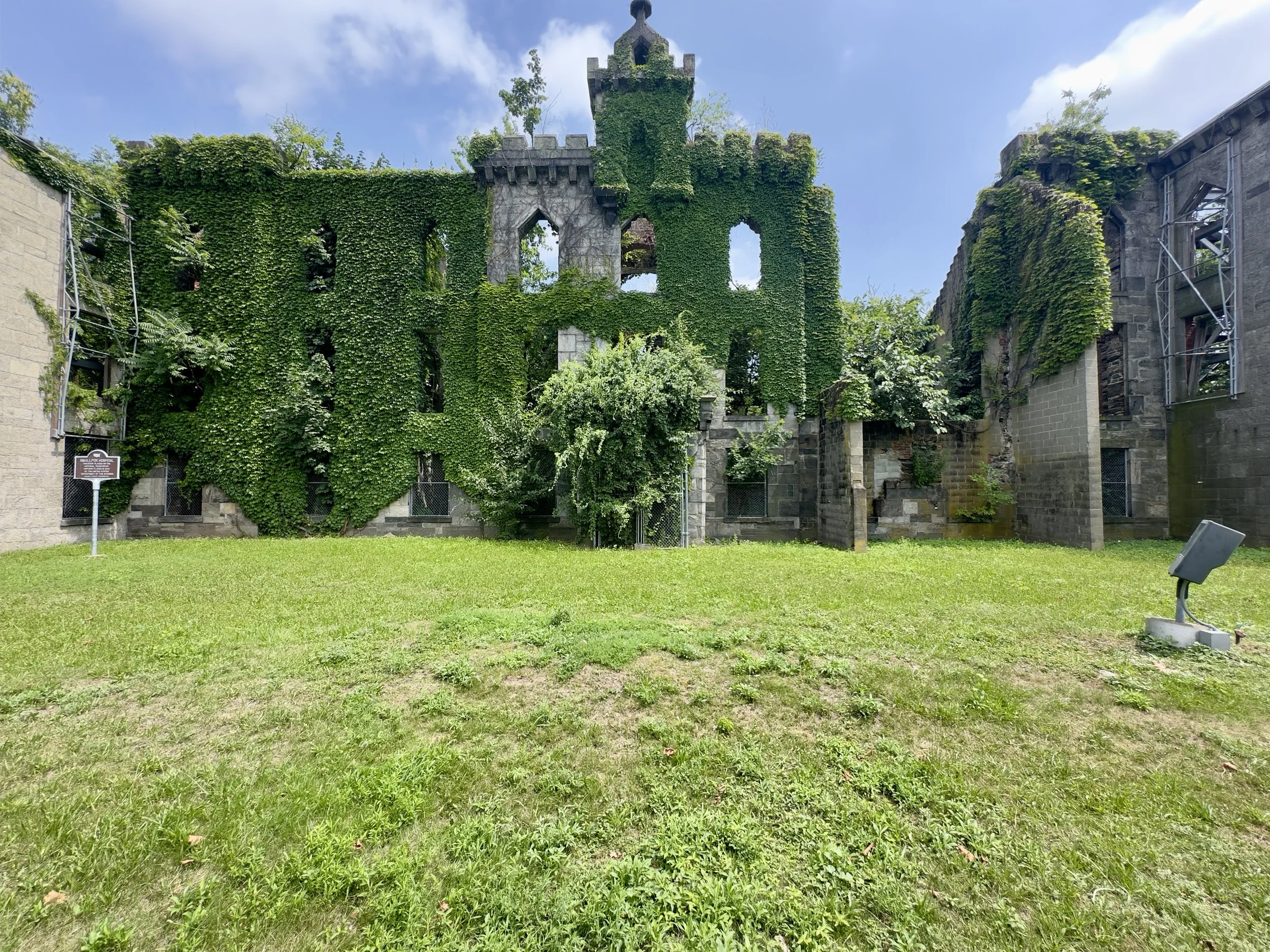
The Renwick Ruin: Smallpox Hospital, Roosevelt Island @Solomon D Crowe
Ivy-covered Gothic Revival ruins of New York City’s former Smallpox Hospital on Roosevelt Island—an 1856 quarantine landmark that still asks what “distance” costs a city.
A stone shell sits on the edge of the East River, its windows hollowed out, its arches softened by ivy and time. Across the water, Manhattan keeps moving—lights, traffic, ambition—while this quiet façade holds its position like a witness who refuses to leave the stand. It is beautiful in the way ruins often are: not because they are broken, but because they tell the truth about what a city chooses to remember, and what it tries to forget.
New York did not invent “social distance” in 2020. Long before the phrase became a daily instruction, the city built distance into its geography—water as a moat, an island as a boundary, an institution as a container for fear. On what was once called Blackwell’s Island and is now Roosevelt Island, the ruins of the Smallpox Hospital—often referred to as the Renwick Ruin—trace back to a purpose-built place that opened in 1856 to isolate people infected with one of the nineteenth century’s most dreaded diseases. The decision was both practical and symbolic: keep contagion away from the dense city, and keep the sight of suffering out of everyday street life.
Blackwell’s Island: where New York sent what it couldn’t hold
Before this was a “view,” it was a system. New York City purchased the East River island in 1828. In 1832, a penitentiary was built there, physically separating prisoners from the city; over time, the island accumulated a network of institutions—workhouses, a general hospital, an almshouse, a hospital for “incurables,” and, for a time, a smallpox hospital. By the early twentieth century, New Yorkers were nicknaming it “Welfare Island,” a shorthand that revealed how deeply the place had become associated with the people the city didn’t know how (or didn’t want) to integrate. The island was officially renamed Welfare Island in 1921, and later renamed Roosevelt Island in 1973, a move the National Park Service connects to disability history in light of Franklin D. Roosevelt’s life with polio. The names are not trivia; they are a moral biography written in municipal lettering.
If that sounds harsh, it’s because the island’s history is harsh. It received national attention when journalist Nellie Bly went undercover in the Women’s Lunatic Asylum and reported abuses and inhumane conditions, helping force a public reckoning. In the nineteenth century, distance did not simply mean “health.” Distance also meant “control,” “containment,” and “out of sight.” Blackwell’s Island made the city’s hierarchy physical: the poor and the sick were moved to the edge, and the river did what walls could not.
This is the context in which the Smallpox Hospital matters. Its ruins are not isolated in meaning; they are part of an island designed to absorb the city’s overflow—disease, poverty, incarceration, disability. When the city built a quarantine hospital here, it was leveraging the same geography it used for prisons and asylums: water as an administrative tool.
Why smallpox demanded distance
Smallpox was not simply another illness. It was terrifying, often deadly, and culturally loaded with fear. Even as vaccination entered the historical timeline, outbreaks and panic persisted. In dense nineteenth-century cities, contagion wasn’t abstract—it was a practical terror that could empty streets, shut businesses, and turn neighbors into suspicious strangers. Isolation, then, became one of the few tools officials could deploy quickly: separate the sick, limit contact, and try to protect the “many” from the “few.”
A National Library of Medicine account describes the hospital’s early purpose plainly: it opened in 1856 to isolate and quarantine patients with smallpox on Blackwell’s Island, at a remove from the rest of New York. By around 1875, the same account notes, it closed as a smallpox hospital, reflecting how public health infrastructure shifts when a crisis changes shape. That is the first lesson the ruin teaches: emergency architecture rarely stays “emergency.” Cities repurpose, downgrade, abandon, and forget.
An architecture that tried to dignify the feared
The second lesson is more surprising: the building was not utilitarian in the way people often imagine quarantine structures. It was designed in the Gothic Revival style by James Renwick Jr.—an architect associated with major cultural and religious landmarks, including St. Patrick’s Cathedral and the Smithsonian Institution Building. If you wanted authority in stone, you hired Renwick. That the city commissioned an architect of this caliber for a contagious-disease hospital suggests something more complicated than mere disposal: even in an age of stigma, there was an attempt—however imperfect—to give the sick a setting that signaled seriousness, order, and a kind of dignity.
Gothic Revival architecture carries a visual language that’s almost impossible not to feel. Arches, vertical lines, and stone ornamentation create a sense of ritual. In the context of a smallpox hospital, that atmosphere could have meant many things at once: a warning to outsiders, a reassurance to staff, and a fragile promise to patients that they had not been reduced to a public nuisance. The ruins we see now are not only the remains of a building; they are the remains of an argument. The argument was that the city could separate people for public safety without erasing their humanity.
But architecture cannot guarantee ethics. Isolation is a form of care, and it can also become a form of punishment when the isolating institution is underfunded, understaffed, or culturally treated as a dumping ground. Every quarantine story carries both possibilities at once. The river boundary protected New York. It also made it easier for New York to look away.
From hospital to ruin to landmark: how a crisis becomes a relic
After the Smallpox Hospital stopped functioning in its original role, it entered the long afterlife that so many institutional buildings inherit: repurposing, neglect, and slow decay. The National Library of Medicine account notes that the structure was abandoned in the mid-1950s. Exposure, weather, and fire left the building hollowed out. And then—an unexpected turn—the city and nation began to treat the ruins as historically significant, not merely as derelict.
The National Park Service notes the ruins of the Smallpox Hospital, which opened in 1856, were added to the National Register of Historic Places on March 16, 1972. This matters for more than bureaucratic reasons. It means the country recognized that a quarantine hospital—an infrastructure of fear and care—was part of the national story worth protecting. The National Park Service also notes that the dilapidated structures on the island are listed as a New York City landmark and are the only ruins in New York City to hold that local landmark designation. A ruin, in other words, became officially meaningful—not despite its brokenness, but because the brokenness is the point.
That designation shifts how the ruin is read. It is not a romantic European relic; it is a modern city’s self-portrait. It says: this is how we built safety. This is what we did with illness. This is where we placed the people who scared us.
The ruin as a modern mirror
In the 2020s, the Renwick Ruin reads differently than it did in the 1970s. After COVID-19, many people carry a new vocabulary for contagion: outbreaks, ventilation, distancing. But the deeper shift is emotional. We have re-learned, at scale, what it means to be told to stay away from one another for safety. We have felt the friction between community and containment. We have also watched how rules are not experienced equally: distance is easier for those with space, money, flexible work, and reliable care. For everyone else, “distance” can feel like a luxury instruction delivered to a life that cannot afford it.
That is why this ruin matters beyond its architectural pedigree. It is a physical reminder that epidemics are not only biological events; they are social events that reconfigure who belongs where. When the city built a smallpox hospital on an island, it was not just building a ward. It was building a map of moral priorities: protect the many, isolate the few, and do it quickly. The logic is understandable. It is also perilous, because once a society gets comfortable isolating certain bodies for the safety of others, the boundary can harden into habit.
This is the uncomfortable truth the ruin holds. A quarantine can be compassionate. It can also become a template for stigma and neglect. The architecture cannot guarantee which one it will be. The architecture can only reveal the choice.
Stabilization, pauses, and the question of what comes next
The future of the Renwick Ruin is still being negotiated. The Roosevelt Island Operating Corporation (RIOC) describes the structure as “now… stabilized” and anticipates it being surrounded by a new park concept called “Wild Gardens, Green Rooms.” Separately, RIOC-linked material connected to a proposed “Public Health Memorial” frames the site as uniquely suited for reflection and describes a phased approach tied to fundraising, stabilization drawings, and eventual public opening.
At the same time, public-facing financial documentation and preservation advocates have described continuing needs for stabilization and restoration, reflecting the complexity and cost of working with a fragile landmark on a constrained, weather-exposed site. Like so many urban preservation efforts, the story is not simply “saved” or “lost”; it is “phased,” “engineered,” and “budgeted,” with public interest and technical reality tugging in different directions.
A 2017 set of schematic design and cost documents for stabilization work illustrates that reality in numbers, outlining a multi‑million‑dollar scope. Even without drilling into every line item, the takeaway is clear: keeping a ruin standing is not romantic; it is infrastructure work. It requires engineering, materials science, and long-term funding—especially when the site is exposed to river weather and seasonal freeze–thaw cycles.
Whether the final outcome looks like a garden, a memorial, an educational site, or a carefully managed “standing ruin,” the underlying question is the same: what should a city do with the physical remains of a public health emergency?
This is not a small question. In the United States, memorials have traditionally leaned toward war, presidents, and triumphal narratives. Public health is harder to memorialize because it is both intimate and collective. It is carried in bodies, in grief, in invisible losses, in the lives that continued because someone else did the work of prevention. A smallpox hospital ruin is an unusually honest artifact for that kind of remembrance. It refuses triumphalism. It asks for humility.
Standing at the edge of the story
To encounter the Renwick Ruin is to stand at a seam—between boroughs and between eras. The site is close enough to Manhattan to feel the city’s pulse, far enough to sense how water changes the atmosphere. It shares an island with contemporary development and everyday domestic life, which makes the contrast sharper: a place built for separation now sits inside a neighborhood built for normalcy.
That contrast is what gives the location its travel power. This is not escapism. It is a kind of urban pilgrimage. You don’t come only for aesthetics; you come for perspective. The ruin invites you to think about how cities build their ethics: where they place their hospitals, whom they protect first, and how they treat those who become inconvenient.
The lesson the stones still offer
Smallpox is, in one of modern history’s rare unambiguous victories, considered eradicated globally through vaccination. But the social mechanics that surrounded smallpox are not eradicated. Fear still moves faster than nuance. Institutions still struggle to balance individual dignity with collective safety. And public trust—always the most important infrastructure in a crisis—still fractures under pressure.
That is why the Renwick Ruin is not just a relic of the nineteenth century. It is a civic mirror for the twenty-first. It reminds us that “distance” can be a medical tool, but it is never morally neutral. It can protect. It can isolate. It can heal. It can hide. The city that built a hospital on an island was making a decision about what kind of community it wanted to be under stress.
In the end, the ruin does not offer a simple verdict on that decision. Instead, it offers something rarer: a place to hold the question. In a culture that moves quickly past discomfort, that may be the most valuable form of preservation there is.
What is the Renwick Ruin?
It’s the remains of the former Smallpox Hospital on Roosevelt Island (formerly Blackwell’s Island), a Gothic Revival structure that opened in 1856 as an isolation hospital.
Who designed the Roosevelt Island Smallpox Hospital?
James Renwick Jr., associated with major projects including St. Patrick’s Cathedral and the Smithsonian Institution Building.
Why is the Smallpox Hospital historically significant?
It represents how New York built quarantine into the city’s geography—using islands and institutions to manage disease and social anxiety—and it is recognized on historic registers.
When did Roosevelt Island change names?
NYC purchased the island in 1828; it was nicknamed “Welfare Island” in the early 1900s, renamed Welfare Island in 1921, and renamed Roosevelt Island in 1973.
The City That Eats Late
In downtown Toronto, snowfall doesn’t close the city—it concentrates it. This editorial explores how late-night food culture, immigration stories, and winter weather intersect near Sankofa Square, where warmth behind glass becomes the truest sign of urban life.
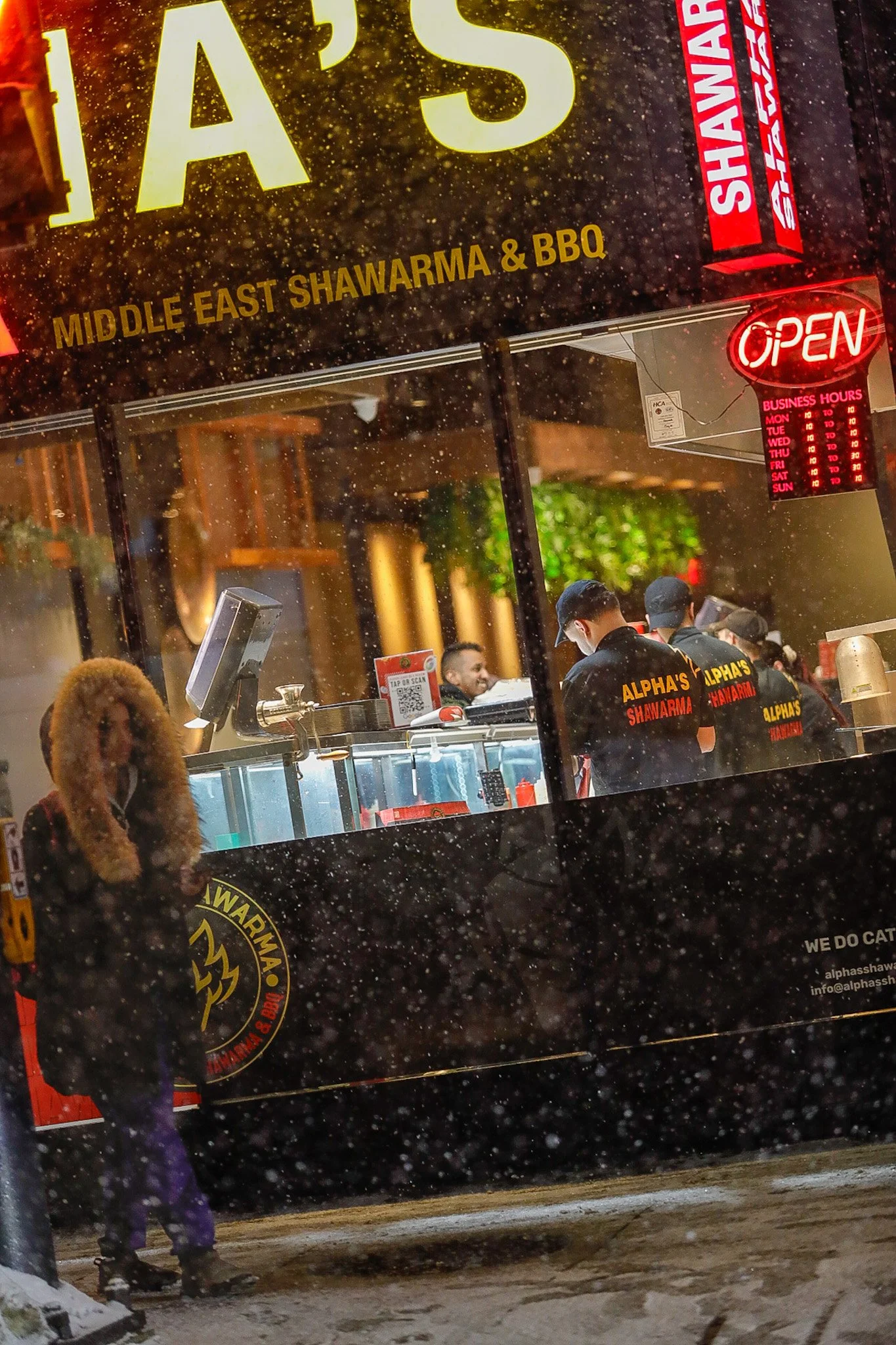
The City That Eats Late — Downtown Toronto in Snow
Snow falls outside a Middle Eastern shawarma shop near Sankofa Square as staff work behind glass—an everyday winter moment that reveals how Toronto feeds itself after dark.
A winter-night editorial from downtown Toronto
Snow has a way of rearranging a city without moving a single building. It softens angles, slows traffic, and forces the eye to narrow its focus to what’s closest: the light in a window, the breath in the air, the movement of hands working behind glass. In downtown Toronto, when the flakes start to fall in earnest, the skyline fades into suggestion and the sidewalk becomes a corridor of instinct. People walk faster, shoulders tucked, collars up. Headlights blur. Steam curls from vents and grates, proof that the city has a circulatory system most of us only notice in winter. And in the middle of that atmosphere, a red “OPEN” sign glows like a declaration.
The city doesn’t stop because it’s snowing. It eats late.
There is something uniquely revealing about the food windows that stay lit after nine o’clock in the core. Office towers may go dark, but the restaurants that operate at street level shift gears instead of shutting down. The crowd changes shape. The early diners thin out, replaced by night walkers, gig workers, transit riders between transfers, shoppers who stayed longer than planned, and residents from glass condos whose kitchens feel too quiet for the hour. In that ecosystem, the shawarma counter becomes more than a place to order dinner. It becomes a node in the after-hours circuitry of Toronto—a small, heated engine that keeps the street alive.
From outside, you see it as choreography. Staff in black shirts pivot between grill and counter. One person shaves meat from the rotating spit in clean, confident strokes. Another assembles plates with the kind of muscle memory that only repetition can build. Someone else calls out numbers, checks receipts, reaches for sauce bottles with the efficiency of a pilot reaching for switches. Snow collects on jackets outside; inside, hands move fast and precise, steam rising not from the sidewalk but from hot metal and seasoned meat. The contrast is almost theatrical: cold and warm separated by glass, hurry and routine sharing the same square footage.
Toronto’s late-night food culture is not accidental. It is the natural result of density and diversity colliding in a city that has grown up fast. Over the last two decades, the downtown core has filled in vertically. Condominiums have replaced parking lots. Office workers have become residents. The distance between “work district” and “living district” has collapsed into a handful of blocks. That compression changes appetite. When thousands of people live within a ten-minute walk of one another, demand doesn’t shut off at dinnertime. It pulses. It shifts. It reappears at eleven o’clock, at midnight, at one in the morning when someone decides that cooking is more effort than the walk downstairs.
Food, in that context, becomes the most honest expression of a city’s identity. It’s where immigration ceases to be an abstract debate and becomes a plate handed across a counter. Middle Eastern shawarma, Caribbean patties, Korean fried chicken, late-night pizza, sushi spots tucked between banks and pharmacies—Toronto’s culinary map is a record of arrival. Every storefront tells a story of someone who came here with a recipe and a plan. Some came for safety. Some came for opportunity. Some came because Toronto promised space to build something without apology. Whatever the reason, the result is visible on winter nights in the glow of a grill: the city eats in multiple languages at once.
The temptation is to romanticize that scene. To treat it like proof that multiculturalism is simple and harmonious and always delicious. But the late-night economy is more complicated than a tidy narrative. It is built on long hours and tight margins. It is sustained by labor that often goes unnoticed because it blends into the street’s background noise. The person shaving meat from the spit is not just performing tradition; they are meeting a demand that peaks precisely when the weather is least forgiving. The person taking orders isn’t just smiling at customers; they are translating between systems—delivery apps, in-person orders, phone calls, cash and card—while the line outside grows restless.
Snow amplifies that tension. Weather doesn’t cancel orders; it multiplies them. When sidewalks turn slick and wind cuts through coats, fewer people want to cook or linger in grocery aisles. The app becomes more appealing. The “just one more block” decision shifts in favor of convenience. And convenience, in a dense downtown, becomes a collective habit. What used to be a special indulgence—food delivered to your door—is now routine. That routine reshapes how restaurants operate. Some counters serve as both dining rooms and dispatch hubs. Riders cluster near entrances. Orders are stacked in paper bags like a small assembly line. The restaurant isn’t just feeding the people who walk in; it’s feeding a network that stretches into every condo tower within range.
That network changes the street’s personality. You can see it in the rhythm of arrivals and departures. A rider checks a phone, steps inside, collects a bag, disappears into snowfall. Another pulls up moments later. Pedestrians adjust their path without thinking about it. The choreography tightens, but it rarely stops. In this way, the shawarma window becomes a case study in how Toronto balances speed and coexistence. It’s not always graceful. There are moments of impatience, moments of friction. But there is also a surprising amount of unspoken cooperation. The person waiting for a pickup holds the door open. The couple stepping aside for a rider doesn’t glare; they nod. The worker behind the counter moves faster, sensing the shift in energy.
This is what makes the city that eats late feel alive rather than chaotic. There is pressure, but there is also adaptation. Toronto has always been a city of adaptation. Its population growth has forced neighborhoods to evolve quickly. What was once an office-only corridor now houses thousands of residents. What was once a lunchtime-only strip now competes for midnight loyalty. The businesses that survive are the ones that understand that eating late isn’t just about hunger—it’s about atmosphere. It’s about offering warmth in a place where winter can feel relentless. It’s about providing a small ritual at the end of a long shift, a quick comfort for someone walking home through snow.
Food is often described as culture, but in a winter downtown it feels more like infrastructure. It supports people physically and emotionally. It keeps foot traffic moving. It keeps lights on. It provides the kind of predictable comfort that makes a big city manageable. In the absence of a late-night café or diner, the core can feel stark. With them, it feels human. The glow from the shawarma shop doesn’t just illuminate the sidewalk; it signals continuity. It says: this neighborhood does not collapse when offices close. It has its own metabolism.
There is an intimacy to ordering food through a glass window in winter. You stand there with snow collecting on your shoulders, your breath visible, watching hands assemble your meal. You can see the process. You can smell it. You can hear the sizzle beneath the hum of traffic. It is transactional, yes, but it is also sensory in a way that app-only interactions can never be. That’s part of the reason these places endure. They offer not just sustenance but evidence—proof that someone is cooking, that someone is present, that the city’s pulse is not purely digital.
For visitors, that intimacy is often the most memorable part of a trip. Landmarks impress; food connects. You might forget the exact dimensions of a building, but you remember the taste of something hot in the cold. You remember the warmth of a small dining room when the sidewalk was frozen. You remember the feeling of stepping back outside with a wrapped sandwich in your hands, the steam rising from the paper as you walk. Those memories anchor a city in the body. They make it more than a skyline.
Toronto’s late-night appetite is also a marker of confidence. A city that eats late believes in its own safety and stability. It believes enough people will walk the streets after dark to justify staying open. It trusts that light will attract, not repel. In a winter storm, that confidence becomes visible. The restaurants that close early retreat from the weather; the ones that stay open claim it. They treat snowfall not as an obstacle but as atmosphere. They understand that some customers will arrive precisely because of the weather, drawn by the idea of warmth against the cold.
None of this is accidental. It is the product of decades of demographic layering. Toronto’s identity has been shaped by waves of immigration that brought not just new languages and traditions, but new hours. Different cultures eat at different times. Some gather late by default. Some treat dinner as an extended social event. When those habits overlap in a dense downtown, they create a culinary clock that stretches beyond the nine-to-five template. The result is a core that feels less like a business district and more like a neighborhood, even in winter.
Of course, that neighborhood feeling comes with trade-offs. Noise complaints. Delivery congestion. The constant presence of riders and drivers competing for curb space. The tension between residents who crave quiet and businesses that rely on volume. The late-night food culture is not purely romantic; it is economic and sometimes messy. But messiness is often the price of vitality. A sterile street might be quiet, but it rarely feels alive.
On a snow night near Sankofa Square, the vitality is undeniable. Even through a lens blurred by flakes, you can see it: the steady flow of customers, the disciplined pace behind the counter, the glow that cuts through the cold. The shawarma shop is not the only one open, but it is emblematic. It represents the shift from spectacle to sustenance, from headline to habit. It is where Toronto reveals itself not as a performance, but as a lived-in place.
The city that eats late is not chasing trendiness. It is responding to density. It is adapting to the way people actually live in the core. It is proof that downtown Toronto has crossed a threshold—from a place people commute into, to a place people inhabit around the clock. That transformation is visible in the smallest details: a line at eleven p.m., a grill that doesn’t shut off at ten, a red “OPEN” sign that glows against falling snow.
Winter will pass. The snow will melt. The sidewalks will widen again. But the memory of nights like this lingers. It’s the memory of a city that refused to dim just because the weather demanded it. It’s the memory of warmth found behind glass when the air felt unforgiving. It’s the memory of watching a street feed itself long after office lights went dark.
Toronto doesn’t stop when it snows. It doesn’t stop when it’s late. It doesn’t stop when the day is over. It eats late, because it lives late. And in that simple, practical fact—one shawarma at a time—you can see the shape of the modern city: layered, restless, and always a little warmer than it first appears.
Rittenhouse Square Philadelphia at Dusk
In the hour when the city stops performing and simply exhales, Rittenhouse Square becomes a shared refuge. Lamplight, trees, and unhurried footsteps turn Center City’s pace into something softer. This feature follows the quiet emotional shift that happens at dusk—why a public park can steady you, even when it fixes nothing at all.
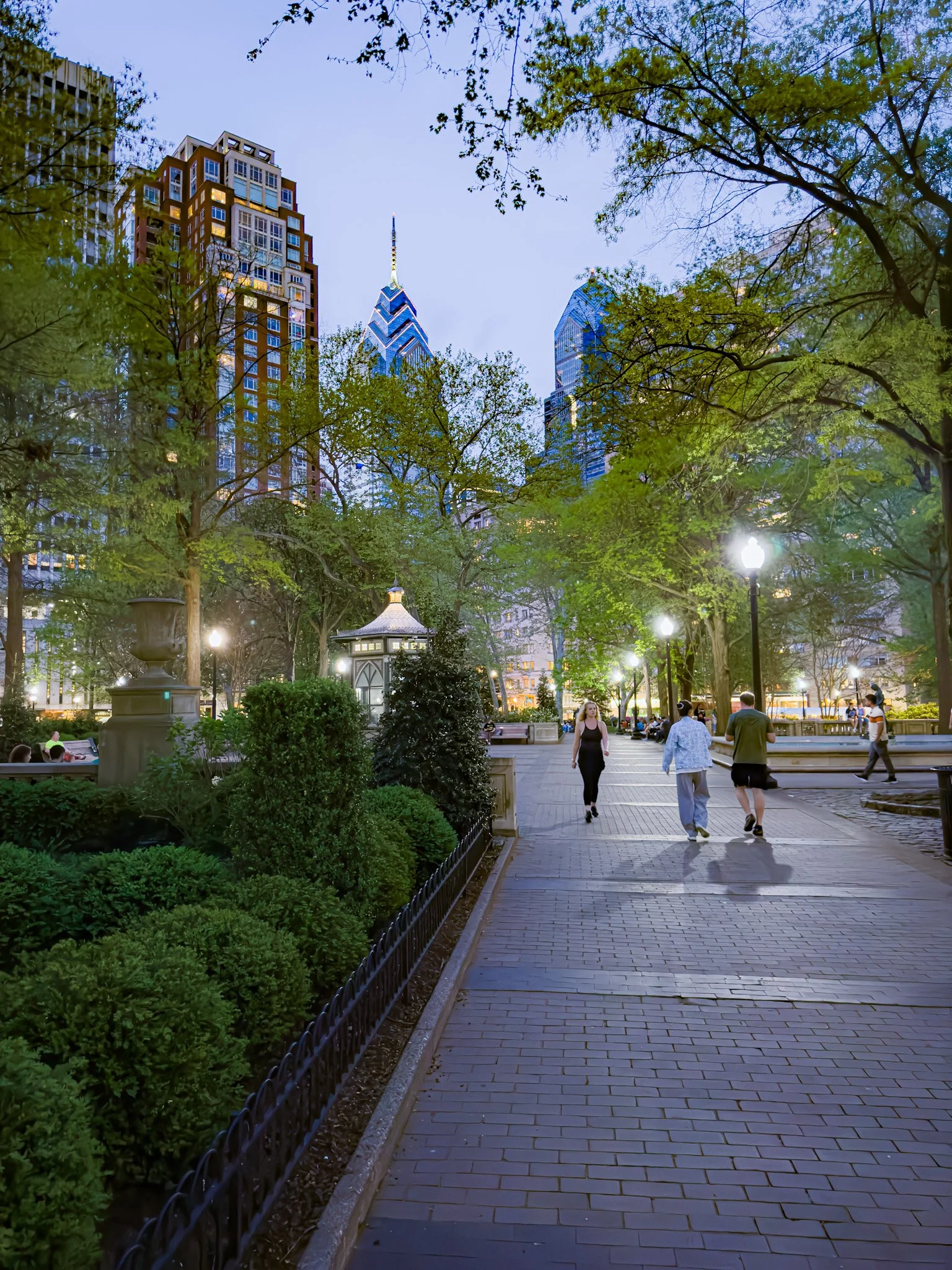
Soft Hour in Rittenhouse
Pedestrians walk along a path in Rittenhouse Square in Center City Philadelphia at dusk, with city buildings visible through the trees.
At the soft edge of evening, Rittenhouse Square Philadelphia becomes less of a destination and more of a release valve. The lamps come on along a brick path, trees hold the last blue light, and a few walkers drift forward with the skyline rising quietly beyond the canopy. That’s the whole spell: nothing monumental, nothing staged—just a public place letting people loosen their grip on the day.
Dusk is when a city shows its real face. Not the rush-hour face, not the weekend face, not the glossy “come visit” face—but the in-between expression that belongs to anyone who’s ever carried groceries home, replayed a hard conversation, or walked off a worry because walking was the only honest thing left. In Center City Philadelphia, the hours can feel like they’re priced and measured, traded and spent. In the square, time behaves differently, as if the air itself refuses to hurry. You don’t have to buy anything to be here, and that detail—simple, almost radical—changes how your shoulders sit.
Story Promise
This is a story about what dusk does to a place—and what a place can do to you. It’s about why Rittenhouse Square Philadelphia feels like a shared living room at the exact moment the day stops asking for your best performance, and the night hasn’t started demanding anything yet. Along the way, we’ll step into the square’s long memory: William Penn’s original vision for green space in a growing city, the name it carried before it was “Rittenhouse,” and the community labor—part civic, part neighborly—that keeps it tender enough to return to. And we’ll stay with the human truth beneath the history: sometimes the most important thing a city gives you is a place where you can simply exist, unremarkable and safe among strangers.
Why Rittenhouse Square Philadelphia Feels Like an Exhale at Dusk
The soft hour doesn’t arrive with fireworks. It arrives with small permissions. Permission to slow your pace because nobody’s honking behind you, permission to stop checking your phone every thirty seconds, permission to look up at the trees like you’re not late for something. At dusk, Rittenhouse Square park becomes a gentle corridor of body language—people walking as if they’re letting go of the day one step at a time. You see it in the way conversations stretch out, in the way dog leashes loosen, in the way a bench suddenly feels like an invitation instead of a pause button. Visit Philly describes the square as a place where locals and visitors gather to stroll, read, relax, and catch up—simple verbs, but they’re the verbs that keep a person from burning out.
A park at dusk is also a mirror, and it doesn’t flatter you. It shows you what you’ve been carrying by how quickly you feel the urge to set it down. Some people come in hot—fast steps, eyes forward, jaw tight—like the city’s tempo has gotten under their skin. Then the path bends, the lamps glow, and something ancient in the brain recognizes safety: trees, open space, other humans not demanding anything. That’s when the breath changes. It’s not dramatic. It’s just the quiet recalibration you didn’t know you needed.
Part of what makes this hour feel so human is that the square isn’t hidden. It isn’t a secret garden behind a gate. It sits in the middle of Center City Philadelphia, surrounded by restaurants, residences, and the constant hum of a neighborhood that never fully goes offline. And yet, inside its boundaries, the tone shifts. That contrast—busy streets outside, softer tempo inside—is the entire emotional architecture. It’s why “an evening stroll” here can feel like a reset rather than another item on a list of things to do in Rittenhouse Square.
A Square Older Than the Lives Passing Through It
It helps to know what you’re walking inside. Long before Rittenhouse was a brand name—before it was shorthand for an upscale zip code and a certain kind of dinner reservation—the square was part of a plan. In the late 17th century, William Penn and surveyor Thomas Holme laid out Philadelphia with a system of public squares meant to keep green space inside the city’s bones. The idea wasn’t just beauty; it was breathing room—space that could temper density and keep the city livable as it grew. Histories of Penn’s plan often point to his desire for a “greene countrie towne,” a city that didn’t have to choose between urban life and access to open air.
Rittenhouse Square didn’t start out with this name. It began as “Southwest Square,” and it carried that straightforward label until 1825, when Philadelphia’s City Council renamed it to honor David Rittenhouse—an astronomer, inventor, and civic figure whose work and reputation mattered enough to be etched into the city’s map. The Friends of Rittenhouse Square, the nonprofit deeply involved in the square’s upkeep today, tells that naming story plainly: a public space given a personal name as a kind of civic tribute. It’s a detail that matters because it shows what cities do when they’re healthy: they remember people, not just profits.
If you’re trying to understand the square’s intimacy, look at its shape. It’s not endless. It’s bounded—by Walnut and Locust, by 18th and 19th—stitched into a walkable grid that makes the park feel like a room rather than a wilderness. Preservation-oriented guides describe these edges clearly, because boundaries are part of what gives the place its character: the square is big enough to disappear into for a moment, small enough to cross without making it a project. That scale is one reason it works so well as a daily ritual rather than a special occasion.
And then there’s the deeper magic: a place can be old without being distant. You don’t need plaques and lectures to feel the time layered here. You feel it because the square has been a respite for generations of Philadelphians—an ordinary refuge that stayed ordinary even as the city around it evolved. The Cultural Landscape Foundation frames it as part of Penn’s original concept, a green square that shifted through uses over centuries while remaining what people needed it to be: a pause in the urban current. When you realize that, dusk takes on an added weight. You’re not just walking in a park; you’re moving through a long-held human habit: step away, breathe, return.
The Beautiful Work You Don’t See
The soft hour feels effortless, but it isn’t. A park doesn’t stay inviting by accident. Lawns don’t manicure themselves, paths don’t remain walkable by pure luck, and trees don’t thrive just because people want them to. Rittenhouse Square sits inside Philadelphia’s larger parks system, and Philadelphia Parks & Recreation describes its mission in human terms—connecting residents to the natural world, to each other, to “fun things to do and see,” while managing historic and cultural sites across the city. That’s the public backbone.
Then there’s the quieter layer: the neighborhood stewardship that turns a public park into a cared-for one. The Friends of Rittenhouse Square is explicit about this relationship—Rittenhouse Square is part of the Fairmount Park system and is operated in partnership with Philadelphia Parks & Recreation. This is not romantic language; it’s operational reality. It means a public space is kept alive through a blend of civic management and community support, the kind of collaboration most people never think about while they’re sitting on a bench. But the moment you do think about it, the square becomes even more human: it exists because people decided it should.
In 2010, the American Planning Association recognized Rittenhouse Square as one of the country’s Great Public Spaces, and local reporting emphasized why: it’s inviting, it anchors a vibrant neighborhood, and community members have repeatedly fought to keep it that way. That sentence contains the entire emotional economy of public space. Parks don’t endure because they’re pretty; they endure because people argue for them, fund them, maintain them, and return to them until returning becomes tradition. The “soft hour” at dusk is, in a sense, the dividend on all that invisible work.
But here’s the honest edge: a beloved park also carries a complicated burden. When a place becomes known as one of the best parks in Philadelphia, it attracts more than quiet walkers. It attracts attention, expectation, and competing definitions of what the space is “for.” That’s not a scandal; it’s the nature of successful public places. A square holds lunch breaks and grief walks, first dates and last conversations, tourists taking photos and locals who wish the tourists would disappear. The real achievement isn’t that everyone uses the park the same way; it’s that the park can hold many uses without collapsing into conflict.
Leaving the Square Without Losing the Calm
The truest test of a park is what happens when you leave it. Not whether it looks good on your phone, not whether it impresses an out-of-town friend, not whether it earns a glowing review. The test is whether you carry something out with you—something quieter than you arrived with. In Rittenhouse Square Philadelphia, dusk often does that work gently. It doesn’t “fix” anything. It simply interrupts the momentum long enough for you to remember your own pace.
If you’ve ever walked here after a day that felt too full, you know the strange relief of being anonymous among other humans who are also winding down. Nobody asks you to explain yourself. Nobody needs your résumé. You can be the person behind the person you’ve been performing all day. That’s why parks matter even when the city is full of more exciting options; a public square is one of the few places where presence itself is enough.
When the sky deepens and the lamps become the dominant light, you can feel the moment turning—people peeling off toward Walnut Street, toward dinner plans, toward home. The square doesn’t cling to them; it doesn’t demand loyalty. It’s there tomorrow, and that promise—quiet, nonverbal, reliable—is its greatest luxury. Near the end of the day, when everything else feels temporary, the square feels steady. You walk out, and the city resumes its speed, but you’re not quite as hurried as before.
And that’s the point. Not escape. Not fantasy. Just a pocket of steadiness inside the real world. A dusk walk through Rittenhouse Square Philadelphia is a reminder that the city still has places where you can be a person first—and everything else second.
Windows That Remember: St. Peter Catholic Church Charlotte at Night
A downtown built for speed still makes room for silence—if you know where to look. On South Tryon Street, St. Peter Catholic Church has outlasted the city’s reinventions, holding steady as glass towers rise around it. This feature explores what remains when everything else updates, and why a warm window at night can feel like a lifeline.
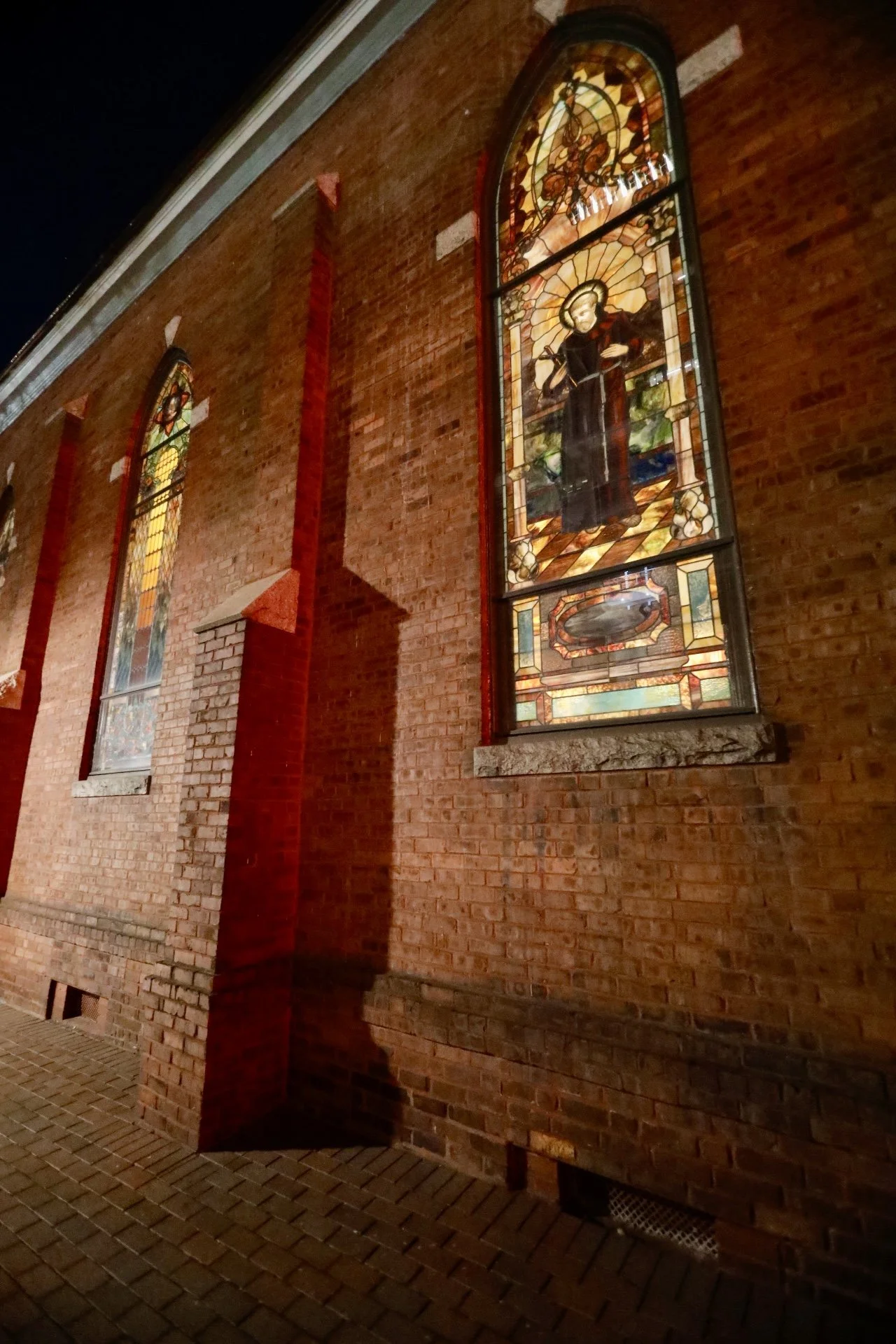
Windows That Remember
St. Peter Catholic Church on South Tryon Street in Uptown Charlotte, North Carolina, photographed at night.
On a late night in Uptown, St. Peter Catholic Church Charlotte holds its light the way some people hold their breath—quietly, on purpose. From the sidewalk on South Tryon Street, you can see brick, stained glass, and the reflective edge of newer towers behind it. The windows glow warm against the streetlamps, not asking for attention so much as refusing to vanish. In a district built for velocity—cars, calendars, quarterly goals—this is a place that doesn’t hurry. It simply stays.
Most nights, the city’s soundtrack is a layered thing: tires on wet pavement, a distant siren that never quite arrives, laughter escaping a doorway, the small electronic chirp of someone crossing when the signal says “walk.” People move through that sound carrying private cargo—grief disguised as errands, hope disguised as plans, exhaustion disguised as competence. Even when you’re not looking for anything spiritual, you’re still looking for something human: proof that you’re not just passing through a machine. Sometimes that proof shows up as a building that has outlasted the phrases the city uses to describe itself.
There’s a difference between a landmark and a lifeline. A landmark is something you point to, something you use to get somewhere else. A lifeline is something you return to, even if you don’t enter, even if you only let it steady you for a moment. At night, old churches in modern downtowns do a particular kind of work: they make space for the parts of a person that don’t fit inside a schedule. They offer a pause that feels almost rebellious.
This story isn’t really about architecture, even though architecture is the doorway. It’s about memory—how it survives in a city that constantly updates itself, and why that survival matters to people who feel updated-out. It’s about what a stained-glass window can do that a glass curtain wall can’t, and what it means when the oldest things in the center of town are still places of gathering rather than consumption. Along the way, we’ll step into the history of St. Peter—founded in the 1850s era of Charlotte—and into the present-day pressure of a downtown that rarely lets anything remain unchanged. And we’ll end where most nights begin: on the sidewalk, deciding what kind of person you want to be as you keep walking.
When a City Moves Faster Than Its Memory
Charlotte is a city that knows how to grow. If you’ve lived here long enough—or visited, left, and returned—you can feel the acceleration in the skyline itself. Comparisons of past decades to today often read like a before-and-after: the outlines are familiar, but the scale is startling, as if the city decided to think bigger and never stopped. Growth, though, has a shadow side that doesn’t always make it into the celebratory language. When newness becomes a civic reflex, older buildings don’t just age—they disappear.
The strange thing is how quickly we adapt to that disappearance. Humans are built to normalize their surroundings; we can make peace with almost anything if it happens gradually enough. A beloved corner becomes a construction fence, then a grand opening, then simply “the place you go now.” You can miss a building the way you miss a person: not in one dramatic moment, but in a series of small recognitions—I used to turn here, I used to meet them here, I used to be someone else here. Cities don’t just hold our routines; they hold our earlier selves.
In Uptown, the pressure of redevelopment can feel almost metaphysical, like the ground itself wants to be something different every decade. A university-based look at the oldest buildings in Uptown points out how few structures over a century old remain, and it names the trade-off plainly: creating a newer city has often meant destroying much of the old. That same context notes what tends to survive among the oldest structures: churches, because communities fight for them in a different way than they fight for storefronts.
And that fight isn’t only about history nerds preserving artifacts. It’s about a deeper need: continuity. Not nostalgia, not “everything used to be better,” but continuity—the sense that your life is not happening on a disposable stage. In a city of promotions and relocations, you can start to feel like even your own story is temporary. Old walls don’t solve that feeling, but they challenge it. They insist that something can be built to last longer than a marketing cycle.
St. Peter Catholic Church Charlotte and the Discipline of Staying
St. Peter’s story begins before “Uptown” became a brand. The parish traces back to the early 1850s, with the church’s own historical account describing a cornerstone laid in 1851 and a first building rising when Charlotte was still small enough to have edges you could name. In that telling, St. Peter originally stood at what was then the extreme southern limits of the city—an outpost more than a center. That detail matters, because it flips the way we usually talk about downtown churches today. They look like they’ve always been surrounded by towers, but towers came later; the church was here first.
The building people recognize now dates to another threshold moment: 1893, when the cornerstone was laid for the Victorian Gothic-style structure that still stands on South Tryon. The church’s own history describes a neighborhood that changed in waves—empty lots becoming homes, homes replaced by businesses, the city growing around the parish until the outpost became the heart. It’s a simple narrative, almost too clean—except it’s also what cities do: they swallow their outskirts and call it progress.
When you read that history, you also feel the stubbornness required to remain. St. Peter is described as the oldest edifice remaining on Tryon Street, a constant in an urban landscape that keeps rewriting itself. That’s not a sentimental statement; it’s a practical one. Remaining means paying for repairs when land values make selling tempting. Remaining means enduring seasons where membership shifts outward, when downtown empties at night, when the city’s energy moves to the next neighborhood that feels “hot.” Remaining is a discipline, and disciplines always cost something.
It’s also a discipline that sometimes requires reinvention without surrender. In 1986, St. Peter regained full parish status, and Jesuit priests began serving the growing parish and surrounding business community in a more intentional way, with daily Mass and reconciliation named as part of that continued presence. That date is more than an administrative milestone; it marks a moment when the church chose to live as a downtown church in a downtown that was becoming something else. The Jesuits’ broader ministry listing for St. Peter emphasizes the same two anchors—its founding in 1851 and Jesuit staffing since 1986—like coordinates you can navigate by.
The address itself—507 South Tryon Street—feels almost like a dare to the city: try to outgrow this, too. The Diocese of Charlotte’s parish listing places St. Peter right there in the center of the map of Catholic life, complete with a weekly schedule that reads like a quiet insistence that community is still possible in the core. A downtown parish doesn’t only serve residents; it serves the commuters, the visitors, the workers who arrive before sunrise and leave after dark. It serves the people whose lives are split into “where I live” and “where I earn.”
What Stained Glass Teaches a Glass City
There are cities built of brick, and cities built of glass. Charlotte, in its recent decades, has learned the language of glass fluently: reflective towers that mirror the sky, lobbies that feel like controlled climates, conference rooms where the day is measured in decisions. Glass is beautiful, but it has a habit of turning everything into a reflection. You see yourself in it. You see the city’s image of itself in it. And after a while, you can forget there are other ways to look.
Stained glass is not the same kind of seeing. It’s glass that refuses to be neutral. It takes light and gives it a story. It turns glare into color, and color into meaning, and meaning into a kind of patience. That patience matters downtown. Because downtown life trains your eyes to scan: signage, signals, notifications, faces, risk. Stained glass asks for a longer gaze, the kind that says, slow down; you might miss what’s true. You don’t have to be religious to understand the invitation. You only have to be tired.
The streets around St. Peter have also become a corridor of art and performance—another kind of meaning-making layered into the same blocks. The Levine Center for the Arts, completed in 2010 through a partnership of civic and philanthropic support, helped formalize this stretch of South Tryon as a cultural destination, with institutions and venues that pull people downtown for reasons other than work. Nearby listings for St. Peter in Uptown Charlotte’s visitor resources even describe it in that same ecosystem—both a church and a presence among museums, theaters, and the steady foot traffic of the district.
That context can make the church feel like an aesthetic complement—brick as a counterpoint to steel. But that’s the shallow reading. The deeper truth is that cities need more than attractions; they need interiors. They need places where you’re not performing your life, not selling your competence, not optimizing your minutes. Art can do that. So can worship. So can simple quiet. The point isn’t which door you choose; it’s that the doors still exist.
And there’s another lesson in stained glass that downtown buildings rarely teach: limitation. Stained glass windows are designed to be framed. They are beautiful precisely because they accept boundaries—lead lines, panels, shapes that hold the image together. Modern life often treats boundaries like enemies, as if the good life is limitless choice and constant access. But any honest person knows that a life without boundaries doesn’t become free; it becomes scattered. A framed window can remind you that structure isn’t the opposite of beauty. Sometimes structure is what makes beauty possible.
The Quiet Work of Doors
If you stand near a downtown church long enough, you’ll notice something subtle: people behave differently as they pass. Not everyone, not dramatically, but enough to feel the shift. Voices lower a notch. Steps slow, almost unconsciously. Some people glance up as if checking their bearings against something older than themselves. It’s not superstition; it’s recognition. A church is one of the few remaining public signals that a person is more than a consumer moving between transactions.
St. Peter’s, specifically, carries the Jesuit imprint in the way it describes its mission. Uptown Charlotte’s guide to the church highlights it as the only Jesuit parish and emphasizes a spirituality shaped by Ignatian language—finding God in all things, discernment, service, community. Even if you’re not part of that tradition, you can hear the human version underneath it: pay attention, live deliberately, don’t let your life become accidental. That message lands differently when delivered by a building that has watched the neighborhood change from lots to homes to businesses to skyscrapers.
There’s also something important about a church that stays downtown: it refuses to outsource the soul of the city to the suburbs. In many American cities, spiritual life migrates outward with families and housing, leaving the core to commerce and nightlife. But a downtown parish says: the center still deserves care. It says: the worker matters as much as the resident, the weekday matters as much as the weekend, the noon hour matters as much as Sunday morning. The Diocese’s schedule listing is ordinary on paper—times, days, consistency—but ordinary is exactly the miracle in a place built to be exceptional.
And memory, real memory, is always tethered to ordinary repetition. You don’t remember the one glamorous night as clearly as you remember the thousand small routines that formed your life. That’s why “windows that remember” is more than a poetic phrase. It’s a description of how places carry us: by being there when we return, by offering the same light through different seasons of our own changing faces. In a city where so much is designed to be replaced, the refusal to be replaced becomes its own kind of testimony.
So you keep walking. You pass the doors, maybe you enter, maybe you don’t. But you leave with a different interior weather than you arrived with—slower, steadier, less convinced that speed is the same thing as purpose. And if you find yourself back on South Tryon another night, you’ll notice the same stubborn warmth holding its ground. St. Peter Catholic Church Charlotte will still be there, doing what it has done for generations: letting light mean something, and letting the city remember it has a heart.
A Small Light in a Big City: The Comfort of the Familiar
In the middle of a big city, familiarity becomes its own kind of shelter. This Toronto editorial uses one glowing sign, rising steam, and a civic landmark to explore why the smallest comforts often make the boldest travel possible.
A Small Light in a Big City — Sankofa Square, Toronto @Solomon D Crowe
A familiar 7‑Eleven sign glows near Sankofa Square as sidewalk steam rises and Old City Hall anchors the background—three layers of Toronto in a single blue-hour moment.
There’s a particular shade of blue that only shows up when a city is switching shifts—when daylight has surrendered but night hasn’t fully taken control. It’s the hour when glass towers turn into aquariums, when streetlights feel like punctuation, and when the pavement starts to look like it’s holding its own heat. In downtown Toronto, near Sankofa Square and the civic spine that runs through the core, that blue hour makes everything look slightly unreal—like the city is pausing to decide which version of itself it’s going to be for the next twelve hours.
And then there’s the sign.
Not a landmark. Not a cathedral. Not a museum. Just a bright, familiar circle of color that reads instantly, without translation, without context, without a guidebook. It hangs there with the confidence of something that doesn’t need to be introduced. Under it, the sidewalk breathes. Steam rises from a vent in the concrete—an exhale from the underground infrastructure that keeps the city warm, moving, running. Behind it, the old stone of City Hall sits in the background like a memory that refuses to be overwritten. Three layers of modern life in one glance: the quick stop, the hidden system, the long history.
It’s an image that looks simple until you realize how many people it applies to.
Because the truth about big cities—especially when you’re traveling, especially when you’re tired—is that novelty is expensive. Not financially, necessarily, but mentally. New streets require decisions. New restaurants require courage. New neighborhoods require attention. Every “authentic experience” is another tiny leap into the unknown. That’s what makes travel thrilling. It’s also what makes it exhausting.
So at some point, even the most adventurous person reaches for something familiar—not because they’ve failed at discovery, but because they’re human. They want a small light in the big city. Something that says: You’re fine. You can solve this in five minutes. You can reset here.
That’s the unspoken role of places like this. They are the safety rails of travel.
The city sells itself on its highlights—icons, festivals, skyline views, perfect plates on perfect patios. But the city actually functions on dependable nodes: convenience stores, transit stops, late-night counters, bright signs that stay awake when everything else feels uncertain. Those are the places where you watch the real story move through: the visitor who doesn’t know the neighborhood; the worker ending a shift; the couple debating where to go next; the person who just needs a bottle of water, a receipt, a moment to breathe.
In travel writing, we don’t always admit how much these nodes matter because they don’t photograph like romance. But they are romance of another kind: a city’s quiet willingness to provide for you without asking who you are.
The most dramatic part of this scene isn’t the architecture or the neon. It’s the emotion behind it—the fact that a familiar sign can lower your heart rate. That it can turn an unfamiliar block into a manageable one. That it can make a city feel less like a test and more like a place you can live inside.
If you’ve traveled enough, you know the feeling. It’s not about craving processed snacks or needing a brand name. It’s about the instant relief of recognition. The comfort of a shared language. The way a predictable place gives you back your attention so you can spend it on what matters: the streets, the culture, the people, the wonder.
And that’s where Toronto excels, whether it’s trying to or not.
Toronto is a city of layers—of old stone and new glass, of civic buildings and quick commerce, of underground systems that hum beneath the surface while street-level life keeps reinventing itself above. It’s a destination that can feel “easy” in the best sense: navigable, legible, safe enough to explore, alive enough to surprise you. It is also a city that can overwhelm quickly if you demand that every moment be exceptional.
The smartest travelers don’t demand that. The smartest travelers build in recovery. They let the city be ordinary sometimes. They accept that a “great night” often begins with something small and unglamorous: a quick stop for water, a snack for the walk, a pause to regroup, a moment to decide what happens next. They understand that the best travel isn’t a nonstop highlight reel; it’s a rhythm—intensity, stillness, intensity again.
This is where the steam matters—not as a special effect, but as a reminder that cities have bodies. Toronto has a circulatory system: heat, power, water, transit, service corridors, maintenance schedules, invisible workers doing invisible work. The steam rising up is the city’s breath escaping into the night air, a visible reminder that comfort is built, not accidental. Travelers experience the surface—restaurants, attractions, nightlife—but the surface is only possible because the below-ground systems are functioning.
There’s a reason that breath feels comforting, too.
It suggests continuity. It suggests that someone is keeping the lights on.
When you put that next to the old civic building in the background, the story deepens. You start to feel the contrast between “fast” and “lasting.” Between places built to serve you now and structures built to outlast you. Between the night’s quick decisions and the city’s longer memory. This is what makes downtown Toronto photogenic beyond aesthetics: it’s a place where eras are visibly stacked, where the modern city doesn’t hide its past—it simply builds around it.
There is an argument that global brands flatten cities, turning every destination into a familiar loop of the same signs. That argument isn’t wrong. If all you do is chase familiarity, you miss the soul of a place. You miss the local. You miss the strange, the specific, the unrepeatable. You miss the very point of going.
But there’s another truth that rarely gets equal airtime: familiarity can be a doorway, not a destination. A traveler doesn’t stop at a bright sign because they want the city to be the same everywhere; they stop because they want the city to be survivable enough to keep exploring.
Familiarity is how many people stay brave.
It’s how a visitor who’s never navigated a dense downtown at night convinces themselves to keep walking. It’s how someone who is alone in a city still feels part of something. It’s how a newcomer finds a foothold. It’s how a tired person gives themselves permission to keep going.
Cities that offer those footholds feel generous. Cities that don’t can feel punishing.
Toronto—especially around its busiest intersections and squares—offers footholds everywhere: signs, lights, late hours, easy access to basics. It’s a city where you can wander without feeling like you’re gambling with your safety or your time at every turn. That matters. Not as a marketing slogan, but as a real travel advantage. You don’t have to be a “hardcore” traveler to enjoy it. You don’t have to be brave all the time. You can just be curious.
And that is where an editorial like this becomes less about a convenience sign and more about modern travel itself.
Because travel culture often glorifies the extreme: the remote, the rugged, the “hidden gem” that requires an algorithm-proof level of effort to reach. That’s one kind of travel, and it’s legitimate. But for many people—especially the ones who return to a destination again and again—the best travel is the kind that doesn’t demand constant performance. It’s the kind that lets you take a breath. It’s the kind that holds you when you’re tired.
Sometimes the most valuable part of a destination is that it feels doable.
That it has a rhythm you can step into.
That it has small lights.
The irony is that these small lights often appear most clearly against big backdrops. A bright sign feels more like comfort when the building behind it looks old and serious. Steam feels more like warmth when the air feels sharp. Traffic feels more like life when the city seems to stretch beyond your field of view. The scene becomes a reminder that cities aren’t just collections of attractions. They are environments—emotional as much as physical.
A city can welcome you without speaking to you.
A city can calm you without knowing your name.
That’s why the most viral travel stories—the ones that spread, the ones people share and say “this is exactly it”—often aren’t about the top-ten list. They’re about recognition. A reader sees themselves in the moment. They remember the feeling: being somewhere new, wanting to be adventurous, but needing one familiar anchor to keep the courage alive.
And suddenly the editorial isn’t just about Toronto.
It’s about every person who has ever stepped out of a hotel lobby, looked down a busy street, and felt the simultaneous thrill and fatigue of being out of place. It’s about the quiet psychology of travel: the way the mind constantly negotiates risk, comfort, curiosity, and energy. It’s about the truth that you can love discovery and still crave something known.
In that sense, the 7‑Eleven sign isn’t the subject. It’s the symbol. It’s a short sentence in a longer story about modern movement.
The steam is not the subject either. It’s the reminder that the city is alive, breathing through the cracks, powered by systems that rarely get photographed but always get felt. Old City Hall isn’t the subject. It’s the witness—a stone anchor reminding you that cities have long memories, even if the streets feel like they change every year.
Put them together, and you get a travel editorial with a point: the most important part of a destination isn’t always what’s unique. Sometimes it’s what makes you feel steady enough to go looking for what’s unique.
Because the truth is, no one travels on inspiration alone. People travel on a combination of wonder and reassurance. They travel on the idea that they will be safe enough to enjoy the unfamiliar. They travel on the expectation that there will be water when they’re thirsty and light when they’re lost. They travel on the belief that the city will hold them, even briefly, even casually.
And if you want to understand a destination, pay attention to what stays open late. Pay attention to what glows. Pay attention to what people orbit when the plans fall apart or the night runs long. Those are the places that reveal a city’s real hospitality—not the curated hospitality, but the functional kind.
In downtown Toronto, near Sankofa Square and the civic heart, the small lights are everywhere. They aren’t glamorous. They aren’t trying to be. They’re simply doing their job: keeping the city legible, keeping people moving, keeping the night from becoming too big.
That’s what this scene holds, and why it works. It’s not just “Toronto at blue hour.” It’s modern travel in one glance: a familiar sign, a breathing street, a historic backdrop, and the unspoken relief of knowing that even in a big city, you can still find something small that understands you.
Editorial licensing note: This story and the accompanying images are available for editorial licensing and publication.
Decew Falls as Mirror: Morningstar Mill, the Bruce Trail, and the Price of Wonder in St. Catharines
Decew Falls isn’t just a scenic stop—it’s a mirror. In St. Catharines, the waterfall, the mill above it, and the footpaths that lead in reveal a modern truth: the way we move through beautiful places shapes what those places become. This feature follows the thin line between access and preservation—where wonder is abundant, and responsibility is the quiet cost.
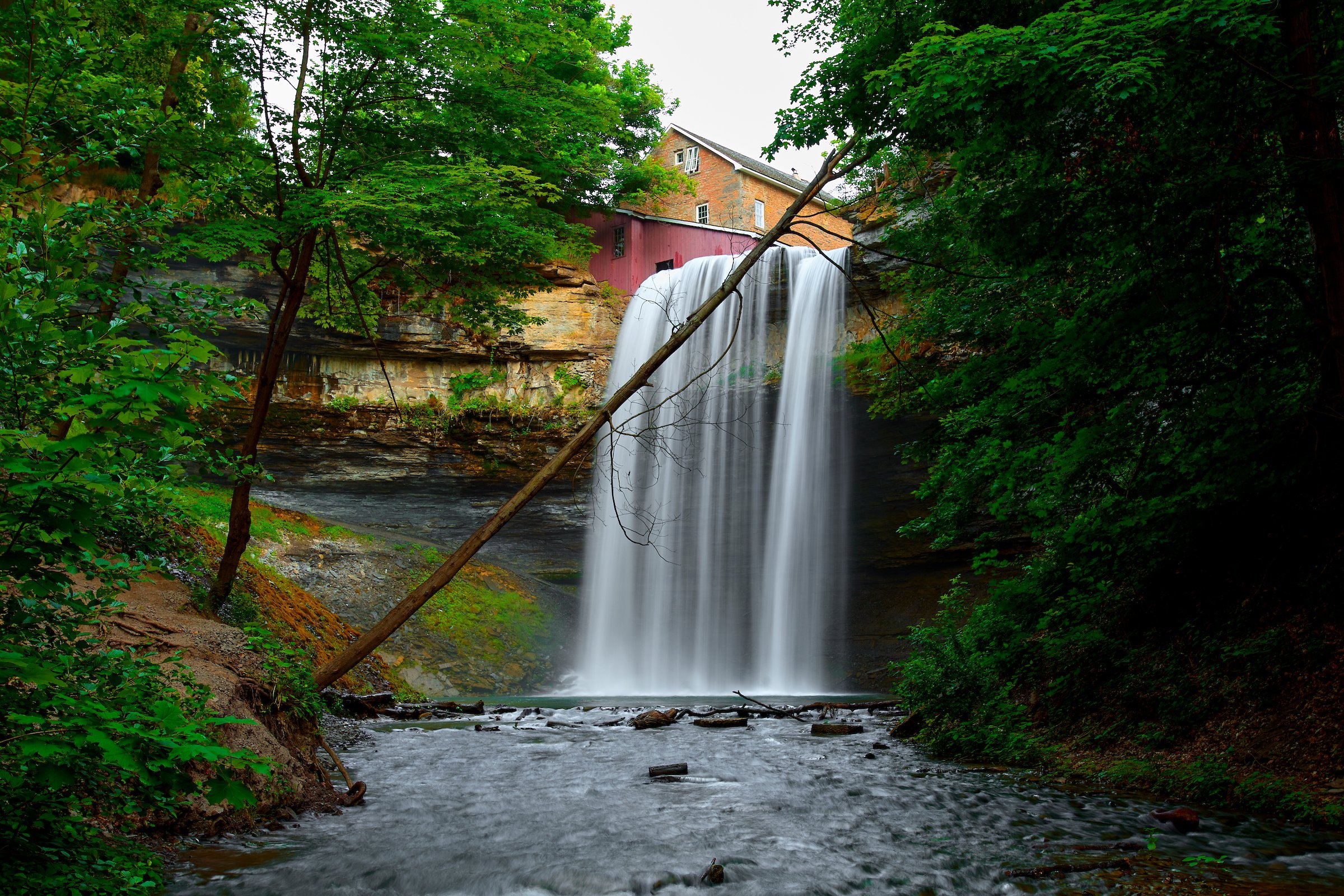
Decew Falls and Morningstar Mill, St. Catharines @Solomon D Crowe
Decew Falls drops over the Niagara Escarpment below Morningstar Mill in St. Catharines, Ontario—where heritage restoration and public access meet the modern demand for wonder.
There are places that don’t ask for much—no ticket booth, no velvet rope, no timed entry—just a turn off a familiar road and a short walk into the green. Decew Falls is one of those places, which is exactly why it has become a test of who we are right now. In an age when attention is currency and the map in your pocket can route you to anything worth seeing, Decew Falls offers a kind of “free” wonder that feels almost out of place. Yet the first thing a visitor learns in this season is that wonder is never truly free. The Morningstar Mill site—home to the restored water-powered mill perched above the falls—has been closed for a major construction and restoration project, with no on-site parking, and the closure has stretched beyond its original end date as work continues. The trail still runs along the side of the property, but the site itself is paused, mid-sentence, while the scaffolding and planning catch up to the promise we all make when we say we love a place.
It’s tempting to treat a waterfall like a photograph: fixed, reliable, always ready. But a waterfall is more like a living agreement between water, rock, access, and restraint—an agreement the modern world keeps renegotiating without reading the fine print. Decew Falls sits along the Niagara Escarpment, one of Ontario’s great natural thresholds, where geography does what good stories do: it forces a change in pace. People arrive with different reasons tucked inside them. Some come for the straightforward pleasure of a day outdoors, the kind that makes the lungs feel bigger than the calendar. Some come to show their kids what “real” looks like, beyond screens and schedules. Some come with a tripod, chasing the long exposure and that silky ribbon of falling water. And some come because the internet promised a shortcut to awe. The falls don’t care which category anyone falls into, but the place does keep score—through worn footpaths, strained parking shoulders, rescue calls, and the quiet resentment that can build when locals feel their backyard turning into someone else’s backdrop.
If Decew Falls works as a mirror, it’s because the reflection is never just of water. It’s of our habits. The way we arrive. The way we take. The way we leave. Modern travel—especially the “micro-adventure,” the quick-hit day trip that feels like a reset—has trained us to believe we can collect experiences the way we collect tabs on a browser: open, skim, close, move on. Decew Falls resists that rhythm. It asks for the humility of a walk. It asks for attention that isn’t monetized. And it asks for patience in a moment when patience is increasingly rare. The closure at Morningstar Mill isn’t simply a logistical note; it’s an accidental metaphor. A place can be beautiful and still need time off. A landmark can be iconic and still require maintenance, funding, and unpopular decisions like closing gates and removing parking. It’s the sort of reality that makes a destination feel less like content and more like community.
To understand why this particular waterfall matters, it helps to remember what the water used to do here—what it was built to do. Before “heritage” became an aesthetic, the escarpment’s falling water was a practical force, harnessed to make things move: wheels, belts, saws, stones, livelihoods. Historical accounts of Morningstar Mill describe how water was directed through a penstock to drive a turbine that powered the machinery inside the mill—an elegant conversion of gravity into work, long before most of us had ever thought about electricity as something delivered invisibly through a wall. The modern Morningstar Mill is a living museum precisely because it doesn’t treat that history as a plaque; it treats it as a motion. Restoration is not nostalgia here. It’s mechanics, carpentry, upkeep—an insistence that the past is only meaningful if it can still do what it was made to do, even if only as demonstration. And when a site like that closes for restoration, it’s not just an attraction pausing; it’s a whole chain of memory and craft being protected from the slow erosion that comes for everything unattended.
Then there’s another chapter—less visible to casual visitors, but arguably more world-changing—that unfolded at Decew Falls in the late nineteenth century. In 1898, the Decew Falls hydro-electric plant transmitted electrical power at high voltage over a distance of 56 kilometers to Hamilton, a milestone in Canadian engineering and early long-distance power transmission. Multiple historical summaries note the technical specifics with a kind of reverence: 22,500 volts; 66 2/3 Hz; two-phase; a distance that, at the time, was extraordinary. It’s easy to read that as a trivia fact, the kind of thing you file away as “interesting.” But stand with that for a second. This water—falling in the Niagara Region—helped make distance irrelevant. It helped prove that energy could be generated here and used there, changing the geometry of industry, labor, and the modern city. Decew Falls isn’t only a scenic detour; it’s part of the infrastructure story of Canada becoming Canada: connected, electrified, accelerated. In that sense, the falls are not a retreat from modern life. They are one of the reasons modern life looks the way it does.
That is where the mirror sharpens. We live in a time when the systems that power our lives are increasingly invisible—energy arrives with a flick of a switch, groceries appear at the door, a ride shows up because an algorithm decided it should. We experience “convenience” as if it were a natural feature of the world, rather than a chain of engineering, maintenance, and human labor. Decew Falls punctures that illusion in two directions at once. First, it reminds you that nature is not a static wallpaper; it’s a force. Second, it reminds you that the human structures built around nature—mills, trails, interpretive sites, fences, parking lots, rescue protocols—are not automatic. They’re choices. The Morningstar Mill closure, the lack of parking, the continued access to the Bruce Trail along the side of the property: all of it is the visible edge of governance and stewardship, the kind of behind-the-scenes work that rarely goes viral but determines whether a place survives its own popularity.
And popularity is not neutral. Decew Falls is braided into the Bruce Trail network—Canada’s oldest and longest marked footpath—threading along the Niagara Escarpment with hundreds of kilometers of main trail and side trails that keep pulling people into landscapes they might otherwise never enter on foot. The Bruce Trail Conservancy describes the trail not only as a recreational asset, but as part of preserving and protecting the escarpment—a place recognized by UNESCO as a biosphere reserve, with striking ecological variety across elevations, coastlines, wetlands, woodlands, and cliff edges. “Access” and “protection” are held together here like two hands that sometimes strain against each other. The better the trail is, the more people come. The more people come, the more the land needs to be defended from love that behaves like consumption. Decew Falls lives inside that tension. It’s a destination, yes—but it’s also a pressure point where Ontario’s appetite for the outdoors collides with the reality that sensitive landscapes have limits.
When the mirror turns toward risk, it turns hard. Waterfalls attract boundary-testing the way cliffs attract climbers: there is something in the human brain that mistakes proximity for permission. Over the years, incidents at Decew Falls have prompted public reminders about waterfall safety, precisely because some visitors attempt routes that have nothing to do with hiking and everything to do with bravado—scrambling where they shouldn’t, scaling where the rock and water do not forgive. It’s not necessary to sensationalize that reality to understand it. The modern world trains people to chase intensity in small doses—an adrenaline spike, a dramatic shot, a moment that can be translated into a story people will react to. But nature doesn’t run on reaction. It runs on consequence. A place like Decew Falls is a reminder that the line between “epic” and “avoidable” can be one bad decision, and that emergency response—often volunteer-heavy, always resource-heavy—becomes the unseen cost of the attention economy. The mirror doesn’t just show us our wonder. It shows us our impatience.
So what does Decew Falls say about today, if the story isn’t “a waterfall is pretty,” and it isn’t a lecture about industry? It says this: our relationship with places has changed, and we are still learning the terms. We used to travel primarily for distance—going far to feel different. Now we travel for contrast—going anywhere that can interrupt the monotony of work, screens, and routine. In that world, Decew Falls becomes a kind of local pilgrimage site, a place that promises the reset without the airfare. That promise is powerful, and it’s why places like this are increasingly crowded, increasingly regulated, and increasingly forced to choose between openness and survival. The Morningstar Mill restoration project is one of those choices made in public. Closing a beloved site, removing parking, extending timelines into the next year—none of that wins applause in the short term. But it signals something worth noticing: the people responsible for this place are trying to keep it from becoming a “used-up” landscape, a casualty of its own fame. The mirror, in other words, is not only reflective; it’s corrective. It asks whether we want destinations that exist for our consumption, or places that endure for the next generation to discover with fresh eyes.
The most useful way to leave Decew Falls—mentally, not just physically—is with a new definition of what it means to “visit.” To visit is not to extract. To visit is to participate, even if quietly, in the ongoing health of a place. That doesn’t require grand gestures; it requires a shift in posture. It means respecting closures and understanding that “no parking” is not an inconvenience but a management tool. It means staying on trails and treating fences like boundaries rather than challenges. It means recognizing that the Bruce Trail is not just a line on a map but a maintained, protected corridor that exists because organizations and volunteers fight for land, signage, and safe access year after year. It means admitting that some of the best travel stories are not the ones that prove how close you got to danger, but the ones that prove you were attentive enough to leave a place intact. Decew Falls will keep falling long after the current restoration is finished and the mill welcomes visitors again. The question—quiet but relentless—is what kind of people will be standing there when it does.
The Darkness You Can Feel: Inside Ontario’s Screaming Tunnel After Midnight
Ontario’s Screaming Tunnel isn’t terrifying because it “does” something. It’s terrifying because it waits. A look at Niagara’s most persistent legend—and why darkness can feel physical after midnight.
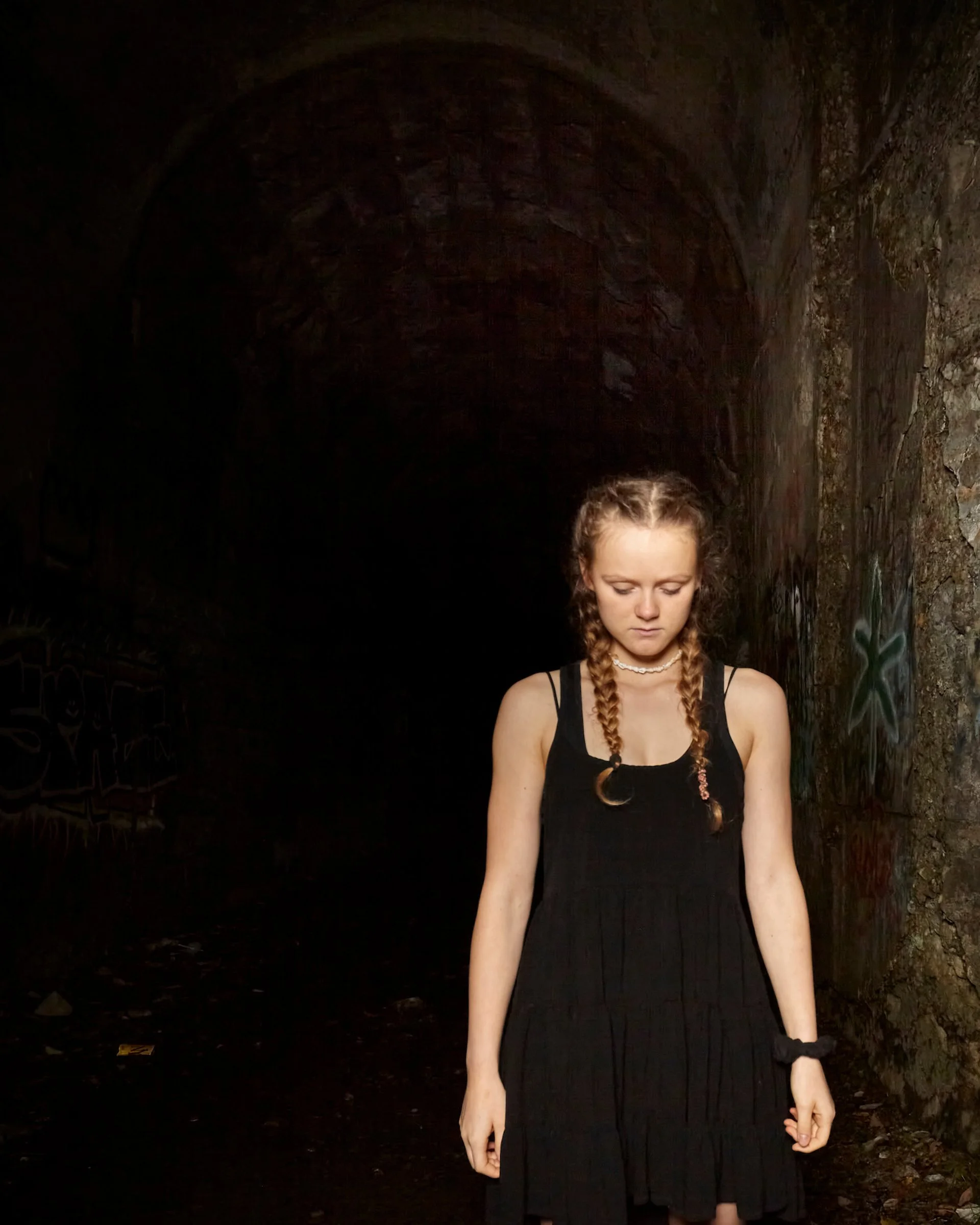
Screaming Tunnel After Midnight, Niagara Region @Solomon D Crowe
A solitary figure stands at the threshold of the Screaming Tunnel in Ontario’s Niagara region—an ordinary limestone underpass turned cultural landmark by one of the area’s most enduring legends.
There are places that scare you because they’re loud—because something jumps, or shrieks, or chases. And then there are places that scare you because they refuse to perform. They don’t lunge. They don’t move. They just wait, calmly, like a closed door you can’t stop staring at. The Screaming Tunnel—tucked into the Niagara region’s quiet backroads—belongs to the second category. It doesn’t need theatrics. It doesn’t need special effects. It doesn’t even need a story to be unsettling, though it has one of the most persistent stories in Canadian folklore. What it needs is time. And a little less light than you’re used to. When the hour runs late and the countryside goes still, the tunnel becomes something else entirely: not a landmark, not a curiosity, but a physical sensation—darkness with weight, darkness you swear has texture.
That’s what people mean when they say the darkness there is “thick.” It’s not a metaphor you reach for to sound poetic. It’s a description of how your body reacts when your eyes stop being useful. The night presses in, and the tunnel doesn’t give you the comfort of distance. It’s short enough to tempt you, close enough to feel manageable, but long enough to erase the world behind you the moment you commit. It’s a simple architecture—stone, a curve, an opening on either end—and yet it behaves like a threshold. You step toward it and the air changes. The sound changes. Your breath gets louder, as if the space is amplifying you on purpose. Whatever you brought with you—your thoughts, your confidence, your skepticism—suddenly feels like luggage you didn’t pack carefully.
The irony is that the Screaming Tunnel wasn’t built to be sinister. It wasn’t designed for ghost stories or midnight dares. It was infrastructure—practical, rural, almost forgettable. The tunnel sits off Warner Road and passes beneath railway tracks in Niagara’s northwest corner, a limestone underpass often described as roughly 125 feet long and built to move water and people safely under the line. Over time, it became a conduit for the everyday—farmers, fields, drainage, seasons—until it also became a conduit for something less measurable: a local legend that refuses to die. Even its geography has a liminal quality. It’s frequently associated with Niagara Falls, yet some references place it in Niagara-on-the-Lake, and the story seems to live right in that blur where municipal boundaries stop mattering and the region itself becomes the point.
And then there is the story—the one that clings to the stone like humidity. In the most widely repeated version, a young girl is said to have been caught in a nearby fire and did not survive; her screams are what people claim still echo inside the tunnel. As with most enduring folklore, details shift with each telling. Some versions are vague, some are darker, and many are impossible to verify. Even sources that share the legend are careful to note that it’s a legend—part of Niagara’s oral culture, not a documented case file. The ritual attached to it—the dare people talk about, involving a match and a gust of wind—is less important than what it represents: a human attempt to make the unknown measurable, to press a button and demand a response from the dark. The tunnel, however, keeps its power either way. Belief isn’t required. All you need is the moment when your eyes adjust and still can’t find anything to trust.
The reason the place “works” has as much to do with the body as it does with myth. Darkness is not merely the absence of light; it’s the absence of information. The brain hates that. When vision goes soft, the mind compensates by scanning for threat in every other channel—sound, temperature, vibration, proximity. In a tunnel, those channels compress. Small noises become bigger. Footsteps come back at you. Distance collapses. And because the space is curved and enclosed, you can’t easily map it with a glance the way you would an open road. You have to move to understand it, which means your body becomes the measuring instrument, and suddenly fear is no longer a thought—it’s a pulse in your wrists, a tightening in your throat, a sense that the air is closer than it should be. That’s why people describe the darkness there as something you can feel. It’s the weight of uncertainty pressing down on the most ancient part of you: the part that evolved to survive nights without streetlights.
What makes the Screaming Tunnel especially potent is where it lives—within a region that sells brightness. Niagara, in the popular imagination, is water and spectacle, honeymoon lights, postcards, chandeliers of mist. The Falls dominate the narrative, and everything else is treated as an accessory. But drive a few minutes into the edges—past vineyards and backlots and rail lines—and the region changes character. The glamour fades, and you begin to see the Niagara that existed before souvenir shops: rural, working, quiet, stitched together by roads that feel older than your phone. This is where the tunnel sits, and that contrast matters. It’s a shadow-story inside a bright economy. It reminds you that most places are not one thing. They contain multiple realities, layered like sediment—tourism and agriculture, modern traffic and 19th‑century rail logic, daytime charm and nighttime unease.
That layered reality is part of why the tunnel keeps getting rediscovered. In recent years it’s been folded into the wider ecosystem of Niagara folklore—ghost tours, travel blogs, lists of “most haunted” stops—turning a drainage underpass into a destination. The Niagara Falls Public Library calls the haunting one of the region’s most enduring legends, anchoring it as local heritage even while acknowledging its folkloric nature. Sites that curate oddities and offbeat travel have also helped cement its reputation beyond Ontario, framing it as a place where story and geography fuse. And it appears in roundups that market the Niagara region’s haunted identity, a kind of shadow itinerary that runs parallel to wine routes and waterfall viewpoints. In other words, the tunnel has become a modern artifact: an old structure given new currency by the way we share experiences now—through lists, pins, posts, and the irresistible language of “you have to see this.”
Yet the tunnel isn’t just a social-media prop. It’s also a case study in how folklore attaches to infrastructure. Think about the kinds of places that attract legends: bridges, tunnels, stairwells, abandoned corridors, underpasses—spaces designed for passage, not for staying. They’re inherently transitional, and that makes them psychologically unstable. They don’t belong to anyone in the way a house does. They’re public but not social. Functional but not warm. A tunnel, especially, is a place where you are briefly removed from context—no horizon, no skyline, no easy sense of orientation. In that brief removal, the mind fills in blanks. A story doesn’t need to be true to be powerful; it only needs to be available at the exact moment your senses feel unsure. Folklore is often less about what happened than about what people fear might happen when they are alone with their imagination.
The Screaming Tunnel’s cultural afterlife even reaches beyond tourism. It has been noted as a filming location—most famously connected to David Cronenberg’s 1983 adaptation of Stephen King’s The Dead Zone, a detail that adds another layer to its mystique. That kind of association matters because it turns the tunnel into a visual shorthand: a place that “reads” as eerie even before you know its name. Cinema, like folklore, trades in atmosphere. It borrows locations that already feel charged and amplifies them for the screen. The result is a feedback loop: the place becomes famous because it feels cinematic, and then it feels more cinematic because it becomes famous. The tunnel is no longer only a tunnel. It’s a set, a legend, a dare, a marker on a map, a story that lives in people’s mouths.
Still, the most interesting question isn’t “Is it haunted?” The more revealing question is: Why are we still looking for places like this? In an era where so much of life is backlit—screens, signs, LED everything—true darkness is increasingly rare. We can banish night with a swipe. We can fill silence with a podcast before it has a chance to settle. We can keep ourselves permanently entertained, permanently distracted, permanently buffered from the raw texture of being alone with our thoughts. And then, sometimes, we seek out the opposite. We drive to the edge of a region we think we know. We stand before a small stone opening that promises nothing but a brief passage through uncertainty. We do it because some part of us is tired of curated experiences and wants something that can’t be controlled, something that doesn’t care about our timeline. A tunnel doesn’t adapt to you. You adapt to it.
If you do visit the Screaming Tunnel—or any site like it—the most meaningful approach is not conquest. It’s respect. Not because the place demands superstition, but because it sits at the intersection of public space, private emotion, and local story. Legends often involve tragedy, and even when the details are unverified, the human impulse behind the story is real: people trying to give shape to loss, fear, and memory. Sources that share the legend regularly emphasize its status as lore rather than confirmed history, which is a useful reminder to hold the story with care. Respect also means practical wisdom: staying legal, avoiding trespass, and not turning a rural location into a problem for the community that lives around it. Haunted places become less compelling when they’re treated like disposable content. They endure when they’re treated like cultural weather—something that belongs to the landscape and deserves to be approached gently.
In the end, the Screaming Tunnel is not a lesson in ghosts so much as a lesson in perception. After midnight, in a place where the darkness feels thick enough to touch, you start to understand how little control we actually have over our instincts. The tunnel doesn’t have to prove anything. It simply offers a moment where you can’t outthink your body. And that moment is strangely clarifying. It reminds you that fear is not always an enemy; sometimes it’s a signal that you are paying attention, that you are present, that you are alive in a way that daytime rarely demands. You step back out into the open and the world feels larger—not because you saw something supernatural, but because you briefly re-entered a relationship with the unknown. Niagara’s brightest attraction will always be the Falls, but some of its most unforgettable experiences happen far from the lights, in places where the story is not a performance. It’s a quiet agreement between stone, night, and the human mind.
Where Québec Begins: Place Royale and the Quiet Power of Origins
In Place Royale, Old Québec’s story becomes physical: a small Lower Town square where the outline of Champlain’s 1608 “Abitation” is marked beneath your feet, and Notre-Dame-des-Victoires still stands as a testament to endurance. A travel feature about origins, restoration, and why this compact square remains one of the most meaningful places to begin a Québec City journey.
Where the Street Turns Into a Story — Old Québec @Solomon D Crowe
A cobblestone lane in Québec City’s historic quarter opens onto a towering trompe‑l’œil mural that blurs the boundary between present-day street life and the city’s layered past. Visitors move through the scene at walking speed—pausing, pointing, drifting—while stone walls, old façades, and greenery frame the feeling that Old Québec doesn’t simply show history; it lets you step into it.
Old Québec has ramparts and cliff-top views that photograph like certainty. But the city’s deepest story lives below—where Place Royale, a small square in Lower Town, holds an origin you can still walk across.
The descent to the beginning
Old Québec rearranges your sense of scale the moment you start moving downhill. Up in Upper Town, history feels composed—gates and walls, lookout points, the disciplined geometry of a city built to endure. Then you descend toward the river and the tone changes. Streets narrow. Sound becomes intimate. Stone stops behaving like a monument and starts behaving like a surface people have had to live with—slippery in winter, uneven in rain, stubbornly indifferent to hurry. UNESCO’s description of the Historic District of Old Québec makes this split explicit: Upper Town sits on Cap Diamant while Lower Town grew around Place Royale and the harbour below, and together the district is recognized as a rare, intact example of a fortified colonial city in North America. That matters for travelers because it explains why the city doesn’t feel like a single attraction—it feels like a complete organism with two different temperatures: the elevated, ceremonial city above, and the working, river-facing city below.
The Lower Town carries a different kind of authority. It doesn’t ask to be admired from a distance; it asks to be entered. The lanes were built for feet, carts, conversation—human-scale traffic long before cars and timetables. You feel the river’s influence even when you can’t see it yet: a cooler edge in the air, a faint metallic note, the sense that commerce and weather are never far away. It is easy to arrive in Old Québec looking for a “historic district” the way you might look for a museum. Place Royale, when you reach it, feels like something else: a room still in use. It holds its history without putting it on a pedestal, and it makes the past feel less like a display and more like a foundation.
1608, under your feet
Place Royale is often described as a beginning, but “beginning” can sound like a slogan until the details sharpen it into something physical. Québec City’s own heritage documentation calls Place Royale the site where Samuel de Champlain founded the settlement of Québec in 1608. What he built there is still described with the old spelling—an “Abitation”—a fortified complex that functioned as storehouse, trading post, and residence for the first colonists. This is where the square’s real power emerges: it doesn’t merely represent history; it stands on it. The space is small enough to feel personal, yet historically large enough to feel like a hinge point—one of those rare places where a continent’s story compresses into a few square metres of stone.
One of the square’s most disarming qualities is that it doesn’t keep this history at arm’s length. The Ville de Québec notes that archaeological digs revealed vestiges of Champlain’s outpost, and that the outline of the “abitation” is traced on the ground near the church. Not a theme-park reconstruction, not a loud reenactment—just an outline you can stand inside, a measurement of how small “the beginning” really was. You step across that line and feel, in your own body, how cramped a founding can be: how much can be decided in a footprint that would barely hold a modest apartment today. The outline turns history into something you can’t scroll past. It asks you to imagine the day-to-day pressures that founding dates usually conceal: provisioning, storage, defense, negotiation, fatigue, winter.
That outline also changes the visitor’s posture. You stop treating Place Royale as scenery and start treating it as a kind of civic proof—history that insists on being spatial. It’s a square that gently refuses the modern habit of floating through places without touching them. Here, the past is not a caption; it is a boundary line under your shoes.
Notre-Dame-des-Victoires: a church named for survival
If the outline underfoot is the square’s whisper, Notre-Dame-des-Victoires is its voice. Built in 1688 in Place Royale, the church is widely described as one of the oldest stone churches in North America and is closely tied to the site of Champlain’s early settlement. Its name—“Our Lady of Victories”—is not decorative branding. Parks Canada notes that it commemorates French victories over English attacks in 1690 and 1711. Even if you arrive without any interest in military timelines, the naming lands as something more universal: a community’s refusal to pretend endurance is accidental. “Victories” in a place like this doesn’t mean conquest as much as continuation—the stubborn ability to still be here.
Inside, the church carries the maritime imagination of a river city. Bonjour Québec describes the space as filled with maritime symbolism and votive offerings—evidence of people who have prayed with the St. Lawrence in mind: for safe crossings, for protection, for returns. That detail makes the church feel less like a museum piece and more like a living archive of gratitude and fear. The river has always been both opportunity and threat, a route for trade and a corridor for storms and uncertainty. You don’t need to be religious to understand what happens when a community lives beside water that can feed it and ruin it. People leave traces—names, promises, small offerings that say: we made it back.
Notre-Dame-des-Victoires also reframes Place Royale itself. The square outside can feel, at first glance, like a charming public room. The church reminds you it is also a site where civic identity and private lives have overlapped for centuries. Even if you are not religious, you understand the impulse at work: to anchor a fragile life to something that outlasts it, to mark the victories you survive, to make memory visible. When you step back out into the square, the stones feel heavier—not in a gloomy way, but in the way a well-made thing feels heavy: built to last, carrying more than it shows.
Fire, stone, and a king’s shadow
Place Royale’s beauty has never been effortless. In 1682, a major fire consumed the early wooden buildings of the settlement. The Ville de Québec notes the blaze; Québec’s heritage sources describe the practical response: owners were required to rebuild in stone, with common walls rising above the roofs as fire barriers. It’s an architectural detail with moral weight. The city literally built safety into shared structures—an early reminder that survival in dense communities is rarely an individual accomplishment. A fire doesn’t care whose property line is whose. It forces a city to think collectively, and the stone that tourists now admire as “historic character” started as a hard-edged civic lesson.
A few years later, the square acquired a different kind of construction: symbolism. The Ville de Québec explains that Intendant Jean Bochart de Champigny pursued the idea of a “royal square,” aligned with Louis XIV’s wishes, and installed a bust of the king. Merchants complained about losing space in front of their homes and shops. That small conflict keeps the story honest. It’s easy to imagine “royal squares” as pure ceremony; it’s harder—and more accurate—to picture real people arguing over frontage, foot traffic, and access. In one detail you can see how this place has always worked: big identity statements colliding with everyday logistics, history written in both ideals and irritations.
This is why Place Royale is more than a pretty square. It’s a compressed record of how cities become themselves: through catastrophe and response, through aspiration and argument, through the constant negotiation between public meaning and private need. Even the fact that Place Royale is described as Québec City’s only public square carries this sense of rarity and intention. A square is not empty space; it’s a decision to reserve a room for everyone, to keep it open, and to accept that a public room will always belong to competing uses—commerce, commemoration, loitering, celebration, silence.
Restoration, tourism, and the modern meaning of authenticity
The most modern chapter of Place Royale is not about the 1600s; it is about the 1960s and 1970s, when heritage became a deliberate act. The Québec government undertook a major restoration project to recover the district’s historic character and emphasize its symbolic role as the “cradle of French North America.” The Ville de Québec notes that restoration began in 1965 and that more than half of the buildings were rebuilt between 1960 and 1980. In other words: the Place Royale that moves people today is not only preserved; it is, in significant part, reconstructed—rebuilt with intention, using historical, architectural, and archaeological evidence to make the district legible again.
This is where Place Royale becomes unusually relevant to travel right now, because modern travel is full of authenticity anxiety. People want “the real thing,” and they worry that every famous destination has been turned into a set. Place Royale refuses easy answers. It has been restored, yes—but it has also been maintained, inhabited, and continuously reinterpreted. The district is beautiful because people decided it was worth saving, then did the work: historical research, careful rebuilding, long-term upkeep. The “real” thing here is not untouched perfection; it’s the seriousness of the effort to keep a place from disappearing.
That care comes with its own pressures. A restored district attracts visitors. Visitors create an economy. That economy can keep a place alive—and can also risk turning it into an experience that is always performing for outsiders. Place Royale lives in that tension, which is why it makes such a strong travel subject: it is a place where you can feel both the desire to preserve and the desire to profit, both the dignity of history and the seduction of packaging. If you’re writing a feature story, that double life is a gift. It gives you drama without manufactured controversy. It gives you beauty with systems underneath it. It gives you a place that is photogenic, yes—but also intellectually honest, because it shows its seams.
Visiting Place Royale like a ritual
The best way to experience Place Royale is to treat it less like a stop and more like a ritual of attention. Arrive early, before the square becomes a shared stage. Let your eyes adjust to its modest proportions. Stand on the outline near the church and register what it means that a founding story can fit inside a few measured lines. Step into Notre-Dame-des-Victoires and feel the temperature shift, the maritime symbolism, the evidence of people who turned fear into gratitude with votive offerings. Then come back out and simply stay long enough to watch the square do what public rooms have always done: gather strangers into a temporary community, for a minute, for a photo, for a conversation, for a quiet pause.
From there, let the Lower Town pull you outward without rushing you. Old Québec is famous for photogenic streets, but Place Royale is most rewarding when you use it as a baseline for a different kind of travel—one that prioritizes noticing over collecting. Pay attention to thresholds worn smooth. Notice how stone walls, rebuilt after fire, became both aesthetic and insurance. Notice how the square’s royal symbolism had to negotiate with merchants who needed their frontage. These are not trivia details; they are the mechanics of real life. They are what turn “history” from a wallpaper pattern into something you can actually learn from.
And then, as you climb back toward Upper Town, let the descent you made earlier play in reverse. UNESCO’s simple split—Upper Town above, Lower Town around Place Royale and the harbour below—stops being a description and becomes a way of understanding why the city feels so complete. Old Québec contains both the story it tells the world and the story it had to live to become that world-facing version. You leave Place Royale with more than a photograph. You leave with a recalibrated sense of what a beginning looks like: small, practical, vulnerable, and—if a community decides it matters—enduring.
That is the quiet power of this square. It doesn’t shout. It doesn’t need to. It holds its ground, and invites you to slow down enough to feel what it has been holding all along.