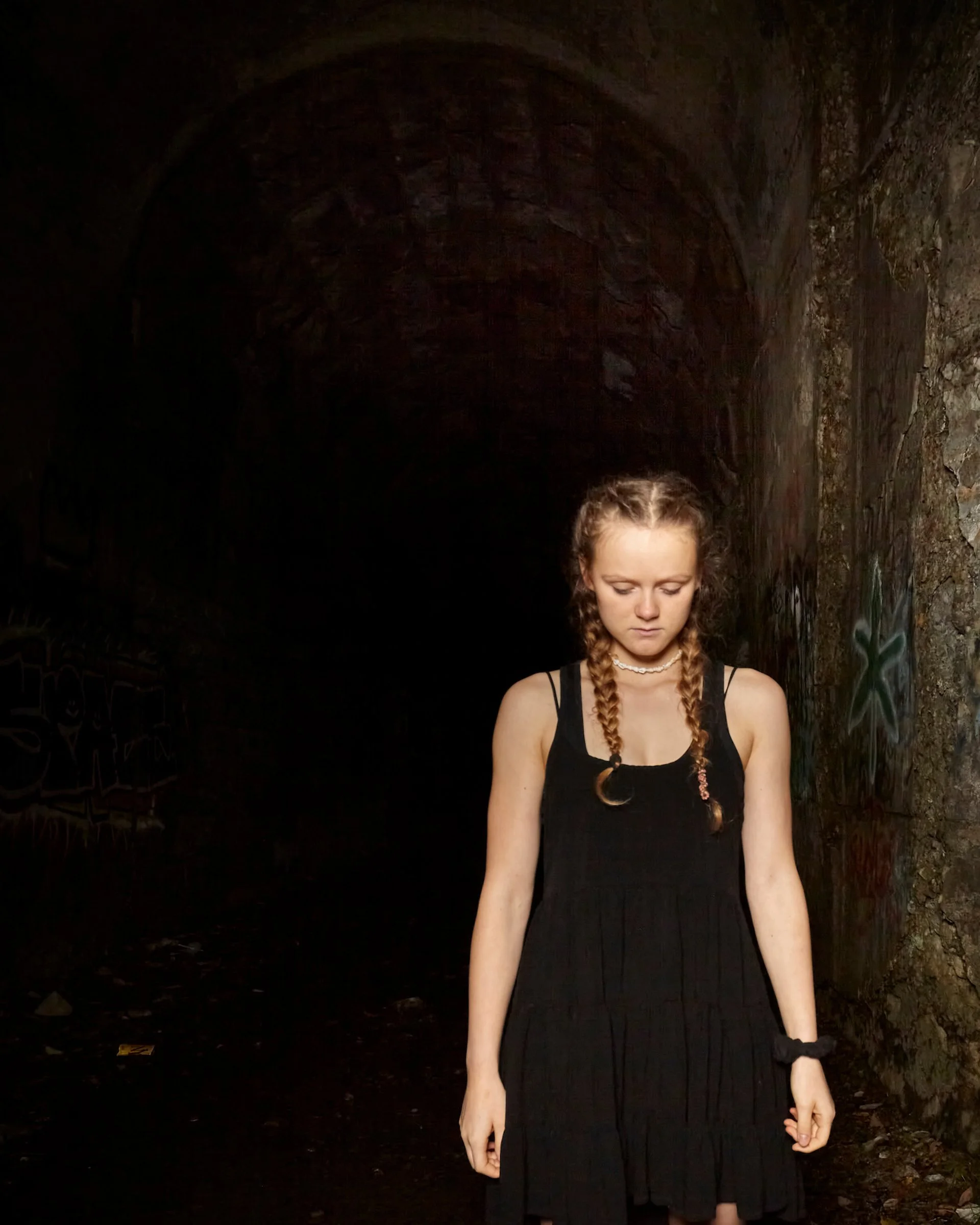
Screaming Tunnel After Midnight, Niagara Region @Solomon D Crowe
A solitary figure stands at the threshold of the Screaming Tunnel in Ontario’s Niagara region—an ordinary limestone underpass turned cultural landmark by one of the area’s most enduring legends.
There are places that scare you because they’re loud—because something jumps, or shrieks, or chases. And then there are places that scare you because they refuse to perform. They don’t lunge. They don’t move. They just wait, calmly, like a closed door you can’t stop staring at. The Screaming Tunnel—tucked into the Niagara region’s quiet backroads—belongs to the second category. It doesn’t need theatrics. It doesn’t need special effects. It doesn’t even need a story to be unsettling, though it has one of the most persistent stories in Canadian folklore. What it needs is time. And a little less light than you’re used to. When the hour runs late and the countryside goes still, the tunnel becomes something else entirely: not a landmark, not a curiosity, but a physical sensation—darkness with weight, darkness you swear has texture.
That’s what people mean when they say the darkness there is “thick.” It’s not a metaphor you reach for to sound poetic. It’s a description of how your body reacts when your eyes stop being useful. The night presses in, and the tunnel doesn’t give you the comfort of distance. It’s short enough to tempt you, close enough to feel manageable, but long enough to erase the world behind you the moment you commit. It’s a simple architecture—stone, a curve, an opening on either end—and yet it behaves like a threshold. You step toward it and the air changes. The sound changes. Your breath gets louder, as if the space is amplifying you on purpose. Whatever you brought with you—your thoughts, your confidence, your skepticism—suddenly feels like luggage you didn’t pack carefully.
The irony is that the Screaming Tunnel wasn’t built to be sinister. It wasn’t designed for ghost stories or midnight dares. It was infrastructure—practical, rural, almost forgettable. The tunnel sits off Warner Road and passes beneath railway tracks in Niagara’s northwest corner, a limestone underpass often described as roughly 125 feet long and built to move water and people safely under the line. Over time, it became a conduit for the everyday—farmers, fields, drainage, seasons—until it also became a conduit for something less measurable: a local legend that refuses to die. Even its geography has a liminal quality. It’s frequently associated with Niagara Falls, yet some references place it in Niagara-on-the-Lake, and the story seems to live right in that blur where municipal boundaries stop mattering and the region itself becomes the point.
And then there is the story—the one that clings to the stone like humidity. In the most widely repeated version, a young girl is said to have been caught in a nearby fire and did not survive; her screams are what people claim still echo inside the tunnel. As with most enduring folklore, details shift with each telling. Some versions are vague, some are darker, and many are impossible to verify. Even sources that share the legend are careful to note that it’s a legend—part of Niagara’s oral culture, not a documented case file. The ritual attached to it—the dare people talk about, involving a match and a gust of wind—is less important than what it represents: a human attempt to make the unknown measurable, to press a button and demand a response from the dark. The tunnel, however, keeps its power either way. Belief isn’t required. All you need is the moment when your eyes adjust and still can’t find anything to trust.
The reason the place “works” has as much to do with the body as it does with myth. Darkness is not merely the absence of light; it’s the absence of information. The brain hates that. When vision goes soft, the mind compensates by scanning for threat in every other channel—sound, temperature, vibration, proximity. In a tunnel, those channels compress. Small noises become bigger. Footsteps come back at you. Distance collapses. And because the space is curved and enclosed, you can’t easily map it with a glance the way you would an open road. You have to move to understand it, which means your body becomes the measuring instrument, and suddenly fear is no longer a thought—it’s a pulse in your wrists, a tightening in your throat, a sense that the air is closer than it should be. That’s why people describe the darkness there as something you can feel. It’s the weight of uncertainty pressing down on the most ancient part of you: the part that evolved to survive nights without streetlights.
What makes the Screaming Tunnel especially potent is where it lives—within a region that sells brightness. Niagara, in the popular imagination, is water and spectacle, honeymoon lights, postcards, chandeliers of mist. The Falls dominate the narrative, and everything else is treated as an accessory. But drive a few minutes into the edges—past vineyards and backlots and rail lines—and the region changes character. The glamour fades, and you begin to see the Niagara that existed before souvenir shops: rural, working, quiet, stitched together by roads that feel older than your phone. This is where the tunnel sits, and that contrast matters. It’s a shadow-story inside a bright economy. It reminds you that most places are not one thing. They contain multiple realities, layered like sediment—tourism and agriculture, modern traffic and 19th‑century rail logic, daytime charm and nighttime unease.
That layered reality is part of why the tunnel keeps getting rediscovered. In recent years it’s been folded into the wider ecosystem of Niagara folklore—ghost tours, travel blogs, lists of “most haunted” stops—turning a drainage underpass into a destination. The Niagara Falls Public Library calls the haunting one of the region’s most enduring legends, anchoring it as local heritage even while acknowledging its folkloric nature. Sites that curate oddities and offbeat travel have also helped cement its reputation beyond Ontario, framing it as a place where story and geography fuse. And it appears in roundups that market the Niagara region’s haunted identity, a kind of shadow itinerary that runs parallel to wine routes and waterfall viewpoints. In other words, the tunnel has become a modern artifact: an old structure given new currency by the way we share experiences now—through lists, pins, posts, and the irresistible language of “you have to see this.”
Yet the tunnel isn’t just a social-media prop. It’s also a case study in how folklore attaches to infrastructure. Think about the kinds of places that attract legends: bridges, tunnels, stairwells, abandoned corridors, underpasses—spaces designed for passage, not for staying. They’re inherently transitional, and that makes them psychologically unstable. They don’t belong to anyone in the way a house does. They’re public but not social. Functional but not warm. A tunnel, especially, is a place where you are briefly removed from context—no horizon, no skyline, no easy sense of orientation. In that brief removal, the mind fills in blanks. A story doesn’t need to be true to be powerful; it only needs to be available at the exact moment your senses feel unsure. Folklore is often less about what happened than about what people fear might happen when they are alone with their imagination.
The Screaming Tunnel’s cultural afterlife even reaches beyond tourism. It has been noted as a filming location—most famously connected to David Cronenberg’s 1983 adaptation of Stephen King’s The Dead Zone, a detail that adds another layer to its mystique. That kind of association matters because it turns the tunnel into a visual shorthand: a place that “reads” as eerie even before you know its name. Cinema, like folklore, trades in atmosphere. It borrows locations that already feel charged and amplifies them for the screen. The result is a feedback loop: the place becomes famous because it feels cinematic, and then it feels more cinematic because it becomes famous. The tunnel is no longer only a tunnel. It’s a set, a legend, a dare, a marker on a map, a story that lives in people’s mouths.
Still, the most interesting question isn’t “Is it haunted?” The more revealing question is: Why are we still looking for places like this? In an era where so much of life is backlit—screens, signs, LED everything—true darkness is increasingly rare. We can banish night with a swipe. We can fill silence with a podcast before it has a chance to settle. We can keep ourselves permanently entertained, permanently distracted, permanently buffered from the raw texture of being alone with our thoughts. And then, sometimes, we seek out the opposite. We drive to the edge of a region we think we know. We stand before a small stone opening that promises nothing but a brief passage through uncertainty. We do it because some part of us is tired of curated experiences and wants something that can’t be controlled, something that doesn’t care about our timeline. A tunnel doesn’t adapt to you. You adapt to it.
If you do visit the Screaming Tunnel—or any site like it—the most meaningful approach is not conquest. It’s respect. Not because the place demands superstition, but because it sits at the intersection of public space, private emotion, and local story. Legends often involve tragedy, and even when the details are unverified, the human impulse behind the story is real: people trying to give shape to loss, fear, and memory. Sources that share the legend regularly emphasize its status as lore rather than confirmed history, which is a useful reminder to hold the story with care. Respect also means practical wisdom: staying legal, avoiding trespass, and not turning a rural location into a problem for the community that lives around it. Haunted places become less compelling when they’re treated like disposable content. They endure when they’re treated like cultural weather—something that belongs to the landscape and deserves to be approached gently.
In the end, the Screaming Tunnel is not a lesson in ghosts so much as a lesson in perception. After midnight, in a place where the darkness feels thick enough to touch, you start to understand how little control we actually have over our instincts. The tunnel doesn’t have to prove anything. It simply offers a moment where you can’t outthink your body. And that moment is strangely clarifying. It reminds you that fear is not always an enemy; sometimes it’s a signal that you are paying attention, that you are present, that you are alive in a way that daytime rarely demands. You step back out into the open and the world feels larger—not because you saw something supernatural, but because you briefly re-entered a relationship with the unknown. Niagara’s brightest attraction will always be the Falls, but some of its most unforgettable experiences happen far from the lights, in places where the story is not a performance. It’s a quiet agreement between stone, night, and the human mind.