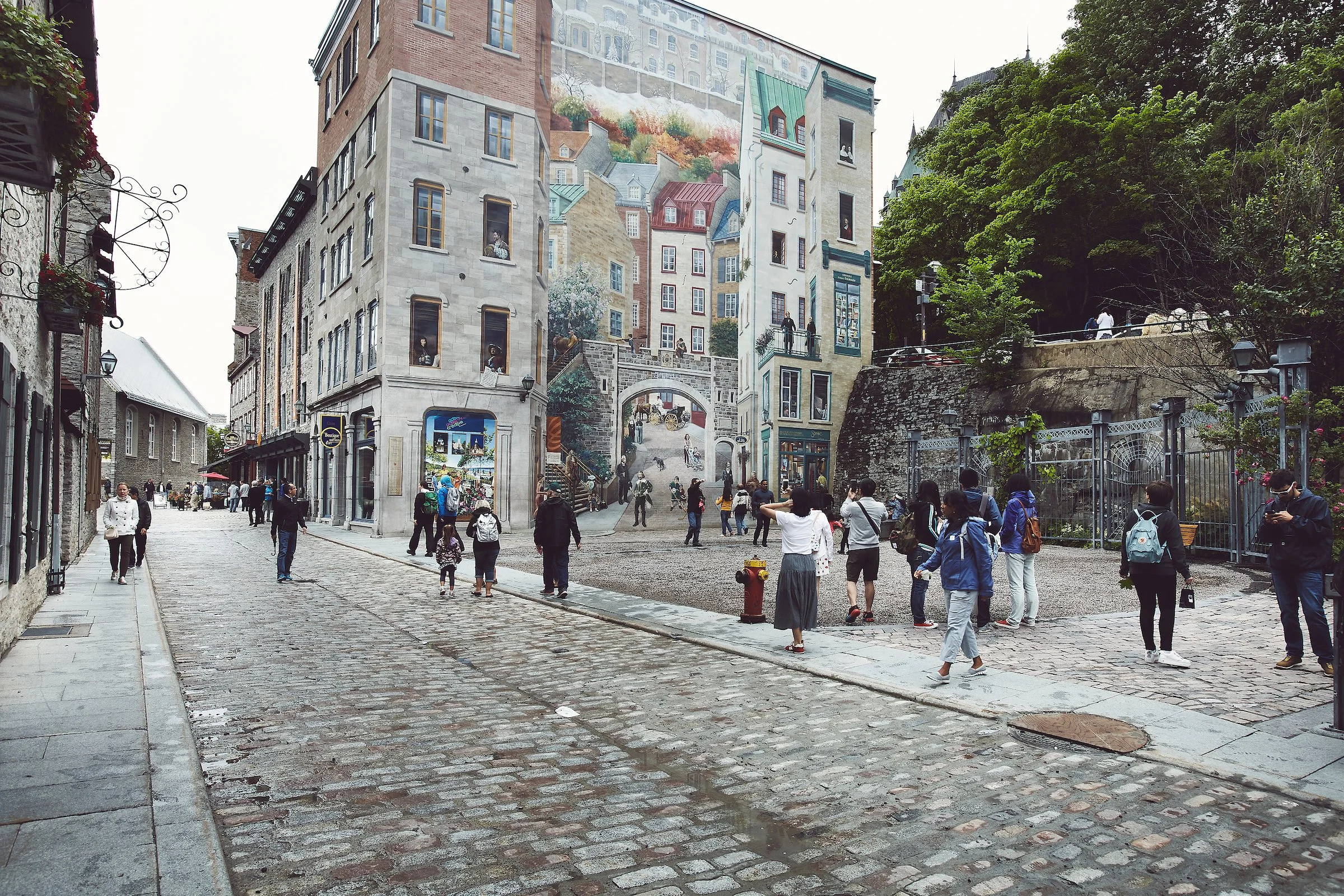
Where the Street Turns Into a Story — Old Québec @Solomon D Crowe
A cobblestone lane in Québec City’s historic quarter opens onto a towering trompe‑l’œil mural that blurs the boundary between present-day street life and the city’s layered past. Visitors move through the scene at walking speed—pausing, pointing, drifting—while stone walls, old façades, and greenery frame the feeling that Old Québec doesn’t simply show history; it lets you step into it.
Old Québec has ramparts and cliff-top views that photograph like certainty. But the city’s deepest story lives below—where Place Royale, a small square in Lower Town, holds an origin you can still walk across.
The descent to the beginning
Old Québec rearranges your sense of scale the moment you start moving downhill. Up in Upper Town, history feels composed—gates and walls, lookout points, the disciplined geometry of a city built to endure. Then you descend toward the river and the tone changes. Streets narrow. Sound becomes intimate. Stone stops behaving like a monument and starts behaving like a surface people have had to live with—slippery in winter, uneven in rain, stubbornly indifferent to hurry. UNESCO’s description of the Historic District of Old Québec makes this split explicit: Upper Town sits on Cap Diamant while Lower Town grew around Place Royale and the harbour below, and together the district is recognized as a rare, intact example of a fortified colonial city in North America. That matters for travelers because it explains why the city doesn’t feel like a single attraction—it feels like a complete organism with two different temperatures: the elevated, ceremonial city above, and the working, river-facing city below.
The Lower Town carries a different kind of authority. It doesn’t ask to be admired from a distance; it asks to be entered. The lanes were built for feet, carts, conversation—human-scale traffic long before cars and timetables. You feel the river’s influence even when you can’t see it yet: a cooler edge in the air, a faint metallic note, the sense that commerce and weather are never far away. It is easy to arrive in Old Québec looking for a “historic district” the way you might look for a museum. Place Royale, when you reach it, feels like something else: a room still in use. It holds its history without putting it on a pedestal, and it makes the past feel less like a display and more like a foundation.
1608, under your feet
Place Royale is often described as a beginning, but “beginning” can sound like a slogan until the details sharpen it into something physical. Québec City’s own heritage documentation calls Place Royale the site where Samuel de Champlain founded the settlement of Québec in 1608. What he built there is still described with the old spelling—an “Abitation”—a fortified complex that functioned as storehouse, trading post, and residence for the first colonists. This is where the square’s real power emerges: it doesn’t merely represent history; it stands on it. The space is small enough to feel personal, yet historically large enough to feel like a hinge point—one of those rare places where a continent’s story compresses into a few square metres of stone.
One of the square’s most disarming qualities is that it doesn’t keep this history at arm’s length. The Ville de Québec notes that archaeological digs revealed vestiges of Champlain’s outpost, and that the outline of the “abitation” is traced on the ground near the church. Not a theme-park reconstruction, not a loud reenactment—just an outline you can stand inside, a measurement of how small “the beginning” really was. You step across that line and feel, in your own body, how cramped a founding can be: how much can be decided in a footprint that would barely hold a modest apartment today. The outline turns history into something you can’t scroll past. It asks you to imagine the day-to-day pressures that founding dates usually conceal: provisioning, storage, defense, negotiation, fatigue, winter.
That outline also changes the visitor’s posture. You stop treating Place Royale as scenery and start treating it as a kind of civic proof—history that insists on being spatial. It’s a square that gently refuses the modern habit of floating through places without touching them. Here, the past is not a caption; it is a boundary line under your shoes.
Notre-Dame-des-Victoires: a church named for survival
If the outline underfoot is the square’s whisper, Notre-Dame-des-Victoires is its voice. Built in 1688 in Place Royale, the church is widely described as one of the oldest stone churches in North America and is closely tied to the site of Champlain’s early settlement. Its name—“Our Lady of Victories”—is not decorative branding. Parks Canada notes that it commemorates French victories over English attacks in 1690 and 1711. Even if you arrive without any interest in military timelines, the naming lands as something more universal: a community’s refusal to pretend endurance is accidental. “Victories” in a place like this doesn’t mean conquest as much as continuation—the stubborn ability to still be here.
Inside, the church carries the maritime imagination of a river city. Bonjour Québec describes the space as filled with maritime symbolism and votive offerings—evidence of people who have prayed with the St. Lawrence in mind: for safe crossings, for protection, for returns. That detail makes the church feel less like a museum piece and more like a living archive of gratitude and fear. The river has always been both opportunity and threat, a route for trade and a corridor for storms and uncertainty. You don’t need to be religious to understand what happens when a community lives beside water that can feed it and ruin it. People leave traces—names, promises, small offerings that say: we made it back.
Notre-Dame-des-Victoires also reframes Place Royale itself. The square outside can feel, at first glance, like a charming public room. The church reminds you it is also a site where civic identity and private lives have overlapped for centuries. Even if you are not religious, you understand the impulse at work: to anchor a fragile life to something that outlasts it, to mark the victories you survive, to make memory visible. When you step back out into the square, the stones feel heavier—not in a gloomy way, but in the way a well-made thing feels heavy: built to last, carrying more than it shows.
Fire, stone, and a king’s shadow
Place Royale’s beauty has never been effortless. In 1682, a major fire consumed the early wooden buildings of the settlement. The Ville de Québec notes the blaze; Québec’s heritage sources describe the practical response: owners were required to rebuild in stone, with common walls rising above the roofs as fire barriers. It’s an architectural detail with moral weight. The city literally built safety into shared structures—an early reminder that survival in dense communities is rarely an individual accomplishment. A fire doesn’t care whose property line is whose. It forces a city to think collectively, and the stone that tourists now admire as “historic character” started as a hard-edged civic lesson.
A few years later, the square acquired a different kind of construction: symbolism. The Ville de Québec explains that Intendant Jean Bochart de Champigny pursued the idea of a “royal square,” aligned with Louis XIV’s wishes, and installed a bust of the king. Merchants complained about losing space in front of their homes and shops. That small conflict keeps the story honest. It’s easy to imagine “royal squares” as pure ceremony; it’s harder—and more accurate—to picture real people arguing over frontage, foot traffic, and access. In one detail you can see how this place has always worked: big identity statements colliding with everyday logistics, history written in both ideals and irritations.
This is why Place Royale is more than a pretty square. It’s a compressed record of how cities become themselves: through catastrophe and response, through aspiration and argument, through the constant negotiation between public meaning and private need. Even the fact that Place Royale is described as Québec City’s only public square carries this sense of rarity and intention. A square is not empty space; it’s a decision to reserve a room for everyone, to keep it open, and to accept that a public room will always belong to competing uses—commerce, commemoration, loitering, celebration, silence.
Restoration, tourism, and the modern meaning of authenticity
The most modern chapter of Place Royale is not about the 1600s; it is about the 1960s and 1970s, when heritage became a deliberate act. The Québec government undertook a major restoration project to recover the district’s historic character and emphasize its symbolic role as the “cradle of French North America.” The Ville de Québec notes that restoration began in 1965 and that more than half of the buildings were rebuilt between 1960 and 1980. In other words: the Place Royale that moves people today is not only preserved; it is, in significant part, reconstructed—rebuilt with intention, using historical, architectural, and archaeological evidence to make the district legible again.
This is where Place Royale becomes unusually relevant to travel right now, because modern travel is full of authenticity anxiety. People want “the real thing,” and they worry that every famous destination has been turned into a set. Place Royale refuses easy answers. It has been restored, yes—but it has also been maintained, inhabited, and continuously reinterpreted. The district is beautiful because people decided it was worth saving, then did the work: historical research, careful rebuilding, long-term upkeep. The “real” thing here is not untouched perfection; it’s the seriousness of the effort to keep a place from disappearing.
That care comes with its own pressures. A restored district attracts visitors. Visitors create an economy. That economy can keep a place alive—and can also risk turning it into an experience that is always performing for outsiders. Place Royale lives in that tension, which is why it makes such a strong travel subject: it is a place where you can feel both the desire to preserve and the desire to profit, both the dignity of history and the seduction of packaging. If you’re writing a feature story, that double life is a gift. It gives you drama without manufactured controversy. It gives you beauty with systems underneath it. It gives you a place that is photogenic, yes—but also intellectually honest, because it shows its seams.
Visiting Place Royale like a ritual
The best way to experience Place Royale is to treat it less like a stop and more like a ritual of attention. Arrive early, before the square becomes a shared stage. Let your eyes adjust to its modest proportions. Stand on the outline near the church and register what it means that a founding story can fit inside a few measured lines. Step into Notre-Dame-des-Victoires and feel the temperature shift, the maritime symbolism, the evidence of people who turned fear into gratitude with votive offerings. Then come back out and simply stay long enough to watch the square do what public rooms have always done: gather strangers into a temporary community, for a minute, for a photo, for a conversation, for a quiet pause.
From there, let the Lower Town pull you outward without rushing you. Old Québec is famous for photogenic streets, but Place Royale is most rewarding when you use it as a baseline for a different kind of travel—one that prioritizes noticing over collecting. Pay attention to thresholds worn smooth. Notice how stone walls, rebuilt after fire, became both aesthetic and insurance. Notice how the square’s royal symbolism had to negotiate with merchants who needed their frontage. These are not trivia details; they are the mechanics of real life. They are what turn “history” from a wallpaper pattern into something you can actually learn from.
And then, as you climb back toward Upper Town, let the descent you made earlier play in reverse. UNESCO’s simple split—Upper Town above, Lower Town around Place Royale and the harbour below—stops being a description and becomes a way of understanding why the city feels so complete. Old Québec contains both the story it tells the world and the story it had to live to become that world-facing version. You leave Place Royale with more than a photograph. You leave with a recalibrated sense of what a beginning looks like: small, practical, vulnerable, and—if a community decides it matters—enduring.
That is the quiet power of this square. It doesn’t shout. It doesn’t need to. It holds its ground, and invites you to slow down enough to feel what it has been holding all along.