After the Ride @Solomon D Crowe
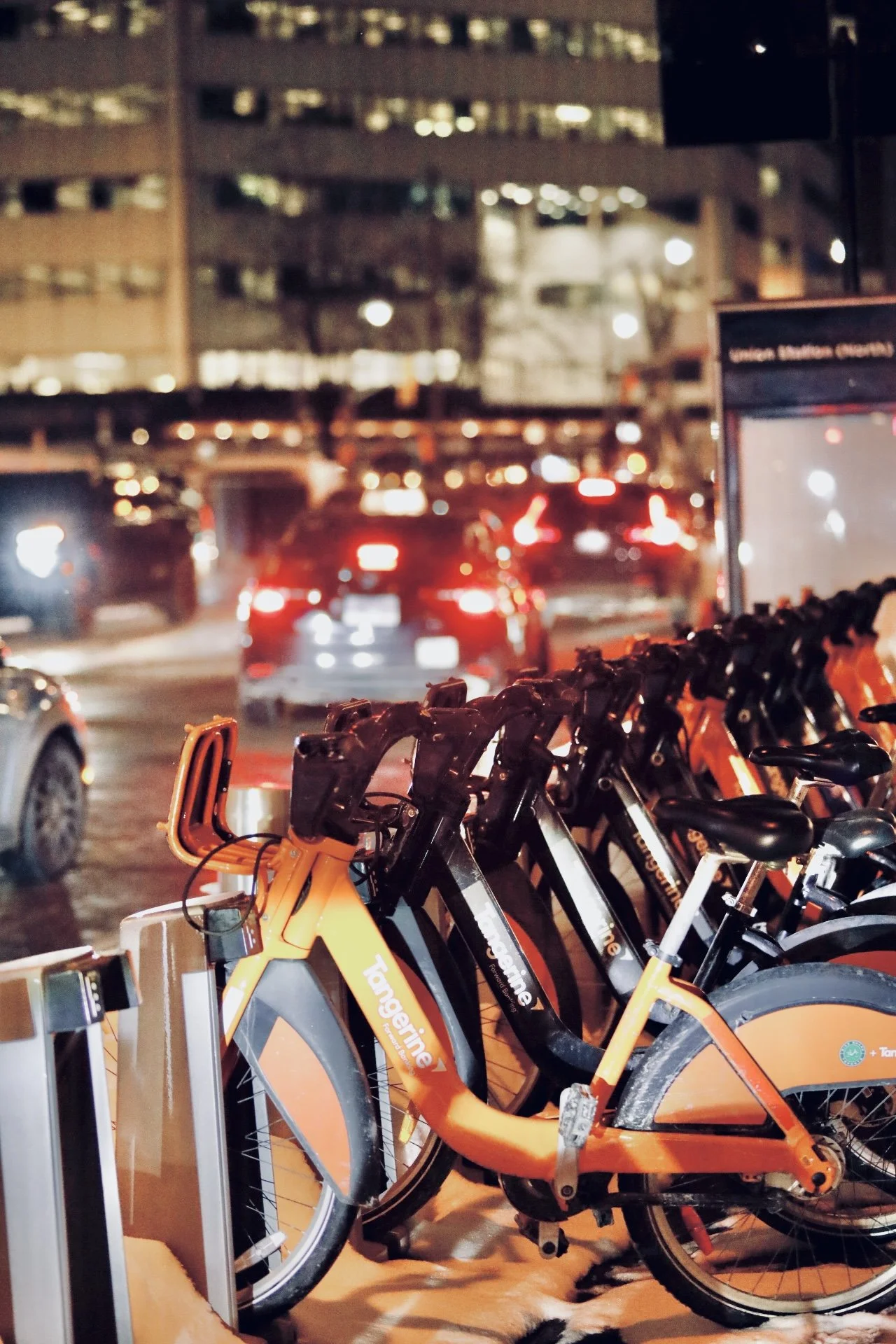
Bike Share Toronto bikes line a downtown station on a winter night—an everyday symbol of a city shifting from storing cars to sharing motion, and the unanswered question of what happens to shared fleets when they age out.
Toronto’s bike-share boom is changing how the city moves. The harder question is what happens when the boom becomes a backlog.
At street level, the future rarely arrives with a ribbon-cutting. It shows up quietly, in a row of identical bikes waiting under office lights, while traffic inches past and winter air turns every breath into something visible. In downtown Toronto, Bike Share stations have become as normal as crosswalk buttons—part of the city’s everyday machinery, a utility you don’t notice until you need it. One tap, one unlock, and the distance between “I’m stuck” and “I’m moving” collapses into a few minutes of rolling momentum. It’s the kind of convenience that feels inevitable the moment it works: why wouldn’t every city let people borrow motion the way they borrow Wi‑Fi?
But every “inevitable” urban trend has an afterlife. The first life is glossy: ads, apps, speed, the idea that friction can be rented away. The second life is quieter, less photographed, more expensive: maintenance yards, broken parts, battery storage, retirement schedules, and the slow realization that a city doesn’t just deploy mobility—it inherits it. That’s the question waiting behind the orange-and-black fleet lines across Toronto: not whether bike share is popular (it is), not whether e-bikes are coming (they are), but what happens when the craze cools, the hardware ages, and the curb becomes a storage problem instead of a solution.
The instinct is to reach for hyperbole—trillions of bikes—because the feeling is accurate even when the math isn’t. The real global number is still staggering. One of the most comprehensive public counts, the Meddin Bike‑sharing World Map 2024 report, estimates that as of the end of 2024 there were 9,278,605 shared bikes across 2,145 systems, spanning 1,700 cities in 92 countries. That’s not a niche mobility experiment; it’s a worldwide layer of infrastructure—millions of frames, wheels, docks, locks, chargers, screens, bolts, brackets, and increasingly, lithium‑ion batteries. Even if the boom never “ends” in a dramatic way, these systems will still cycle through generations of equipment. Bikes wear out. Technology changes. Contracts shift. Operators consolidate. The question isn’t if there will be an afterlife; it’s whether cities plan for it while the ride is still fun.
Toronto, for the moment, is still in the fun phase—because the numbers keep going up. City reporting on cycling in 2024 described Bike Share Toronto milestones that read like a market report: 6.9 million trips in the year, with 1.1 million e‑bike trips (up from roughly 400,000 the year before), and a 35,000‑trip daily record in September 2024. That’s not a fad; that’s a behavioural shift. And the planning documents suggest the city expects the shift to deepen. A 2030 growth strategy briefing projected that in 2025 Bike Share Toronto would operate 1,060 stations and 10,251 bikes, including 2,319 e‑bikes, with ridership on track for 8.1 million trips—the highest in program history. The system is expanding precisely because it’s being used, and because in a city where traffic is relentless and transit can feel crowded or delayed, a bike is a rare thing: individual speed in public space.
What makes Toronto’s story more interesting than a simple “bike share is growing” headline is who runs it. Bike Share Toronto is operated by the Toronto Parking Authority—the same municipal organization behind Green P parking. The Toronto Parking Authority’s own reporting frames its job as connecting people to mobility services through tens of thousands of parking spaces, EV charging, and a large bike share network. In other words: the agency that monetizes the right to stop also operates one of the city’s strongest tools for moving past stopping altogether. Toronto, in miniature, is learning to hold two truths at once: cars still matter, parking still funds things, and yet the street is too valuable to belong to one mode. Bike share is part of the city’s attempt to give the curb a second purpose—less storage, more circulation.
And yet, history has a way of reminding cities that circulation can turn into accumulation if growth outpaces stewardship. The cautionary tale is not theoretical. In the late 2010s, images from China became the global symbol of dockless micromobility’s worst-case scenario: vast impound lots, mountains of abandoned bikes, fields of metal that looked like an industrial-scale hangover after a venture-fuelled party. The Atlantic documented gigantic piles of impounded, broken, and abandoned bicycles—“bike graveyards”—that appeared after companies scaled too fast and cities struggled to regulate the flood. Other outlets chronicled the same phenomenon from different angles, describing how complaints, bankruptcies, and enforcement actions left cities sorting through the physical leftovers. The bikes became a form of urban archaeology: proof that “disruption” isn’t only a software story; it’s also a materials story. Steel and rubber don’t evaporate when a business model does.
Toronto is not on the same trajectory as those dockless oversupply disasters, and it’s important not to force a false equivalence. Bike Share Toronto is a docked system with planned station deployment and a public operator. The bikes are not being dumped into the city like confetti; they are being installed in a network designed to be counted, serviced, and rebalanced. That matters. It is exactly the kind of governance the Chinese “graveyard” era lacked. But the reason the graveyard precedent still belongs in a Toronto editorial is psychological: it places a bright warning sign at the end of the trend line. It asks, What is the lifecycle plan—before the fleet becomes old enough to become inconvenient? It asks, Who owns the afterlife: the operator, the city, the manufacturer, or the neighbourhood that wakes up one day with a pile of obsolete equipment?
Because the e‑bike shift raises the stakes. A pedal bike at end-of-life is a recycling and logistics problem. An e‑bike is a recycling, logistics, and safety problem—because now the most valuable and volatile component is a battery. Cities already treat lithium‑ion batteries as hazardous waste for good reason. Toronto’s own public safety guidance is blunt: lithium‑ion batteries should not be placed in garbage, recycling, or organics bins; they are considered household hazardous waste and should go to proper drop‑off depots or collection events. That’s written for household devices, but the principle scales: batteries require controlled handling, storage, and end-of-life pathways. As bike share electrifies, “what happens when this ends?” becomes “what happens to thousands of batteries when they age out?” This is the part of the story that tends not to trend—until something goes wrong.
The uncomfortable truth is that modern mobility has an invisible back room. On the street, the system feels simple: bikes appear, riders disappear, docks fill, docks empty. Behind the scenes, the system is a moving factory. Bikes get damaged. Parts fail. Wheels get knocked out of true. Locks jam. QR stickers peel. Winter salts metal in ways summer riders never notice. The station that looks full at midnight can be empty at 8 a.m. because demand is directional, tidal, predictable only in aggregate. And so the operator rebalances—trucks, staff, routing software, midnight shifts—moving bikes the way a grocery store moves inventory. It is labour and logistics that make “shared” feel effortless. That labour is also where end-of-life gets decided in practice: at the moment a technician marks a frame as “repairable,” “donor,” or “retire.”
This is where the “what do we do with all these bikes” editorial finds its emotional core. It’s not a doomsday piece about a trend collapsing. It’s a piece about stewardship in an age that treats hardware like an app update. Bike share’s magic is that it turns ownership into access: no storage in your condo, no repairs in your hallway, no theft anxiety if the system is robust. But the trade is that responsibility doesn’t disappear—it consolidates. Someone is still owning the problem, just at city scale. The question is whether Toronto—and cities watching Toronto—want that ownership to be intentional (planned retirements, recycling contracts, refurbishment cycles), or accidental (warehouses full of obsolete bikes, batteries stored because disposal is expensive, public frustration when bikes vanish overnight due to a failed contract or a financial shock).
Financial shocks are not hypothetical either—especially outside publicly operated systems. In the broader shared micromobility world, instability has been a recurring theme. NACTO’s 2023 shared micromobility reporting described bankruptcies and layoffs among private operators and noted that multiple cities in North America lost shared micromobility programs abruptly. That matters to this editorial even if Toronto’s system is structurally different, because it reveals a simple lesson: when a city relies on shared vehicles, end-of-life planning isn’t only an environmental ideal. It’s continuity planning. It’s “what happens to equipment and service if an operator changes, a contract ends, or a business model stops penciling out?” It’s making sure the public doesn’t wake up to missing bikes—or worse, abandoned ones.
So what do cities do, practically, when the boom becomes a backlog? The answer is not one thing; it’s a hierarchy of outcomes, and the best cities aim high on the ladder.
At the top is repair and redeployment—the quiet workhorse of circularity. A system that can replace key parts quickly, standardize components, and keep frames on the road longer reduces waste and lowers total cost. This is where “design for repair” stops being a slogan and becomes procurement criteria: modular components, easy-to-service drivetrains, predictable fasteners, durable coatings, and inventory strategies that don’t rely on rare parts. A bike share system can be built like a consumer product meant to be replaced, or like civic equipment meant to be maintained. The difference shows up years later, not on launch day.
Next is secondary use—the pathway most people never see. Bikes or components that no longer meet fleet standards can still have life in training programs, community repair shops, or controlled resale channels—if the operator designs a safe and ethical exit route. This is where the editorial can be honest without being alarmist: reuse is not always simple, because liability and quality control are real. But a city that can clearly explain what happens to retired assets tends to earn more trust than a city where equipment simply vanishes.
Then comes materials recovery—recycling. This is where the story gets harder, because not everything is easy to recycle, and the economics can be brutal. Mixed materials, proprietary plastics, embedded electronics, and composite parts can turn “recycling” into “downcycling” or landfill. Which is why the editorial shouldn’t pretend there’s a clean ending unless the city demands one up front. Circularity is most effective when written into contracts: minimum recycled content, take‑back obligations, disassembly standards, and reporting requirements that show how many bikes were refurbished, how many were scrapped, and where the batteries went.
Batteries deserve their own paragraph because they are the hinge between a bike-share boom and a waste-management nightmare. The good news is that battery take‑back and recycling pathways are becoming more visible. In 2025, Lime announced a partnership with Redwood Materials aimed at circular battery recycling for its micromobility batteries in multiple countries, framing it as a step toward keeping battery materials in circulation. Independent reporting described the same relationship in practical terms: batteries from e‑bikes and scooters sent for materials recovery of critical minerals. This is not a Toronto-specific program, but it matters as a model. It signals that “battery afterlife” is becoming a defined industry rather than an improvised cleanup. It also suggests what cities should start requiring as e‑bike fleets expand: documented recycling partners, chain-of-custody handling, and public transparency about end-of-life volumes.
And then there is the outcome nobody wants but every city must be designed to prevent: the graveyard. Not because Toronto is destined for it, but because graveyards happen when incentives reward rapid deployment and ignore retrieval, when contracts end without a transition plan, when enforcement and storage become reactive, and when the public pays for the leftovers in space, mess, and trust. The Atlantic’s bike graveyard images became a global symbol precisely because they were so physical: you could see, from the air, what “growth at all costs” looks like when the costs arrive. Cities don’t get graveyards because they wanted them. They get them because nobody priced in the ending.
A solutions-forward ending, then, isn’t a lecture. It’s a set of practical choices that can be made while the bikes are still new enough to feel like progress.
First: procure for the afterlife, not the launch. If a city is buying or contracting for thousands of bikes and batteries, the contract should require end-of-life plans the way buildings require fire exits. Who takes the bikes back? Who pays for recycling? What percentage must be refurbished versus scrapped? What reporting is required? What happens if an operator changes? These are not ideological questions; they’re operational ones.
Second: design for repairability and modular upgrades. The future isn’t just “more e‑bikes.” It’s a rolling cycle of upgrades: better batteries, better motors, smarter locks, new app interfaces. A system designed to swap modules can avoid retiring whole bikes just because a single subsystem is outdated. The environmental benefit is real, but the economic benefit is often what gets policy across the finish line: fewer total replacements, less storage, less disposal, less panic.
Third: build battery pathways into the city’s existing safety and waste infrastructure. Toronto already tells residents not to throw lithium‑ion batteries in the garbage and directs them to drop-off depots. The same clarity should exist for fleet batteries—publicly documented, auditable, and designed to prevent storage bottlenecks. The more e‑bikes a city deploys, the more the battery ecosystem matters: collection, safe transport, secure storage, and verified recycling.
Fourth: tell the truth in public. Trust is built when systems admit their lifecycle. If Bike Share Toronto is breaking records and expanding fast—and official planning suggests it is—then publishing a simple annual “afterlife report” becomes a powerful act: number of bikes refurbished, retired, recycled; number of batteries replaced and where they went; the average lifespan of a bike; what happens to docks and station hardware when locations change. Toronto already shares ridership milestones and growth strategy. The next step is making the lifecycle visible, so the system feels less like a magic trick and more like a civic service with accountability.
Finally: remember that the point is the street. Bike share is not a trend because bikes are trendy. It’s a trend because cities are crowded and people need options that make them feel capable again. The best mobility systems don’t end in a pile; they end in continuity. They build the city’s confidence that it can adopt new tools without being buried by old ones. That’s the real promise of the row of bikes under downtown lights: not just that they can get someone home faster tonight, but that the city can expand choice without leaving a scar on the curb when the next version arrives.
On a winter night, the bikes wait in a tidy line, as if order is easy. Traffic blurs past. Office windows glow. Somewhere a rider unlocks a bike, glides into the grid, and disappears into the city’s moving parts. That is the visible story. The invisible story is everything that happens later—when the bike comes back, when the battery weakens, when the frame gets retired, when the system upgrades, when a contract ends, when the city decides what happens to thousands of objects it once placed so confidently at the edge of the sidewalk. The editorial question isn’t whether the boom will end. The question is whether Toronto—and every city watching Toronto—wants its mobility future to be remembered for freedom… or for leftovers.