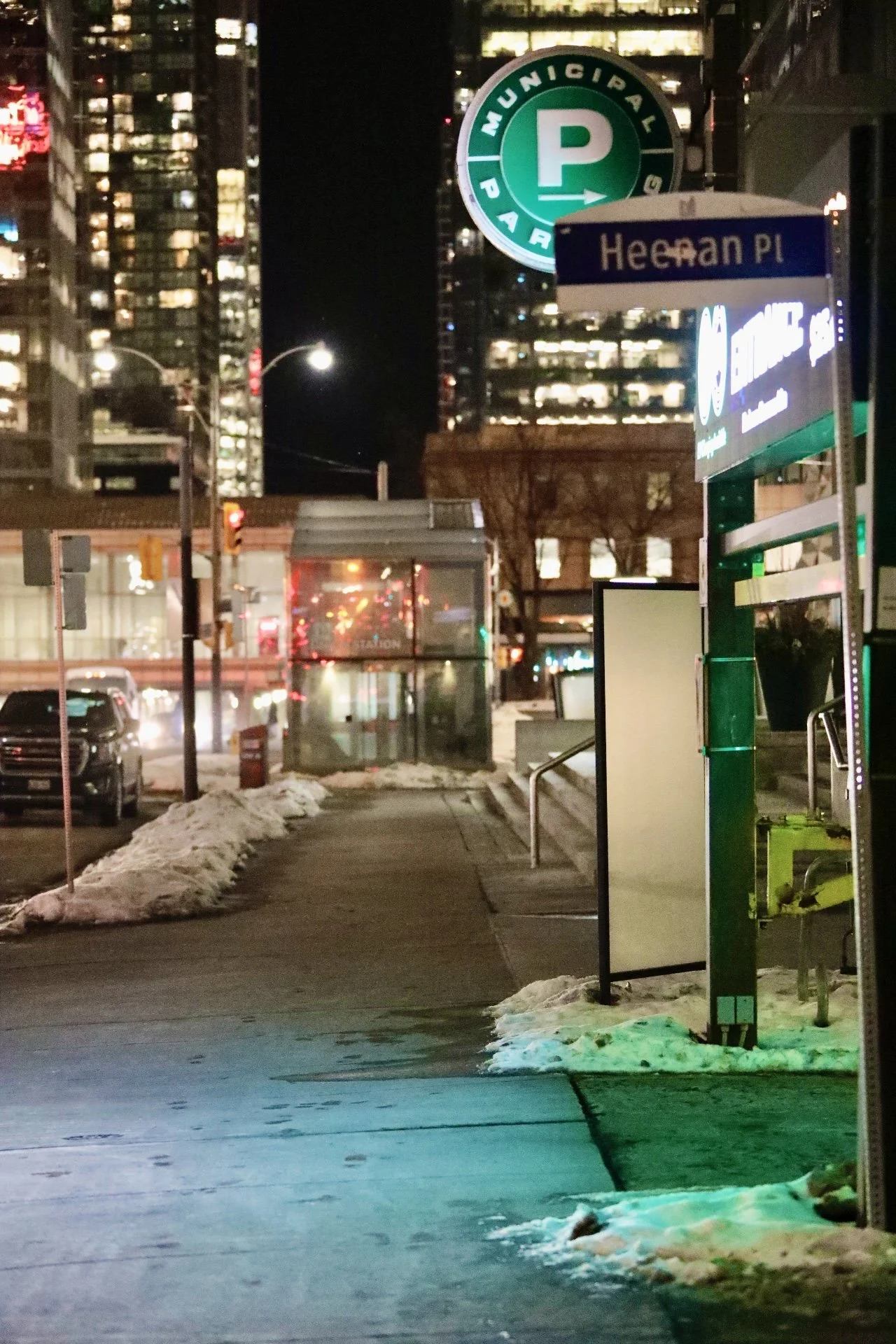
Green P, After Dark — Downtown Toronto @Solomn D Crowe
A Green P “Municipal Parking” marker glows above a winter sidewalk in downtown Toronto, where the simplest promise—a place to stop—has become a daily negotiation between time, technology, and the ever-tightening value of curb space.
There are cities that greet you with a skyline, and cities that greet you with a problem to solve. In downtown Toronto, the first handshake is often a steering wheel, the second is a slow scan for signage, and the third is an unspoken bargain: How much will you pay to be here—right here, right now—without moving? In winter, the bargain is louder. Snow narrows the street the way deadlines narrow a calendar. The curb becomes less a border than a battlefield of inches, and a glowing green “P” can feel like a lighthouse that doesn’t promise safety—only permission. Permission, in Toronto, is rarely free.
Parking is a mundane verb, but in a major city it behaves like a philosophy. It tells you what a place values, what it fears, and how it imagines the future. Toronto’s Green P isn’t just a sign; it’s an interface—between residents and visitors, between analog habits and app logic, between the city’s need for order and the human need for arrival. The Toronto Parking Authority (the agency behind Green P) sits at the intersection of mobility and money: it operates municipal on‑street pay-and-display parking and off‑street facilities, and it’s also the agency that runs Bike Share Toronto. The scale is not small: TPA describes a network of roughly 62,000 parking spaces—about 21.5K on‑street and 41K off‑street—plus EV charging and bike share infrastructure woven through the city’s daily movement.
That scale matters because it changes the emotional temperature of the debate. When someone complains about parking, it sounds like a personal grievance. But parking, at this scale, is a system—and systems have incentives. In 2023, TPA reported $143.6M in total revenue and $38M in net income, returning $31.9M to the City in dividends. In a city where budgets are always a tug-of-war, parking becomes more than a convenience; it becomes a revenue stream dressed up as a service. The 2025 operating budget notes a formal income-sharing arrangement—75% to the City / 25% retained by TPA—and projects $186.095M in revenue, driven by rate changes, transaction growth, and expansion in permits, EV charging, and bike ridership. A Green P sign, in other words, isn’t simply a direction—it’s a ledger entry waiting to happen.
This is why the conversation around downtown parking keeps returning, year after year, like traffic at rush hour. People don’t only resent paying. They resent uncertainty: the sense that they can do everything right and still get punished. They resent friction: the five minutes of circling that becomes fifteen, the small errand that becomes a minor odyssey. And they resent inconsistency: the feeling that the rules are changing mid‑sentence. That resentment is not abstract; it’s measurable in rate hikes, policy pilots, and the growing distance between what a city says it wants—less congestion, more transit, more walkability—and what it still funds with remarkable reliability: the right to occupy curb space.
By the end of 2024, Green P publicly framed new pricing as a mobility tool: rates “set to keep Toronto moving,” encourage turnover, and balance availability throughout the day. Beginning in January 2025, new Green P rates were scheduled to take effect across Toronto. Coverage of the proposed increases made the impact legible: a 25‑cent hourly rise on more than 21,600 metered spaces, with on‑street hourly rates already ranging high enough in dense areas to make an evening out feel like a meter is sitting at the table with you. Global News described the shift as the second metered-rate increase in two years, with most fees rising by 25 cents if approved, and outlined the way Toronto’s rates vary by zone—an invisible map of desirability and demand.
Rate increases are never just about numbers. They are about the story a city tells itself when it decides what scarce things should cost. Toronto’s case is especially telling because it’s not only increasing rates; it’s also modernizing how it collects them—and those two moves together create a particular kind of pressure. Pay more, and do it differently. If the price is the first shock, the method is the second. Toronto has been moving toward cashless and app-first payments for years, and the city’s own reporting shows the direction of travel: CityNews noted that Green P app usage grew from 49% in 2016 to more than 75% in 2023, with over 1.6 million subscribers, and projections toward 85% adoption by the end of 2025. That’s not a niche preference anymore; it’s the default interface for parking in large parts of the city.
The shift to mobile-only zones makes the trend feel like policy rather than preference. A one‑year pilot, approved by Council, introduced 13 “Mobile Only Zones” in downtown Toronto and North York—areas where app usage was higher and the supply of spots thinner. A smartphone becomes the new meter head. A QR code or “Text to Park” becomes the new quarter. For many people, that’s friction removed: no lining up behind someone feeding coins, no guessing whether a machine is broken, no sprint back to a windshield to avoid a ticket. But modern convenience has a shadow: exclusion. CityNews explicitly raised concerns about people without access to technology—older residents, lower‑income drivers, anyone whose phone is dead at the wrong moment—and it’s the kind of concern that turns a service upgrade into an equity question.
The irony is that, even as the city pivots toward mobile, it still spends heavily on the physical machinery of paid parking. CityNews reported that the Parking Authority was continuing to replace aging on‑street machines—$2 million spent to replace 225 machines, with thousands more to go and costs projected to escalate significantly—despite acknowledging that some machines were not generating enough revenue to cover operating and capital costs. The curb, in Toronto, is being asked to be two things at once: a modern, cashless platform and a legacy system built of metal boxes. That tension isn’t just bureaucratic—it’s what people feel when they arrive somewhere and discover the rules exist in two timelines.
And then there is the third pressure: trust. In a city this dense, the parking experience is often the first moment you hand your attention—and your money—to a system you can’t see. When that system fails, the resentment becomes personal quickly, because the failure feels like a trap. In July 2024, CityNews documented a very specific kind of failure: Green P location numbers posted incorrectly in Toronto’s Cabbagetown, leading to drivers receiving tickets even though they had paid through the app. This wasn’t someone overstaying the clock. It was a mismatch between the city’s signage and the app’s logic—a modern form of bureaucracy, where your receipt exists but the system disagrees with itself.
Once you understand that story, the Green P sign changes meaning. It’s no longer only a marker of availability. It’s a test of compliance. It asks: Did you choose the right zone? Did you type the right plate? Did the app reflect what the sign said? And if you fail—whether by mistake or by system error—the burden shifts to you to prove you were right. Green P itself advises drivers how to contest a violation when they have proof of payment—screenshots, email receipts, customer service contacts—because the system presumes disputes will happen and requires documentation to unwind them. In a city where time is already expensive, the dispute process becomes a second meter running in the background.
That dispute process is not a quick catharsis. The City of Toronto’s own parking-violation dispute page includes a line that reads like a quiet warning: “Current turn-around time is up to 10 months.” Ten months is long enough for a season to change twice, long enough for a person to forget what the night looked like when they parked, long enough for a small injustice to calcify into a story told at dinner parties and office kitchens. The point isn’t that every ticket is wrong. The point is that the emotional experience of enforcement is shaped as much by process as by outcome. When the process is slow, the system feels less like order and more like attrition.
Underneath the daily irritations—rates, apps, tickets—there is a deeper truth: the curb is one of the most valuable pieces of public real estate in Toronto. It must serve many masters at once. Drivers want it. Cyclists need it protected. Couriers treat it like oxygen. Transit vehicles require clear lanes. Accessible parking is not a luxury—it is basic dignity. A curbside management study prepared in the Toronto context describes a long list of competing curbside users—drivers, cyclists, pedestrians, couriers, taxis, transit, accessible services, hotels, emergency services—because the curb is where a city’s different modes of life collide at low speed. Parking isn’t just parking; it’s a proxy fight over who gets to touch the city easiest.
This is why downtown parking doesn’t merely frustrate. It produces a kind of low-grade civic anxiety. If you are late for dinner because you can’t find a spot, you blame yourself at first, then the city, then the idea of downtown itself. If you circle long enough, your frustration becomes indistinguishable from congestion. The city tries to solve congestion with pricing and turnover; the driver experiences pricing as punishment and turnover as pressure. Both sides are reacting rationally to scarcity. But the story most people live is not “scarcity management.” It’s “I’m paying more to feel less welcome.”
And yet, to tell the truth, there is another side—one that’s harder to hold in your hand but easier to see on a balance sheet. The Toronto Parking Authority is not a marginal operation; it’s a significant municipal business, and its financial performance is tied to how the city funds other priorities. A 2025 report to the TPA Board stated that net income for 2024 was $44.7 million, with total revenue at $165.6 million—described as a “historical high”—and noted that parking revenues reached 97.2% of pre‑pandemic (2019) levels as businesses adapt to hybrid work. Parking revenue, in other words, is part of Toronto’s post‑pandemic recovery narrative. Even if fewer people commute five days a week, the city still depends on the monetized “pause” to keep certain gears turning.
This is where gratitude can enter the frame—carefully, without pretending frustration isn’t real. People can be grateful that a city maintains parking inventory near hospitals, venues, and dense commercial corridors, or that municipal parking provides predictable options compared to private lots with surge pricing. They can be grateful that a public agency returns dividends to the city, or that the system is investing in modernization that reduces wasted time. The TPA annual report frames its mission in the language of “choice, ease, and speed” and points to the integration of parking with EV charging and bike share as part of a broader mobility network. If you zoom out far enough, Green P isn’t just a place to leave a car—it’s one node in a city’s attempt to choreograph movement.
But zoom back in, and the lived experience remains messy. Downtown Toronto is where private urgency meets public policy. The curb is where everyone’s plan collides with everyone else’s schedule. The reason Green P content performs well online—why people click, share, and argue about it—is that parking is one of the few municipal services most people encounter in a moment of stress. Nobody searches “Green P” when life is calm. They search it when they’re late, cold, lost, or furious. They search it when the city’s abstractions become tangible, when the price of being present is no longer metaphorical.
So if a Green P sign glows over a winter sidewalk, it’s doing more than advertising spaces. It’s broadcasting a question Toronto is still learning to answer: Who is downtown for, and how do we manage arrival without punishing it? Rate increases can be defensible; turnover is real; congestion is costly. Mobile payments can be smarter; the quarter economy is fading; receipts are easier to prove than memories. But trust must be earned with clarity, and clarity is built with signage that matches reality, processes that move at human speed, and technology that doesn’t turn honest mistakes into fines.
The best editorial angle isn’t “parking is bad” or “parking is necessary.” It’s that parking is a mirror—an unglamorous reflection of how a city treats time. Toronto is a city of ambition and velocity. It sells possibility in condos and careers and culture. And yet the smallest, most common transaction—the purchase of a pause—can still feel like a gamble. If Toronto wants downtown to be loved, not merely endured, it will have to treat the curb not as a cash register or a complaint factory, but as a public space that people share under pressure. The “P” will keep glowing either way. The only question is whether it feels like an invitation—or a warning.