Between Stops — TTC Winter Night @Solomon D Crowe
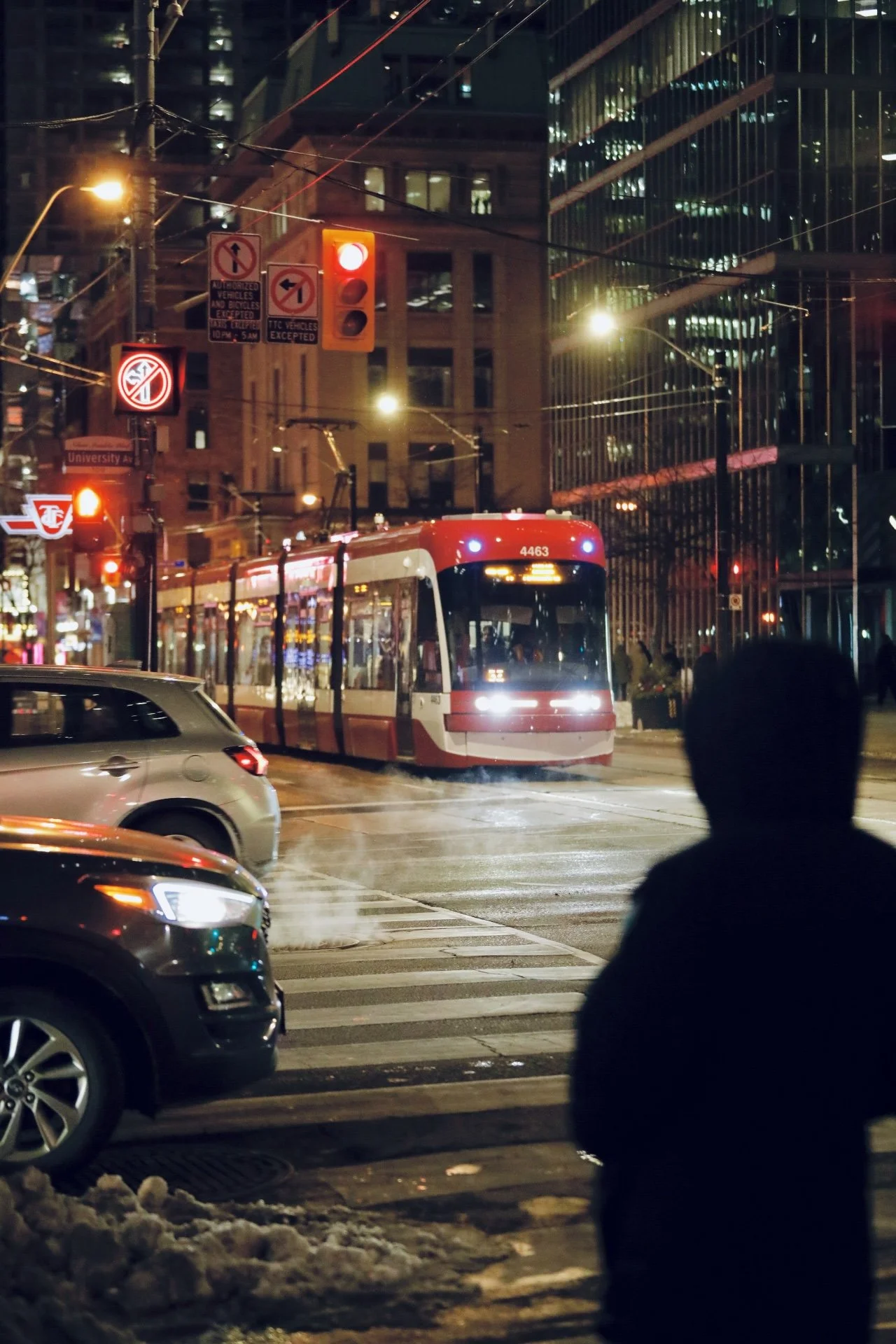
A TTC streetcar pauses at a downtown red light on a winter night—steam rising at street level and overhead wires tracing the city’s grid as Toronto’s shared rhythm waits, then moves.
Toronto’s winter streetcar, and the city’s race against its own clock
Toronto at night is a geometry lesson taught in light. Overhead wires stitch the sky into a grid; glass towers hold hundreds of private lives behind illuminated rectangles; traffic signals pulse like a heartbeat the whole downtown core can feel in its feet. Winter tightens everything. It sharpens the air, narrows the margins, turns the curb into a low ridge of snow that forces you to step where the city allows. And then a streetcar arrives and the scene becomes something else entirely—less like a commute, more like a ritual. Steel on rail, red-and-white bodywork sliding forward with the patience of a machine built for repetition. A pedestrian in a hood becomes a silhouette, paused at the edge of the intersection, the city’s human punctuation mark. Steam lifts from street level and the pavement shines with that particular wet gloss Toronto gets when snow has half-melted and refrozen into something between slush and mirror. The light is warm, but the night isn’t. The tension lives in that contrast: a city designed to move, temporarily held by a red signal, waiting for permission to continue.
The streetcar is where Toronto reveals its true scale—not the skyline scale, but the people scale. Subways disappear you; cars isolate you; streetcars put you on display, at street height, in the same weather as everyone else. That’s why a streetcar photo reads as instantly “Toronto” even to someone who can’t name the intersection: it’s the visible thread between neighbourhoods, the connective tissue the city still wears on its sleeve. The TTC itself describes a system that is quietly enormous: 11 streetcar routes spanning 308 km, carrying over 34.5 million streetcar trips in 2024. And those trips aren’t a footnote to the subway; they’re a major share of how Toronto actually works day to day. In 2024, the TTC reported roughly 204 million bus trips, 181 million subway rides, and about 35 million streetcar trips—a reminder that Toronto’s public life runs on surface movement as much as it runs underground. You can feel that truth in winter, when the city’s choices become physical. When you choose the streetcar, you’re choosing shared space and shared timing. You’re choosing to be part of the city rather than passing through it sealed behind glass. It’s not just transportation. It’s an agreement that, in a place as busy and expensive as this, public movement still matters.
But that agreement is fragile, because Toronto’s streetcars have always carried a contradiction: they’re high-capacity vehicles forced to behave like traffic. They glide on rails, yet they’re constantly negotiated by lanes, left turns, delivery trucks, and the endless micro-claims on curb space that add up to systemic delay. In the scene, the signage is doing what Toronto signage always does—trying to engineer order after the fact. Authorized vehicles. Exceptions. Restrictions. Rules layered on rules because the street is contested territory. The irony is that streetcars are supposed to be the “clean” answer to urban circulation—predictable, efficient, high throughput—and yet their biggest enemy is the same thing that clogs every other mode: congestion. That conflict is why the TTC’s streetcar corridors are such high-stakes streets. Look at the ridership on the major lines and the argument becomes obvious. The TTC’s own operating statistics show how heavily these routes are used: the 504 King corridor averages about 61,000 weekday boardings, while the Queen corridor (501/507/508 combined) sits around 42,000 on an average weekday (based on November 2024 data). These aren’t boutique tourist rides. These are working arteries—moving hospitality staff, office workers, students, families, night-shift workers, and everyone in between. When a streetcar is delayed, it isn’t just one vehicle behind schedule; it’s a ripple that touches thousands of evenings—late dinners, missed connections, extra money spent on alternative rides, and the slow erosion of trust that makes people decide they need a car they can’t really afford.
Toronto has experimented with how to protect the streetcar from the very street it runs on, and the most famous example is King Street. The King Street Transit Pilot began November 12, 2017 with a simple but radical proposition: stop letting through-traffic treat the streetcar’s path as optional. The results were not framed as ideology; they were framed as performance—what the corridor delivered when private automobile interference was reduced. City reporting on the pilot summarized the impact in plain language: faster, more predictable transit journeys, improved efficiency and reliability for streetcar operations, and more people taking transit in the corridor. If you want a story about “what works,” Toronto has already run the lab. The pilot showed that you don’t need a futuristic vehicle to improve a city; sometimes you just need to decide, in a specific place, that the movement of people outranks the convenience of cutting through. It also proved something deeper about Toronto: people will take transit when it behaves like a promise. When it’s reliable, when it doesn’t feel like a gamble, when it doesn’t punish you for trusting it.
And then the internet did what the internet does: it turned a system problem into a simple narrative almost anyone can understand. In the past year, a Toronto runner gained attention for outrunning streetcars, again and again, filming the races and turning the city’s slow points into shareable evidence. It’s viral because it’s absurd—and because it’s recognizable. Everyone who has stood at a cold stop watching a streetcar crawl forward in a line of brake lights understands the emotional math instantly: if a human being can beat the system on foot, the system is not operating at the dignity level a modern city should accept. The runner’s point—reported in mainstream coverage—wasn’t “hate the TTC,” but that streetcars lose time in the core because they’re forced to behave like cars: stalled by signals, blocked by turning vehicles, interrupted by the small chaos of downtown. Virality, in this case, isn’t shallow. It’s a blunt form of accountability. It collapses a complicated set of engineering issues—signal priority, lane design, enforcement, construction scheduling—into one undeniable image: a streetcar being beaten to the next stop by someone in running shoes.
The more interesting part is what happens after the meme. Toronto has begun translating that frustration into physical change you can see from the curb. One of the clearest examples is RapidTO, the city’s approach to transit-priority lanes and corridor improvements. On Bathurst Street, for example, the plan includes converting lanes to priority streetcar lanes using new signage, pavement markings, and red paint—an attempt to carve out space where transit can operate without being constantly interrupted by cars. This is not a glossy “smart city” fantasy. It’s paint, signs, and rules—unromantic tools aimed at a romantic outcome: making the city feel smaller, more navigable, less exhausting. And the urgency is being sharpened by a deadline Toronto can’t ignore. With the 2026 FIFA World Cup bringing global crowds and concentrated movement demands, reporting has highlighted plans to increase service so streetcars run roughly every five minutes during celebrations on key corridors, while the TTC works through concerns about whether the overhead power and infrastructure can support that level of ramp-up. Big events don’t create city problems; they reveal them under brighter light. When a city knows the world is coming, it stops tolerating bottlenecks it has normalized for years.
Fleet and frequency are the other side of the story—the part that doesn’t photograph as cleanly, but determines whether the beautiful night scene becomes a functioning network or a slow-motion frustration. In early 2026, the TTC marked the completion of a major streetcar procurement: 60 new streetcars delivered, bringing the fleet to 264 vehicles—a reported 30% increase intended to support more reliable, accessible service across the city. This matters in a winter-night editorial because you can feel the difference between a city that is “trying” and a city that is “equipped.” More vehicles, in theory, means less crowding, better headways, and less of the bunching phenomenon where you wait a long time and then three streetcars show up like a punchline. But equipment alone isn’t the whole fix. A streetcar fleet is only as effective as the infrastructure under it: track condition, overhead wire health, signal timing, and the city’s willingness to defend transit priority when the curb becomes a battleground. Toronto knows this, which is why so much transit improvement work looks less like a ribbon-cutting and more like invisible maintenance—overhead systems, intersections, and the unsexy systems that determine whether “every five minutes” is a promise or just optimistic copy.
That’s why this winter TTC scene lands as more than urban atmosphere. It’s a snapshot of Toronto’s central tension right now: a city growing faster than its patience. The streetcar at a red light isn’t just waiting for permission to go; it’s waiting for the city to decide what it values. Because every intersection is a values test. Who gets to move first: the largest vehicle carrying the most people, or the private vehicles that consume the most space? Who owns the curb: deliveries, ride-hails, parked cars, or transit stops that serve tens of thousands? How much public inconvenience is Toronto willing to tolerate in order to improve public movement for everyone? Those are governance questions, but they’re felt as human questions: How long will it take me to get home? Will I miss the connection? Will I be late again? Is this city still workable without buying my way out of it? Winter sharpens those questions because cold amplifies time. A five-minute delay on a mild day is annoying. A five-minute delay on a wet, freezing night is existential.
And then the light changes. The streetcar begins to roll. The hooded figure steps forward. The cars adjust, reluctantly, like they’re part of a choreography they didn’t choose but must obey. In that moment, Toronto looks less like a collection of competing lives and more like what it actually is at its best: a shared system, imperfect but capable, where strangers align for a few seconds to let the city function. That’s why streetcars remain such powerful travel imagery. For visitors, they’re a front-row seat to Toronto’s street-level life—neighbourhoods unfolding at human speed, storefronts and towers and street corners threading into a coherent map. For locals, they’re the city’s daily proof that public space can still work, even when it’s stressed, even when it’s cold, even when it’s late. The real editorial point isn’t that Toronto has a streetcar system. The point is that Toronto is still negotiating what kind of city it wants to be: one where movement is a privilege you purchase privately, or one where the shared option is fast enough, frequent enough, and respected enough to feel like the default. In winter, under wires and signal lights, that choice becomes visible. It sounds like steel on steel. It looks like a red-and-white streetcar moving forward—finally—through the downtown night.