Under the Marquee — Fairmont Royal York
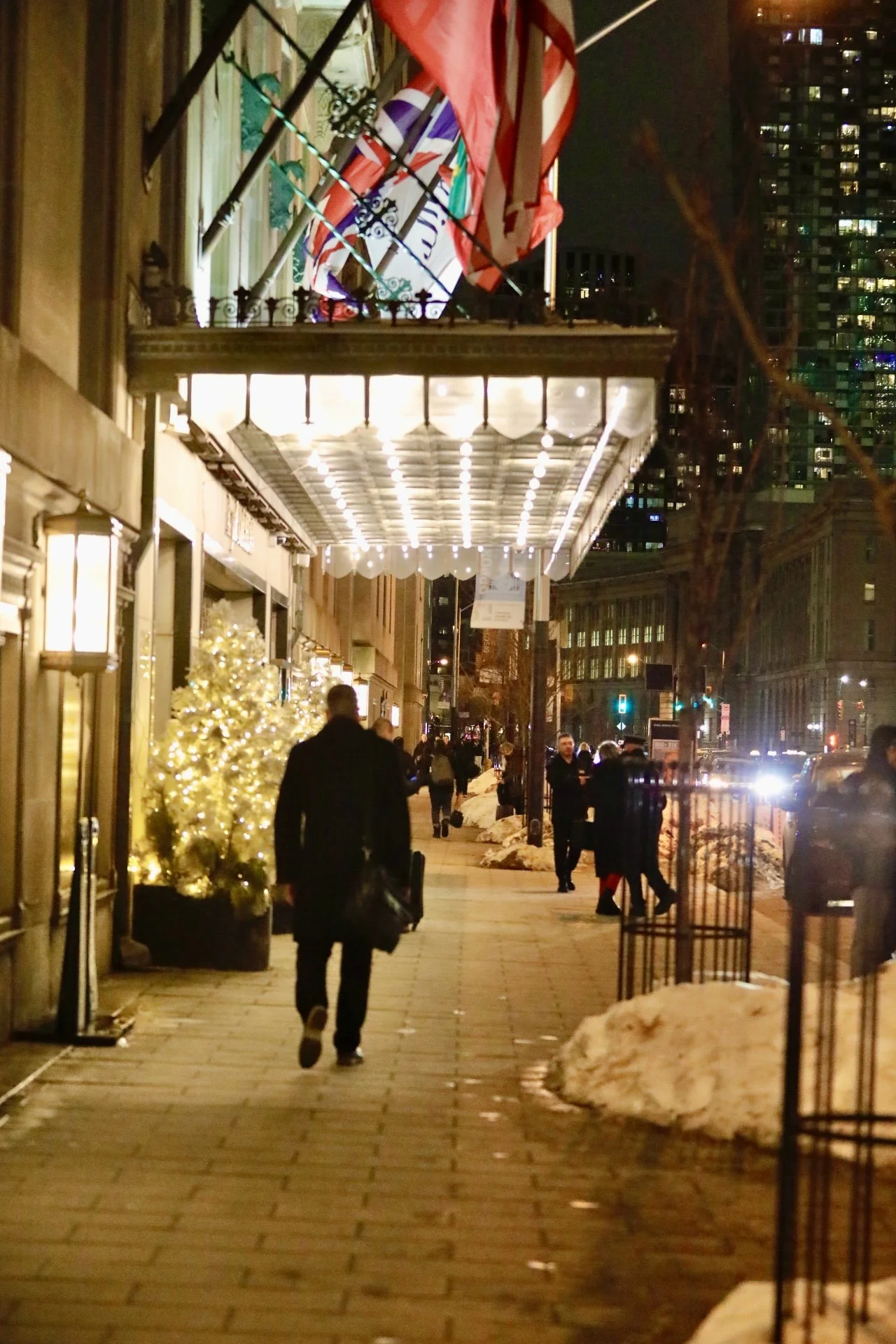
A winter evening on Front Street West, where the Royal York’s canopy lights turn downtown foot traffic into a scene of arrivals-warmth and movement framed in the city’s glow.
Fairmont Royal York, Toronto — and the winter ritual of arrival
Toronto in winter doesn’t greet gently; it announces itself. The air has edges. The sidewalks carry salt and refreeze and the kind of forward motion that makes even a casual walk feel like a commute. Then, right when the street starts to read as purely functional—cars, towers, headlights, deadlines—there’s a canopy of light that changes the entire tone of the block. Outside the Fairmont Royal York, the marquee doesn’t just illuminate the sidewalk; it curates it. People move differently under that glow. Pace softens. Coats loosen. The city’s constant hurry briefly becomes a procession, and for a few yards, Toronto feels less like a machine and more like a stage.
That’s the quiet genius of a great city hotel: it doesn’t simply provide rooms, it creates arrival. The Royal York has always been built around that idea. Long before “downtown lifestyle” was a marketing category, this was a landmark designed to meet the city at its most important threshold—where travelers entered Toronto’s core and needed the first impression to feel certain, capable, and a little grand. It’s why the building still feels perfectly placed: not hidden behind a courtyard, not tucked into a side street, but set directly into the city’s bloodstream, where movement is constant and where a single, well-lit doorway can make the whole metropolis feel legible.
The emotional power of the Royal York at night is that it offers warmth without drama and drama without noise. The flags above the entrance nod to internationalism in the simplest visual language possible, while the row of bulbs under the canopy does what excellent hospitality lighting always does: it flatters, steadies, calms. It’s not the kind of light that screams for attention; it’s the kind that says, you’re safe to exhale here. The lobby may be the famous interior, but the sidewalk is where the story starts—where winter makes everyone look slightly more alone, and the hotel counters with a human-scale glow that gathers strangers into the same scene.
This is what makes the Royal York such a strong subject for travel storytelling: it sits at the intersection of glamour and practicality. In a winter city, practicality matters. Boots, bags, late meetings, last trains, early departures—Toronto runs on schedules, and the streets don’t care how elegant anyone wants to feel. Yet the hotel insists on a different rhythm right at the door. It turns a quick pass-by into a moment worth noticing. It makes an ordinary city block feel like a threshold between two versions of Toronto—the one that works late and moves fast, and the one that still believes a night out should feel like an occasion.
A strong travel editorial doesn’t confuse “luxury” with excess. Luxury, in a city like this, is often control: a dependable entrance, a clear meeting point, a sense that the evening has structure even if the rest of the day didn’t. Under the marquee, the small rituals become visible: arrivals re-centering themselves before stepping inside, couples pausing to decide what the night will be, business travelers moving with that practiced stride that says they’ve done this a hundred times and still appreciate a door that works like a promise. The city beyond is glass and speed; the hotel edge is warmth and order, a place where the cold doesn’t get to dictate the mood.
And that’s the Toronto winter truth: the best nights aren’t only made by what happens inside venues, they’re made in the transitions—sidewalk to lobby, street noise to quiet, cold air to controlled light. The Royal York’s entrance is a masterclass in transition design. The canopy doesn’t simply cover; it frames. It doesn’t simply brighten; it invites. It doesn’t announce itself as “historic” or “iconic” in neon language. It lets the city do what it does, then gently edits the scene into something cleaner, softer, more cinematic.
By the time the block recedes behind you, what lingers isn’t a list of amenities or a brochure-perfect pitch. It’s the feeling that Toronto—so often defined by motion—has a few places that still know how to receive people. In winter, that matters more than ever. Anyone can build a tall building. Not every place can build a moment. The Fairmont Royal York does, night after night: a strip of light in a fast city, turning winter travel into something that feels, for a few seconds, like a classic.