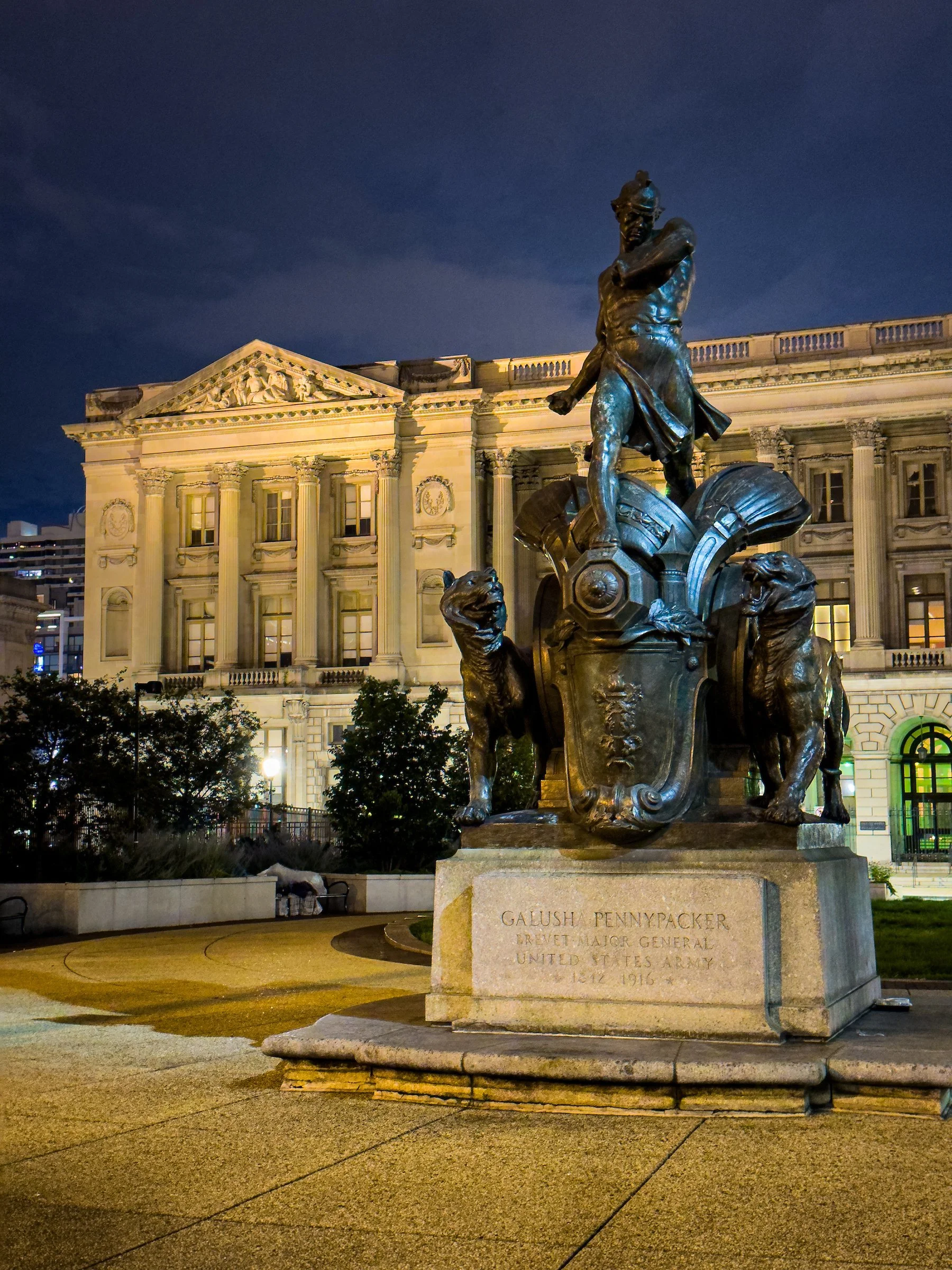
Blue Hour at Logan Square @Solomon D Crowe
The General Galusha Pennypacker Memorial (1934) stands near the Benjamin Franklin Parkway at Logan Square—bronze drama against a deepening Philadelphia sky.
A night walk at Logan Square, where Philadelphia turns its history into atmosphere.
Blue hour in Philadelphia doesn’t arrive like a curtain drop. It arrives like a slow agreement between stone and sky. The day’s sharp edges soften. The traffic noise loses its teeth. Light stops being practical and becomes theatrical—streetlamps and building uplights doing what dusk does best: making familiar places look newly expensive. On the Benjamin Franklin Parkway, that shift is the whole point. This is a boulevard designed not merely to move people, but to stage a city’s cultural confidence—one mile of diagonals and monuments intended to be read like a sentence you can walk through, from City Hall to the steps of the Philadelphia Museum of Art.
At the center of that sentence sits Logan Square—Logan Circle, if you’re speaking in traffic geometry—a civic room with a fountain in its middle and some of Philadelphia’s most commanding architecture at its edges. The Parkway’s designers were never shy about their references: the boulevard was modeled with unmistakable French influence, planned and brought to completion by major figures including Paul Philippe Cret and Jacques Gréber, with the whole composition consciously echoing the Champs‑Élysées. Logan Square was even envisioned as a great “circle” in the spirit of Parisian civic space.
And then there’s the statue—because blue hour needs a protagonist. Near 19th Street and the Parkway, the General Galusha Pennypacker Memorial stands with the kind of dramatic confidence you’d expect from an era when cities believed public art should compete with cathedrals and courthouses. Installed in 1934, it depicts a youthful figure in classical attire stepping forward from an elaborately decorated cannon, flanked by two roaring tigers—a composition that reads less like a polite tribute and more like a scene paused mid‑motion. The work began as an idea developed by sculptor Charles Grafly, and after his death it was completed by his former student and assistant Albert Laessle, who carried the project across the finish line.
If you’re looking for why this monument pops at night, it’s because it’s built on an unusual choice: it refuses stillness. Most memorials want you to stand respectfully in front of them; Pennypacker’s memorial seems to be leaving without you. The tigers don’t behave like ornamental animals—more like a warning that the statue is not interested in being background. In the Beaux‑Arts tradition that shaped so much of the Parkway’s public art, symbolism matters as much as likeness, and the classical costume isn’t a history lesson so much as a statement: this is not one man frozen in time, but a set of ideals the city wanted to engrave into the air.
Pennypacker himself brings a human tension that makes the monument feel oddly contemporary. He’s remembered as a Chester County native associated with being the youngest general to serve in the Civil War—though even reputable sources note debate about his exact birth year, which shifts the arithmetic of “youngest” depending on what record you believe. What’s less debated is his reputation for bravery: he received the Medal of Honor for action at Fort Fisher, North Carolina, in January 1865, a citation that’s blunt in the way official history often is—he led a charge, planted regimental colors, and was severely wounded. The monument’s energy suddenly reads differently with that in mind: not generic heroism, but a biography written early, fast, and hard.
But the real travel story—the one that brings people back to Logan Square at night even when they’re not thinking about Civil War history—is how this single sculpture connects to the Parkway’s larger idea: that culture shouldn’t always require a ticket, a reservation, or a doorway. The Benjamin Franklin Parkway was conceived in the early twentieth century as a City Beautiful project: a grand, European‑influenced boulevard connecting the civic heart of downtown to the city’s premier park and, over time, becoming a district of cultural institutions and a commons for celebrations. The trick of the Parkway is that it functions as both infrastructure and theater. You can cross it in a rideshare, or you can treat it like a curated corridor—an outdoor museum stitched into the city grid.
Blue hour is when that corridor finally feels legible on foot. In the daytime, the Parkway can read as busy: buses, commuters, museum queues, school trips, tour vans doing their loops. At dusk, the traffic stays, but it stops dominating the story. You begin to notice the deliberate composition: the long diagonals, the sightlines, the way buildings hold the boulevard like bookends. You also notice what Gréber and his collaborators wanted Logan Square to be: a place where civic architecture and public art are not scattered accidents, but neighbors introduced to one another on purpose.
That purpose becomes especially clear in the paired Beaux‑Arts civic buildings near Logan Square—part of the Parkway’s French DNA. The planners didn’t just build a boulevard and hope culture would follow; they proposed major civic institutions as anchors, and they did it with direct Parisian references. The Free Library was conceived as one of those anchors, and the Library of Congress’s architectural documentation notes that the Central Library’s design favored French architecture of the seventeenth and eighteenth centuries and drew inspiration from the buildings framing Paris’s Place de la Concorde. The Free Library itself records that the Central Library opened for service at its Logan Square location on June 2, 1927, after years of planning and delays. If you want to understand the Parkway’s atmosphere at night, stand where you can see that architecture and then look back to the Pennypacker memorial: you’re looking at Philadelphia trying, very deliberately, to turn culture into a civic habit.
The reason this works for a feature travel editorial—especially one designed for discoverability—is that it offers the kind of experience people actively search for but rarely describe well: Philadelphia at night, done without clubs, without crowds, without the sense that you’re settling for “what’s still open.” The Parkway after dark is a high‑yield walk because it contains the city’s museum district energy even when museum doors are closed. It’s also a rare urban landscape where the “free” option doesn’t feel like a compromise. You can do it as a slow loop around Logan Square, or as a longer drift up and down the Parkway, letting the skyline change as you move from the center outward. The city gives you a clear spine, and the art gives you stopping points.
This is where Pennypacker becomes more than a statue. It becomes a wayfinding device for mood. There are monuments that disappear into the daytime noise; this one seems to wake up when the light goes low. The bronze holds mixed lighting—streetlamp warmth, building uplight, sky-blue shadows—in a way that photographers recognize instinctively, even if they don’t use the phrase “blue hour.” You don’t need to be a photographer to feel why people pause here. The memorial’s composition is already cinematic: a stride frozen mid‑step, animals caught in a perpetual snarl, the whole mass raised above the sidewalk like a scene lit for a stage.
One of the smartest things Philadelphia has done—quietly, without turning it into a theme park—is to give people a way to hear this outdoor collection, not just see it. The Association for Public Art’s Museum Without Walls: AUDIO program offers an accessible audio layer for sculptures across the city’s public art landscape, including the Parkway. It’s not a single authoritative guide voice; the program is built around “authentic voices”—people connected to the art by experience or expertise—and the Association notes it includes more than 75 audio segments featuring over 160 unique voices, with multiple ways to listen, including via the Bloomberg Connects app and other on-site options. That matters for travel storytelling because it converts a casual night walk into a richer, shareable experience without making it feel forced or overly guided.
Logan Square itself contributes another layer of nighttime gravity: the Swann Memorial Fountain, created in 1924 by Alexander Stirling Calder, sits at the circle’s center like a civic hearth. The Association for Public Art describes it as a memorial to Dr. Wilson Cary Swann and notes that its figures symbolically represent Philadelphia’s waterways—the Delaware and Schuylkill Rivers and Wissahickon Creek—turning geography into sculpture. Whether the fountain is running or not, it defines the space as a place where people naturally gather, linger, reorient, then move again toward whatever their night becomes. In a travel piece, it’s the perfect counterpoint to Pennypacker’s intensity: water and bronze calm at the circle’s heart, then the tigers and stride waiting just off to the side, as if the square holds both serenity and force in the same breath.
A good feature editorial also needs human texture, and the Parkway gives it to you in the hours between dinner and midnight. Blue hour is when locals start reclaiming the corridor for themselves—couples taking the long way home, runners pacing the sidewalks, visitors asking quietly if they’re “still near the museums,” photographers posted at corners where the architecture reads like a postcard without trying. The Pennypacker memorial becomes a meeting point without needing a sign that says so. People use it the way cities have always used statues: as a landmark for rendezvous, as a pause button for conversation, as a momentary substitute for scrolling.
And if you zoom out, the Pennypacker memorial sits inside a bigger, highly searchable truth about Philadelphia: the Parkway is a one-mile cultural axis stacked with institutions and sculpture. Official visitor resources describe it as a diagonal boulevard stretching one mile through the museum district, with major attractions clustered along the route and the Parkway’s French‑inspired design language baked into its identity. That’s why this “after dark” version works as a travel feature—because the daytime itinerary is already obvious. What people crave, and what they search for, is the in‑between itinerary: what to do when the crowds thin, when the city feels quieter, when you want something memorable but not exhausting.
There’s a subtle, almost radical promise inside that: you can experience a city’s cultural backbone without being herded through it. Museums do an essential job, but they also come with scripts—hours, tickets, lines, audio guides, gift shops. The Parkway at blue hour is the unscripted version. You can stand five feet from a monumental work of public art and feel its full scale without anyone telling you where to look first. You can drift from one landmark to another at a pace that matches your mood, not your reservation time. The experience becomes less about consumption and more about attention, which is the most valuable currency a destination can offer now.
Pennypacker’s memorial, in that sense, is a perfect emblem for Philadelphia’s nighttime grandeur because it refuses to be polite. It’s not a gentle civic handshake. It’s a city saying: this is who we are—unapologetically historical, unapologetically designed, unapologetically willing to put drama in the open where anyone can encounter it. The monument’s origin story also carries a quiet Philadelphia signature: the relay between artists, the passing of a concept from Grafly to Laessle, the idea that public work outlives its maker and becomes the city’s responsibility. The Association for Public Art notes the memorial was commissioned by the State of Pennsylvania and the Pennypacker Memorial Commission and is owned by the City of Philadelphia—public art as a long-term civic commitment rather than a short-term installation.
If you want the most honest takeaway from a blue-hour walk here, it’s not a list of “top things to do.” It’s a feeling: Philadelphia is at its most magnetic when it’s not rushing to impress you. The city doesn’t need fireworks when it has proportion, material, and light. Logan Square gives you all three. The Parkway gives you a clear direction. And the Pennypacker memorial gives you a final image that feels like it could only exist here: a young general rendered as myth, tigers at his sides, the whole scene holding its ground against a darkening sky as if daring you to look away.
You leave with the sense that you’ve found a version of Philadelphia that many people miss because they treat nights like a logistical problem instead of a travel opportunity. “What’s open?” becomes the wrong question. The better question is, “What’s beautiful when it’s quiet?” On the Benjamin Franklin Parkway, the answer is waiting at blue hour—bronze and limestone, water and sky, a city’s cultural ambition still glowing long after the doors have closed.