Barefoot Under the Pitons @Solomon D Crowe
St. Lucia’s west coast turns a simple shoreline walk into a full reset—salt air, quiet water, and the Pitons holding the day in place.
A St. Lucia feature on the kind of luxury you can’t pack: scale, salt, and a day that finally slows down.
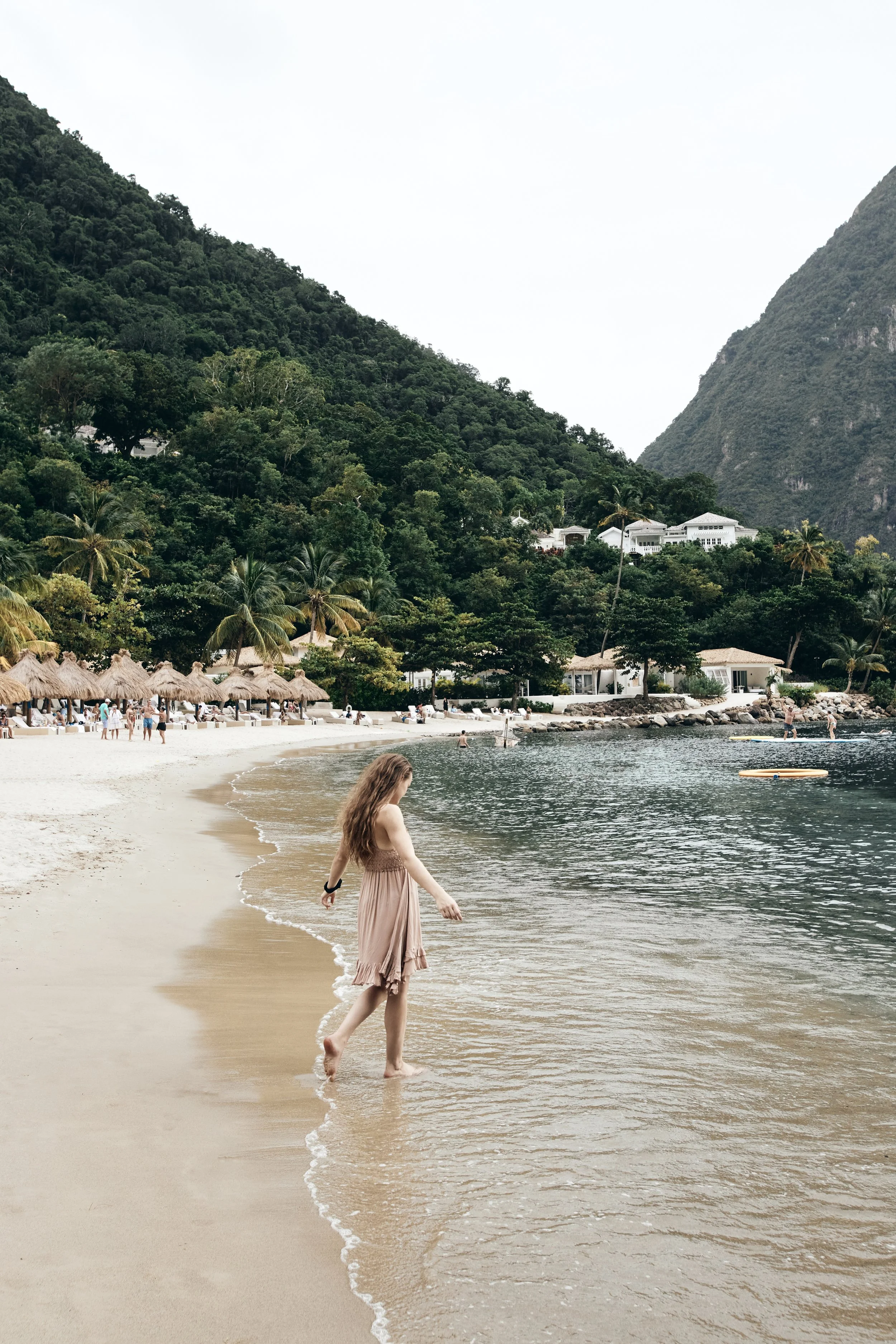
St. Lucia doesn’t ease you into wonder—it drops it on your shoulders like a warm towel. One moment you’re moving through the ordinary logistics of arrival, and the next you’re standing at a shoreline where the island’s famous geometry takes over: forested slopes, a protected curve of water, and the Pitons rising with the kind of authority that makes conversation go quiet. The model in your frame isn’t there to “sell” the destination; she’s there because St. Lucia changes the way a person occupies space. You stop walking like you’re late. You stop holding your breath for the next notification. You start moving like the day is yours again, because for once, it is.
The Pitons are not background. They are the island’s signature—two volcanic spires near Soufrière that dominate the west coast and anchor the UNESCO‑listed Pitons Management Area. When people say St. Lucia is the ultimate destination, they usually mean a single thing: you can have romance, drama, and calm in the same frame without forcing it. The mountains give you scale; the sea gives you softness; the rainforest gives you depth; and the villages give you a pulse that isn’t imported. The result is a place where “vacation” stops meaning entertainment and starts meaning permission—permission to return to your senses without needing to explain why you needed it so badly.
There’s a reason the simplest movement—a barefoot walk—lands like a headline here. At home, walking is often just transit between tasks. Here, it becomes a form of arrival. The model’s pace in the sand reads like a subtle refusal of modern speed: no earbuds, no hurry, no performance. The shoreline does what great destinations do: it edits your life down to essentials. Water. Light. Breath. The quiet click of small waves collapsing and retreating. The kind of calm that doesn’t feel like “doing nothing,” but like finally doing the thing your body has been asking for all year.
St. Lucia rewards people who understand that the best itinerary is built around contrasts. Start with the island’s softest contrast: the calm of a bay beneath the Pitons, where the sea behaves like a lake until you step in far enough to feel the temperature shift. Then let the day tilt toward the island’s other personality—its volcanic heart. The Pitons Management Area isn’t only about scenic impact; UNESCO describes a volcanic complex that includes geothermal features such as sulphurous fumeroles and hot springs, with coral reefs covering a large portion of the marine area. That’s the St. Lucia advantage: you’re not choosing between beach and “something to do.” The island stacks experiences vertically—sand at your feet, rainforest at your back, volcano under the road.
Drive south toward Soufrière and you can feel the island’s heat rising through the story. St. Lucia is one of the few places where the word “volcano” isn’t marketing—it’s literally part of the day’s menu. The Sulphur Springs site is widely promoted as the world’s only “drive‑in volcano,” and whether you arrive as a believer or a skeptic, the air makes its case first: mineral tang, warm ground, the sense that the island is still alive beneath the surface. The mud baths are the kind of experience that sounds gimmicky until you’re in it and realize it’s doing something simple and ancient—resetting you by force of sensation.
If you want St. Lucia to feel less like a brochure and more like a place, follow flavor. Not “fine dining” flavor—real, everyday flavor that carries history without turning it into a speech. Castries Market is often framed as a culinary entry point, and it makes sense: the island introduces itself through produce, spice, and the rhythm of buying and selling. A good travel feature doesn’t list ingredients like trophies—it watches what people reach for, what they cook with, what they consider normal. In St. Lucia, that normal includes fruit you forgot existed, roots and greens that show up in soups and stews, and the kind of seasoning logic that makes you realize how bland your “busy life food” has become.
Then, when you’re ready to make the island personal, do the most St. Lucian thing possible: let cacao tell the story. Hotel Chocolat’s Rabot Estate has built an immersive “Tree to Bar” experience around a working cacao farm, turning chocolate into something you can walk through, smell, and understand as an agricultural product—not just a sweet. This is where St. Lucia separates itself from other “ultimate” destinations: it doesn’t only offer beauty. It offers substance. You don’t just consume the island—you learn how it grows.
The model’s presence matters most in these in‑between moments, the ones travel writers often skip because they don’t photograph like fireworks. The walk back from water. The pause under shade. The way a person’s posture changes when they’re no longer braced against their schedule. St. Lucia is built for that kind of transformation because it’s a place of strong edges and soft interiors: dramatic peaks, gentle bays; intense heat inland, cool water at the coast; loud celebration in the right village, deep quiet ten minutes away. Your images hold that tension without needing to explain it. They say: here, a person can be small and safe at the same time.
And if you want a narrative arc that feels complete—something that reads like a feature, not a caption—give the day a proper ending. St. Lucia’s rum culture is not an accessory; it’s part of the island’s craft identity. St. Lucia Distillers invites visitors into a structured tour experience (their “Rhythm of Rum” tour) and positions the distillery in the Roseau Valley as a place where blending and production are taken seriously. Even if you don’t drink much, there’s something satisfying about seeing a destination’s “signature” made by real hands—barrels, aging, process, pride. It turns the island from a view into a place with competence, and competence is always more attractive than marketing.
From there, you can choose your night based on the mood you’re chasing. If you want quiet, St. Lucia will give it to you: a table near the water, the kind of conversation that doesn’t get interrupted, a horizon that stays visible even after dark. If you want pulse, the island has that too—especially on a Friday, when Gros Islet’s street party is regularly framed as a must‑do experience, with seafood, music, and the kind of crowd energy that feels communal rather than curated. This isn’t “nightlife.” It’s the island exhaling in public.
Here’s what makes St. Lucia feel ultimate, and why your model-in-place frames work so well: the destination doesn’t require spectacle from the person inside it. The island provides the scale. The person provides the human measure. When the Pitons hold the skyline, the subject doesn’t need to overact. The best St. Lucia photos aren’t about proving a life— they’re about witnessing a life slow down enough to feel itself again. That’s why the strongest travel editorials set here don’t chase adrenaline. They chase recalibration.
A good feature story also tells the truth about effort—because St. Lucia is gorgeous, but it’s not flat. Getting anywhere can involve winding roads, steep grades, and time. That “time cost” is part of why the island feels different: it forces you to stop treating your trip like a checklist. You can’t do ten things in a day without turning the island into a blur. St. Lucia rewards the opposite: fewer moves, longer moments. Choose one bay and let it become your morning. Choose one inland experience—volcano, waterfall, cacao—and let it define your afternoon. Choose one night story—quiet table or street party—and let it end the day cleanly. The island doesn’t want to be skimmed. It wants to be lived.
If there’s a single emotional thread that ties the model to the location, it’s this: St. Lucia makes people softer without making them feel weak. The mountains are too big for your usual self-importance, and the water is too gentle for your usual defensiveness. You end up in a rare middle state—humble, relaxed, awake. That’s the travel promise most destinations advertise and few actually deliver. St. Lucia delivers it the old way: through place, not pitch.
And when you leave—when the sand is finally rinsed out of your shoes and the last salt smell has faded from your bag—the island doesn’t linger as “a beach trip.” It lingers as a reference point. A visual standard for scale. A sensory standard for calm. A reminder that the world can still be this green, this steep, this quiet, this complete. Your photos become more than memories; they become proof that your nervous system has lived somewhere else for a few days—somewhere slower, larger, and kinder. That’s what a feature travel editorial is supposed to do: not just show a place, but show what the place does to a person.