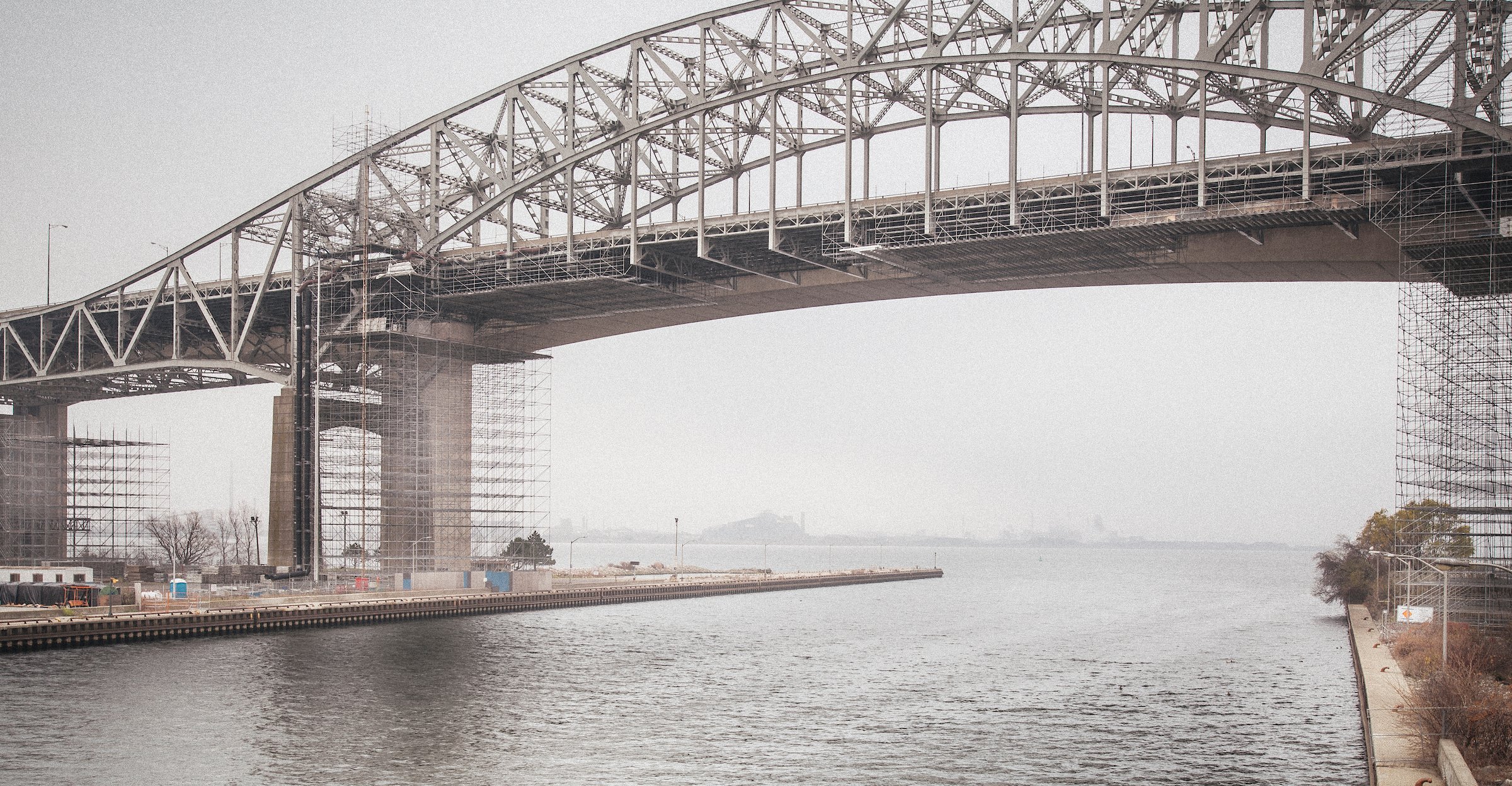
City Between Stories — The Skyway Over Hamilton Harbour @Solomon D Crowe
The QEW Skyway cuts a high arc over the water in Hamilton, Ontario, its temporary scaffolding revealing a larger civic truth: the most essential structures—physical and human—often do their work quietly, supporting an entire region without demanding the spotlight.
There are crossings in Southern Ontario that don’t feel like travel so much as calibration. The air cools. The lake widens. The horizon turns spare and pale, the kind of overcast that flattens color into a single disciplined tone. From below, the Skyway’s steel geometry reads like a sentence written in trusses—an argument for connection, for speed, for the simple belief that distance should be conquered. And then you notice what interrupts the clean line: the lacework of scaffolding, the temporary lattice that clings to the span like a second nervous system. It doesn’t tell you what’s being changed or why; it simply reveals a truth we spend most of our lives trying not to see—that the built world is not static, that permanence is borrowed, that every “normal day” depends on structure you rarely think about until something forces you to look up. The water beneath the bridge doesn’t care about schedules or reputations. It just moves. And the city on either side—Hamilton—keeps doing what it has always done best: carrying the load while other places take the credit.
Hamilton is a city most people think they know without ever really knowing it. They know it as a waypoint on the drive: between Toronto’s gravity and Niagara’s romance; between boardrooms and vineyards; between the airport run and the weekend rental; between a place you “go” and a place you “get through.” It’s a dangerous kind of familiarity, because it makes a city disappear in plain sight. The most consequential places are often like that: not the headline, but the hinge; not the brand, but the backbone. Hamilton doesn’t just sit inside the Golden Horseshoe—it absorbs its pressure. It holds commuters, industry, hospitals, ports, campuses, and the second-order realities that keep a megaregion functioning when the spotlight is pointed elsewhere. If Toronto is the narrative people sell, Hamilton is the infrastructure people rely on. And the older you get, the more you realize that “rely on” matters more than “look at.”
That in-between status is so baked into Hamilton that even its nicknames read like competing biographies. “Steeltown.” “The Ambitious City.” “The Hammer.” Names that swing between pride and defensiveness, between industrial muscle and reinvention, between the city Hamilton was and the city it keeps insisting it can be. You can hear the tension in them: a place that refuses to be reduced to a single chapter, but also refuses to pretend it doesn’t have roots. Those roots matter because they explain Hamilton’s posture—why it doesn’t perform the way glossy cities perform, why it can feel blunt, why it sometimes seems more interested in function than applause. When a place has been measured for generations by output—by what it produces, what it ships, what it services—it develops a different relationship to image. It learns to distrust the cosmetic. It learns that what holds is more important than what sells.
The temptation, when you say “Hamilton,” is to make it all about steel. That’s the easy shorthand, and it’s not wrong—just incomplete. Companies like ArcelorMittal Dofasco trace their roots in Hamilton back to 1912, and Stelco’s corporate story runs deep in the city’s industrial lineage; for decades, steel wasn’t just an industry here, it was an identity—an entire social ecosystem of shifts, paycheques, lunch buckets, union debates, air quality arguments, pride, and fatigue. But what makes Hamilton truly current—truly “today”—is the way it has diversified without erasing itself. The city’s economic centre of gravity has been evolving toward health, education, research, and life sciences in ways that don’t always show up in outsider conversations. “Life sciences” can sound like brochure language until you remember what it actually means on the ground: hospitals, clinical trials, labs, biotech, and the infrastructure of care. Invest in Hamilton describes the sector as a “powerhouse of innovation and research,” and the region’s health institutions and university ecosystem give that claim weight beyond marketing. McMaster continues to pull research investment and economic activity into the city, and Hamilton Health Sciences is consistently positioned as a major employer and anchor of the local workforce. This matters for an honest editorial because it reframes what “a working city” looks like in 2026: not only smokestacks and mills, but operating rooms, research grants, and the steady logistics of keeping people alive.
Then there’s the cultural story—the one outsiders often miss because it doesn’t arrive packaged as a skyline. Hamilton’s creative identity has matured into something that doesn’t need permission. Supercrawl, founded in 2009 by Hamilton artists and community builders to showcase the city’s cultural vibrancy, didn’t just create a festival; it helped establish a new civic self-image—one rooted in street-level life, music, art, food, and public presence rather than corporate spectacle. By the organizers’ own reporting, Supercrawl in 2025 covered 22 city blocks and attracted more than 285,000 visitors, which is the kind of scale that quietly rewrites what a “second city” is allowed to be. And Hamilton’s streets have become more than stages for its own events—they’ve become sets for other people’s narratives, too. Tourism Hamilton openly maps the city’s filming locations, pointing out how productions use its architecture and downtown textures as versatile stand-ins for elsewhere. A place can be flattered by that, but Hamilton’s deeper trick is subtler: it can host other stories without losing its own. Even the infrastructure that supports filming—the studios, the equipment ecosystem, the location support—signals that this isn’t a fluke, it’s a working creative economy with its own supply chain.
This is where the scaffolding in the photograph becomes more than a literal structure. It becomes a thesis. Hamilton is a scaffolding city in the best sense: the support system people depend on but rarely praise. Not glamorous, not always tidy, but essential. Consider what happens here every day that most people don’t emotionally register. Port operations move quietly at the edge of the public imagination, yet the Port of Hamilton handles over 12 million tons of cargo and sees hundreds of vessel visits each year—numbers that translate into food inputs, fuel, construction materials, industrial components, and the less poetic realities that keep households and businesses functioning. Hospitals absorb the region’s emergencies with routines so practiced they can look effortless from the outside, even when they are anything but. Universities and research networks turn the city into a lab for health innovation and a magnet for specialized talent, and those gains ripple outward into suppliers, housing demand, and small businesses that live or die by whether people show up year-round, not just on festival weekends. The point isn’t to turn this into an “industry” editorial; it’s to name a human truth: modern life runs on layers of unseen competence, and Hamilton is one of those layers for the entire region.
And yet, the most important scaffolding Hamilton provides isn’t cargo tonnage or institutional capacity. It’s psychological. Hamilton is where the myth of effortless prosperity gets replaced by the more adult idea of endurance. It’s where you can still feel the cost of things—housing, time, labor—without the city trying to distract you with constant gloss. That is precisely why more people are drawn to places like Hamilton now: not because they want less ambition, but because they want ambition that doesn’t require performance. The City of Hamilton notes that the population increased to 569,355 in 2021, up more than 32,000 from 2016—growth that reflects how the region’s pressures are redistributing people and decisions across the map. Zoom out, and Statistics Canada’s CMA population estimates show Hamilton’s broader metro area continuing to rise—another signal that the “in-between” is becoming its own gravitational field, not merely overflow. For years, research and policy work have pointed to spillover dynamics in housing markets around the GTA—how price pressure and demand radiate outward, reshaping nearby communities. CMHC has explicitly examined GTA house price spillover effects on Hamilton, which is one of the cleanest institutional ways to say what many residents have felt personally: people don’t just move here for charm; they move here because the math of the region forces choices.
That redistribution creates tension, and any editorial that aims to be honest has to sit inside the tension without preaching. Growth can energize a city and also strain it. New investment can revive streets and also price out long-time residents. A creative renaissance can feel like rebirth to some and erasure to others. Hamilton, more than many places, is living that contradiction in real time because it’s close enough to Toronto to catch the wave, but different enough to resist becoming a replica. This is where the “city between stories” framework becomes useful: Hamilton is not finishing one story and starting another; it’s holding multiple stories at once—industrial legacy, health and research expansion, cultural confidence, housing pressure, and the quiet daily labor of staying functional. The mistake outsiders make is trying to reduce it to a single narrative: “steel city,” “revival city,” “spillover city.” Hamilton is all of these and none of them, depending on which street you’re on and what time of day you arrive.
So what does it mean to write a travel-and-culture editorial about Hamilton using a bridge as the visual anchor, without becoming trapped by the bridge itself? It means treating the image the way strong editorial photography is meant to be treated: as a doorway, not a destination. The Skyway’s arc becomes a metaphor for every adult crossing happening in the region right now—people shifting careers, downsizing homes, moving closer to aging parents, choosing a smaller city without choosing a smaller life. The water under the span becomes the quiet counterpoint to the noise of the corridor, a reminder that movement is constant whether you name it or not. The scaffolding becomes the most honest symbol in the frame: a visible acknowledgment of the supports we depend on and rarely celebrate, from bridgework to shift work, from public services to the invisible emotional labor people spend keeping families and communities intact.
Hamilton deserves a different kind of attention than it usually gets—not the attention that turns a place into a trend, but the attention that recognizes value before it needs to be marketed. If you come here only looking for “things to do,” you’ll miss the point. The deeper travel experience is learning how a region actually runs, and why some cities become indispensable precisely because they aren’t constantly posing for the camera. Hamilton is not a detour. It’s an answer to a question the Golden Horseshoe is increasingly being forced to ask: what happens when growth outpaces glamour, and the future depends more on support systems than on skyline shots? The honest reply is that the future starts in hinge cities—the places between stories—where people build lives that don’t require applause, only stability, opportunity, and a little room to breathe.