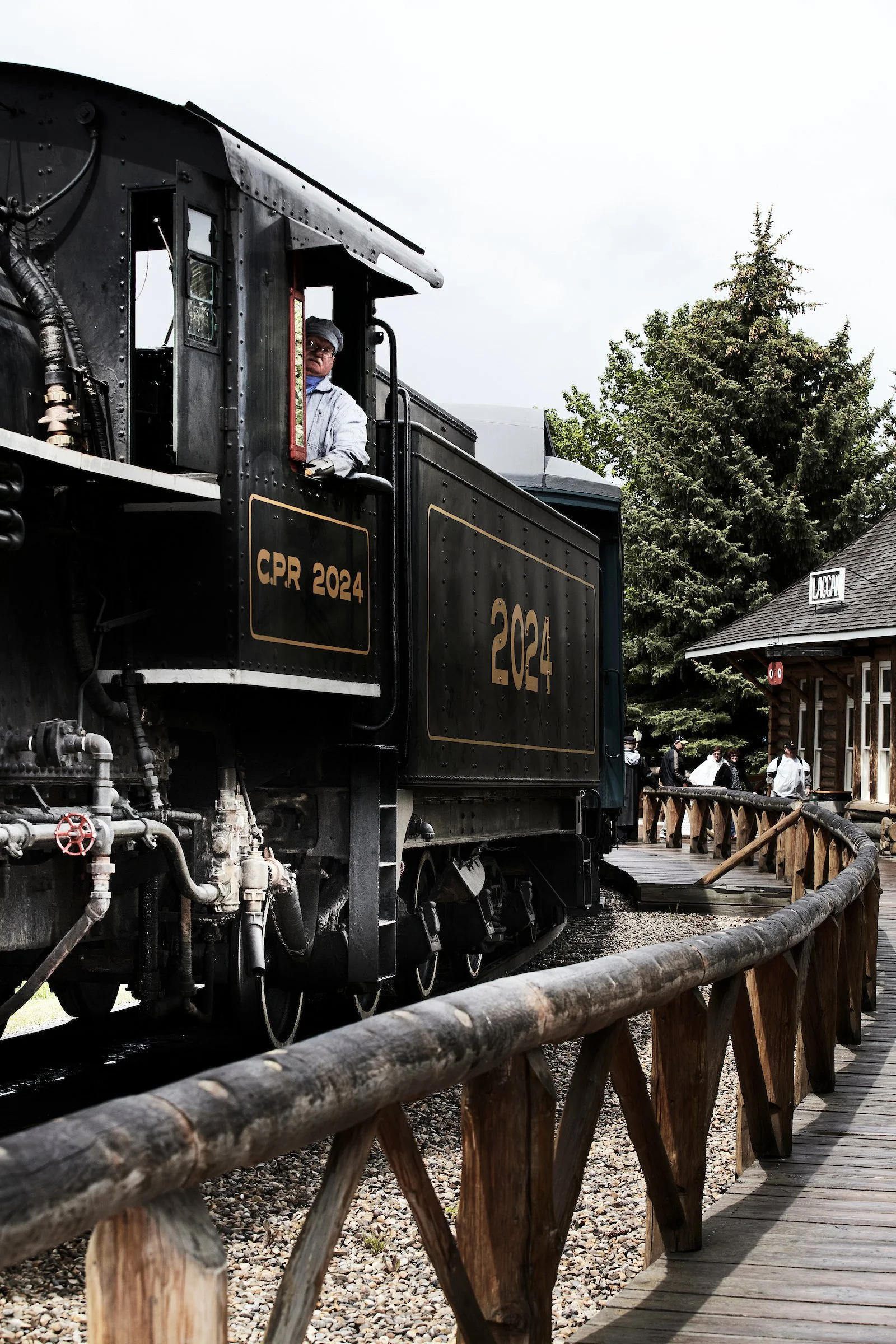
CPR 2024: The West on a Working Loop
A steam locomotive lettered 2024 operates at Heritage Park in Calgary—painted in Canadian Pacific’s pre‑1915 livery despite never being owned by the CPR. Built in 1944 by Lima Locomotive Works for U.S. Army service and later sold as surplus to Pacific Coast Terminals in 1947, the engine now runs Heritage Park’s 4,300‑foot standard‑gauge loop: a living demonstration that the West was built on water, steel, maintenance, and time.
There are places where history is curated behind glass—quiet, climate‑controlled, politely distant. And then there are places where history still sweats. Where it still consumes fuel and water. Where it still demands hands, timing, and a kind of humility that the modern world keeps trying to delete. Standing beside a working steam locomotive is not the same as looking at one. The difference is physical: vibration through the soles, the faint metallic tang in the air, the way your brain re-calibrates when confronted with a machine that refuses to be “content.” It doesn’t want to be liked. It wants to be maintained. It wants to be understood. And in a decade when most of our days are spent shuttling invisible files across invisible networks—rent, health care, layoffs, mortgages, meetings that evaporate the moment they end—something inside an adult audience recognizes the relief of a system you can actually see.
The engine in this frame wears a number—2024—like a badge and a dare. Not a year, not a marketing hook, but a designation that signals how museums sometimes stitch together story and system to make the past legible again. At Heritage Park in Calgary, Locomotives 2023 and 2024 are painted in Canadian Pacific’s pre‑1915 livery even though they were never owned by the Canadian Pacific Railway. Their road numbers were chosen because they fit “blanks” in the CPR numbering system of that era, a curatorial decision that tells you something important: history is never only what happened; it’s also how we decide to remember it. That choice isn’t deception—it’s translation. It’s an invitation for the public to read an artifact within the visual language of the West that built Calgary, a region that learned early that identity is often carried by infrastructure.
But the deeper truth is that 2024 is not a prop. It is a veteran of a different kind of war—one fought with logistics, steel, and standardized design. Heritage Park documents that both engines were built in the 1940s to a standard United States Railway Administration design and were intended for U.S. Army service in the Far East: #2024 was built in 1944 at the Lima Locomotive Works in Lima, Ohio, and #2023 in 1942 by ALCO in Schenectady, New York. When the world reordered itself after WWII, the engines were sold as surplus to Pacific Coast Terminals in Vancouver in 1947, then worked for 18 years as yard engines on the wharves at New Westminster, British Columbia—the kind of work that rarely becomes legend but makes legend possible: switching cars, feeding ports, keeping commerce from stalling. In 1965, as they were being scrapped, a private citizen bought them, and they were eventually resold to Heritage Park, where the museum’s stated aim is to keep them in active service “for generations to come.” That single arc—war design to industrial drudgery to preservation—contains a whole philosophy of North American life: build fast, use hard, forget quickly, and then, years later, realize what you’ve lost.
To understand why this matters in Calgary, you have to understand what the railway did to the idea of distance on the Prairies. Calgary’s modern story is often told through oil booms, corporate towers, and the Stampede spectacle, but the spine of the city—the thing that turned a remote fort into a place that could scale—was rail. The Canadian Encyclopedia notes that the railway reached Fort Calgary in 1883, and the CPR subsequently laid out the Calgary townsite west of the Elbow River, a planning decision that shaped the city’s core and its future. When people say “Calgary was built on the West,” that phrase can feel like romance—until you recognize it as a literal description of settlement patterns, supply routes, and the economic geometry rail imposed on the landscape. Alberta’s own energy‑heritage history resources describe the arrival of rail transportation in the late nineteenth century as one of the most important developments in modern Alberta’s history, noting again that the Canadian Pacific reached Calgary in 1883. Calgary didn’t just grow; it was connected into existence.
And Canadian Pacific itself—still one of the most consequential corporate authors of the country’s geography—frames its founding in 1881 as a project to link Canada’s populated centres with the “vast potential” of the West, completed when the “last spike” was driven on Nov. 7, 1885 at Craigellachie, B.C. Whatever you think of the politics and consequences of that nation‑building story—and adults increasingly hold more than one truth at once—you can’t deny the mechanical reality: rail was the technology that made “Canada” operational at scale. That is why a working steam engine, circling a heritage loop in Calgary, is not nostalgia. It is a reminder of the original operating system.
Yet there is a harder layer beneath the romance, and serious storytelling can’t dodge it. Heritage Park explicitly acknowledges that it sits on Treaty 7 territory, recognizing the deep historical connection to the land by the Blackfoot, Tsuut’ina, Îyârhe Nakoda, and Métis peoples and positioning itself as a place where Indigenous people share traditions and tell stories about heritage and attachment to the land. That matters here because railways didn’t only deliver mail and cattle cars; they delivered a new order—new property lines, new enforcement, new economies, and new pressures on the people who were already here. For adult readers, this is not a footnote. It is the cost line in the ledger. The West was built, yes—but it was also taken, re‑mapped, and administrated. A locomotive can be a marvel and a witness at the same time.
This is where the story stops being about a preserved engine and becomes a state‑of‑affairs editorial for right now. Because our current era—despite all its “innovation”—is suffering from a crisis of comprehension. We live inside systems we cannot see and therefore do not trust. Food arrives without us understanding the chain. Packages land on porches like magic. Money moves as numbers, then disappears as fees. Work becomes an endless scroll of dashboards. Even politics has been flattened into feeds: loud, fast, and forgettable. The adult nervous system is exhausted by abstraction. So we seek places where the world is re-materialized—where cause and effect are visible again. That is the hidden power of operational heritage: it re-teaches the public what a real system costs, what it consumes, what it requires to keep going.
Heritage Park’s railway was unveiled in 1964 specifically to keep a working example of the transportation that had the greatest effect on the history of western Canada. The park’s collection includes nearly 30 pieces of rolling stock from multiple railways, built between 1882 and 1949, running on standard gauge track with 100‑pound rail and a main loop 4,300 feet long. Those numbers are not trivia; they are the language of constraint. And then there’s the most telling detail of all: water. Heritage Park notes that locomotives 2023 and 2024 each have a water tender capacity of 3,000 gallons, and when in use, one of these engines travels approximately 72 kilometres in a single day on the park’s track, using between 1,600 and 1,700 gallons of water. Every morning, the engine is filled from a water tower the park built in 1973 from a 1902 CPR plan, with pipes and valves salvaged from a retired water tank at East Coulee, Alberta, east of Drumheller. In a world where we argue online about “efficiency” like it’s a personality trait, a steam locomotive makes you confront efficiency as physics. It eats resources. It turns them into motion. And it does not pretend otherwise.
That is why this kind of image—steam, steel, a human in the cab—lands with adults who are not looking for a theme park. They are looking for orientation. The engine’s story carries a quiet indictment of our present: we’ve optimized for convenience and lost reverence for the infrastructure that makes convenience possible. We don’t maintain relationships; we “replace” them. We don’t repair objects; we “upgrade” them. We don’t preserve institutions; we starve them until they become content or collapse. Heritage Park, by contrast, describes a planned maintenance program aimed at ensuring these engines will see active service for generations. That is not merely a museum practice. It is a counter‑ideology: care is the opposite of disposability. And care, at the adult level, is what most of us are starving for—care from systems, from leadership, from communities, and from ourselves.
There is another reason this locomotive hits a nerve: it’s a working metaphor for midlife. Not in the cliché sense—no self‑help slogans, no “live laugh love”—but in the real sense of resource accounting. Adults eventually learn that momentum is never free. Something always fuels it: time, sleep, health, attention, money, someone else’s labor. Steam power makes that truth visible. The water tower, the daily fill, the valves and pipes, the tender capacity—these are not decorative elements. They are the receipts of movement. The West that Calgary inherited was built by people who understood receipts because they couldn’t outsource consequences to the cloud. When the water froze, the line froze. When the siding didn’t exist, the town didn’t exist. When the timetable failed, the economy failed. That doesn’t mean the past was better. It means the past was less deniable. In 2025, deniability is everywhere—and it is making us anxious.
So when you place this photograph on a page, the goal isn’t to “teach people about trains.” The goal is to remind them what they already know but have been trained to forget: that every functioning life is a network of maintained systems. Calgary’s origin story is proof. The CPR arrives in 1883, the townsite shifts, the city’s core takes shape; the line becomes the spine. Later, other engines, other fuels, other booms arrive. But the underlying pattern stays the same: the West runs on coordination. On logistics. On people doing unglamorous work with disciplined repetition. In an era that celebrates only the visible—followers, brand deals, virality—this is a radical message: the most important work is often the work nobody photographs.
And yet here we are, photographing it—because the camera, at its best, is not a machine for prettiness. It’s a machine for attention. A good editorial image doesn’t just show you a subject; it shows you a structure. The conductor in the cab—anonymous to most viewers, essential to the machine—becomes a stand‑in for every human role modern life treats as background: operators, maintainers, schedulers, mechanics, dispatchers, the invisible hands that keep cities from stalling. The locomotive’s number—2024—becomes a reminder that identity is sometimes assigned for coherence, not because the artifact is lying, but because the audience needs an entry point. And the setting—Heritage Park, a place built explicitly to keep the West’s story operational—becomes the stage where the past isn’t merely remembered; it is rehearsed, so the present can see itself more clearly.
If you want this editorial to travel—if you want it to reach beyond railfans and into the bloodstream of people who haven’t thought about a locomotive since childhood—then the hook is not steam. The hook is trust. The hook is maintenance. The hook is the ache adults carry when they realize the world is run by systems they can’t audit. And the quiet comfort they feel when confronted with a machine that can’t hide what it needs: water, heat, care, and time. Calgary was built on the uncompromising logic of those needs. This locomotive is not a toy echoing the past; it is a working argument with the present. It asks: what happens to a society when it stops valuing the people who keep it running? What happens when we treat maintenance as a cost instead of a virtue? What happens when we forget that every “modern miracle” rests on a timetable somebody still has to keep?
The answer, in part, is why images like this matter. They don’t solve the crisis. They don’t fix the systems. But they restore the viewer’s ability to feel something accurate: respect for what’s real, and suspicion of what’s frictionless. They bring us back to the West’s original lesson—Calgary’s first lesson—that momentum is built, not wished for. That distance is conquered by cooperation, not commentary. And that the most durable progress is the kind you can still ride decades later, because someone cared enough to keep the machine alive.