The Stranger Next to You @Solomon D Crowe
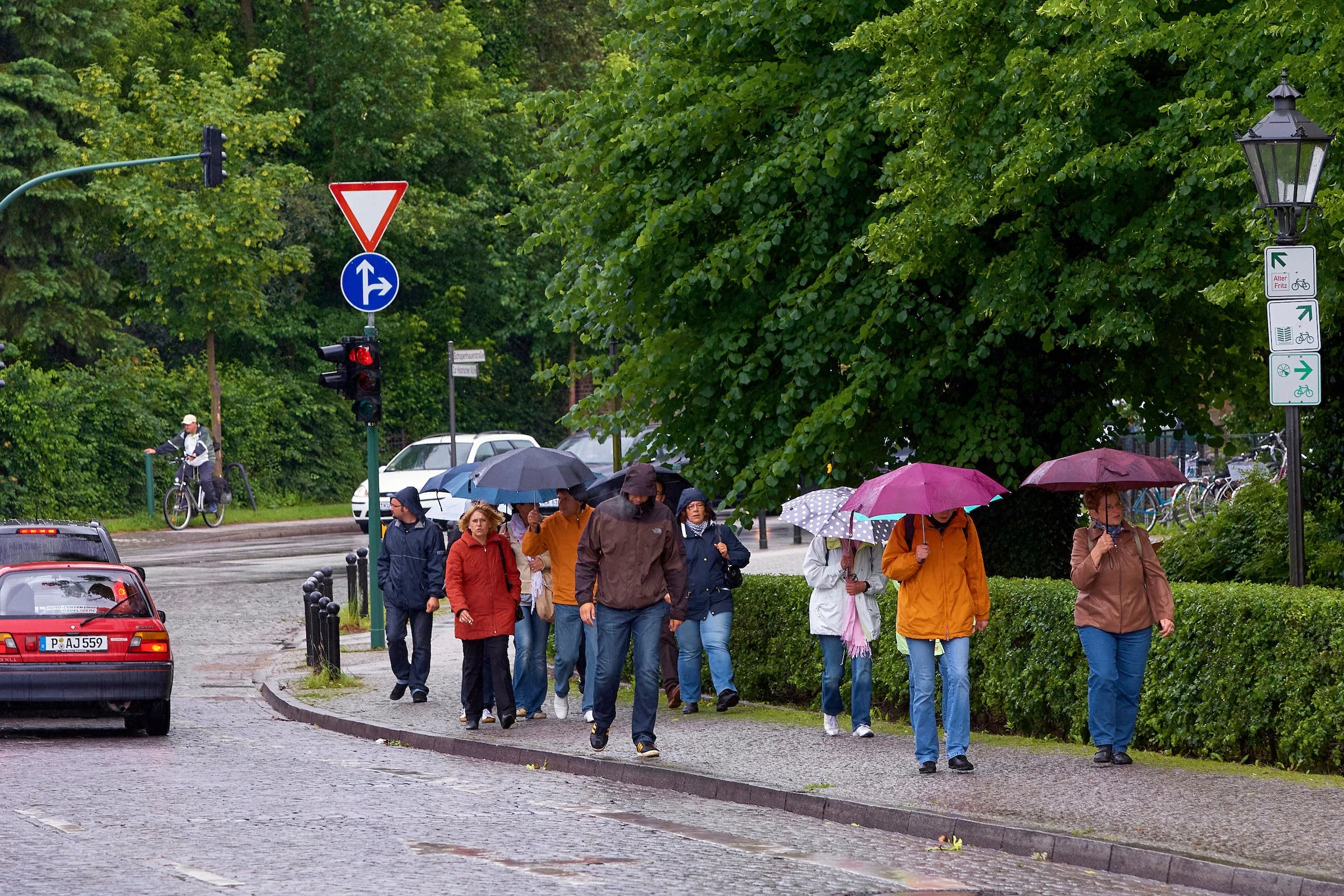
Pedestrians move in loose formation beneath umbrellas along a Potsdam sidewalk, sharing public space with cars and cyclists while remaining sealed inside private rhythms—an everyday scene that captures how modern cities train people to travel together without truly meeting.
On a wet afternoon in Potsdam, the sidewalk becomes a moving compromise. A loose cluster of umbrellas advances along the curb, their canopies overlapping and separating in the same rhythm as the people beneath them—close enough to share air and pace, far enough to remain unclaimed. Traffic idles nearby, bicycles slip through the background, and the street’s instructions hang above the scene in clean European geometry: a red triangle warning, a blue circle directing, signals rationing time. There is a license plate with a single letter that quietly gives the city away—“P,” the code for Potsdam—an administrative detail that feels almost poetic in context because it reduces a whole place to one character, the same way modern life has reduced countless human encounters to glances that don’t land. The group moves forward with the practiced efficiency of people who have walked past one another for years without ever meeting. It is not loneliness in the melodramatic sense. It is something more familiar and harder to name: proximity without contact, togetherness without claim, public life conducted at a distance even when bodies are close enough to brush sleeves.
What’s visible in moments like this—more visible than we like to admit—is how modern privacy has migrated out of buildings and into behavior. We used to think of privacy as walls, doors, and rooms. Now it is posture, pace, and what you choose not to notice. The umbrella is a literal version of the trend: a portable ceiling, a small boundary that says, “I’m here, but I’m not available.” The same logic exists everywhere else on the street. Headphones are a social gate. The phone held low is a shield. The eyes that stay forward are a kind of quiet contract: we will share the sidewalk and spare one another the obligation of acknowledgment. It isn’t cruelty. It’s economy. Each person carries a day’s worth of tasks, alerts, news, and mental tabs, and the smallest interaction—eye contact, a greeting, even a moment of courtesy—can feel like one more demand. Over time, these micro-avoidances become a culture of movement. People learn how to live among strangers without being touched by them, and the skill becomes so common it starts to feel like the natural state of cities, as if sidewalks were built for bodies rather than for human beings.
But public life has not always operated this way, and it doesn’t operate this way everywhere. Potsdam is a city that, on paper, should resist private-world drift. It is built around walkable scale and layered history, where parks and routes connect neighborhoods with the kind of everyday beauty that encourages lingering. Even the street signage tells you the city expects you to move through it slowly enough to choose a direction: a cycling route labeled “Alter Fritz,” named for Frederick the Great, points outward toward a UNESCO-laced landscape that is meant to be traversed rather than consumed. Yet even here—even in a place where the built environment still invites public life—the dominant mood of modern streets is increasingly one of parallel solitude. People are physically near one another, but socially sealed. The paradox is that the more “connected” we become through devices and platforms, the more we rehearse disconnection in the spaces that once taught us how to be citizens of each other’s presence.
That paradox is no longer merely a cultural observation; it has become a matter of public health and public policy. The World Health Organization’s Commission on Social Connection has described loneliness as widespread globally, reporting that roughly one in six people experience it, with higher prevalence among adolescents and young adults. In the United States, the Surgeon General’s advisory on social connection framed the stakes in blunt terms, linking loneliness and social isolation to increased health risks and treating social connection as a protective factor rather than a sentimental luxury. Europe, too, has been measuring what used to be dismissed as subjective. The European Commission’s Joint Research Centre reported, based on an EU-wide survey, that in 2022 more than a third of respondents felt lonely at least sometimes and 13% felt lonely most of the time—numbers that turn the private ache of disconnection into an infrastructural concern. Germany has gone further, commissioning a national “Loneliness Barometer” to track long-term trends, a move that signals the issue has crossed from personal psychology into the domain of governance. The OECD has also pointed to measurable deprivations in social connectedness across wealthy countries, including shares of people who feel unsupported, report having no close friends, or experience loneliness frequently—evidence that the decline of everyday social fabric is not confined to one nation or one kind of city. In other words, the stranger beside you is no longer just a social fact of urban life; the widening gap between bodies and belonging is being treated as a structural risk.
If that sounds abstract, the street makes it concrete. The modern sidewalk has become one of the last remaining “commons” where people must share space regardless of ideology, income, or identity, and that forced proximity is precisely what makes it revealing. We can debate polarization, mental health, and the effects of the internet in essays and studies, but the daily proof lives in small behaviors: whether someone holds a door; whether a group makes room; whether a cyclist signals; whether a pedestrian acknowledges the near-collision that did not happen. These are not personality quirks. They are outputs of systems. Digital life trains attention to fragment and flit; platforms reward instant reaction more than slow recognition; and the smartphone—now nearly universal in some countries, and psychologically hard to set aside—turns every spare moment into an opportunity for stimulation. In the U.S., Pew reports that about nine-in-ten adults own a smartphone, and a significant share describe their internet use as almost constant; the exact numbers matter less than the pattern they document: a society trained to fill every gap with input. Meanwhile, the city itself has changed the terms of encounter. Rising costs push people into longer commutes and tighter schedules; service work and shift work distort the old “shared hours” when neighbors once overlapped naturally; and the decline of civic institutions and regular group participation—documented repeatedly in contemporary reporting—reduces the number of places where strangers become familiar faces. When life is organized around efficiency and consumption, the casual, unplanned conversation becomes an endangered species.
And yet, the photograph also hints at the counter-story: public life hasn’t disappeared; it has become thinner, more fleeting, and easier to miss. Even in a crowd moving forward with heads down, the street still produces moments of involuntary coordination. Someone subtly angles an umbrella to avoid hitting a neighbor. A person at the edge of the group slows for an older walker without making a show of it. A cyclist waits at the light because the signal is red, not because a camera is watching. A pedestrian steps closer to the hedge to allow another to pass—an act so small it would never be called kindness in conversation, yet it is exactly the kind of micro-consideration that keeps cities livable. These gestures rarely result in friendship, and that is not the point. Their function is civic, not intimate. They reaffirm a basic premise: that strangers can share space without hostility, that cooperation can be habitual rather than negotiated, that the public realm still contains a thin thread of mutual recognition even when everyone seems sealed into private worlds. Places like Potsdam—where the built environment still supports walking and cycling routes that link neighborhoods and landmarks—quietly increase the odds that this thread survives because they keep people in the same physical frame long enough for courtesy to occur. A city designed for cars can move people. A city designed for bodies can still, occasionally, connect them.
This is why the “stranger next to you” has become such a potent figure in contemporary life. The stranger is the test of our civic muscles. Family and friends don’t tell you whether a society is functioning; private affection can thrive even in a broken public realm. The stranger tells the truth. If strangers can share a sidewalk with grace, if they can yield and navigate without aggression, if they can look up long enough to notice each other as real, then public life has not fully collapsed into private broadcast. And if they cannot—if every encounter is treated as interference, if every shared space becomes a competition, if every person becomes an obstacle—then the city is still standing but the society inside it is thinning. The most unsettling part is that neither outcome is inevitable. The data points from health agencies and governments, from EU surveys and national barometers, suggest the stakes are rising; loneliness is being measured because it is now too widespread to ignore. But the street-level reality suggests something else as well: the solution is not likely to arrive as one dramatic cultural reversal. It will arrive, if it arrives at all, as a million small corrections—more places that reward lingering, fewer systems that punish unstructured time, and a renewed social tolerance for being briefly available to the people beside us.
In the end, the sidewalk does not ask anyone to become a hero of community. It asks something smaller and more realistic: to remain human in public. To share space with competence. To recognize that the private world you carry—your phone, your worries, your schedule, your internal soundtrack—does not cancel the fact that you are moving through a shared environment built by others and sustained through cooperation. That is the quiet discipline of city life, and it is easy to lose when everything else trains you to be alone together. The stranger next to you may never become your friend. But the stranger is still part of your world, and the future of public life depends, more than we like to admit, on what happens in the brief, unrecorded moments when our umbrellas overlap and we choose, instinctively, whether to make room.