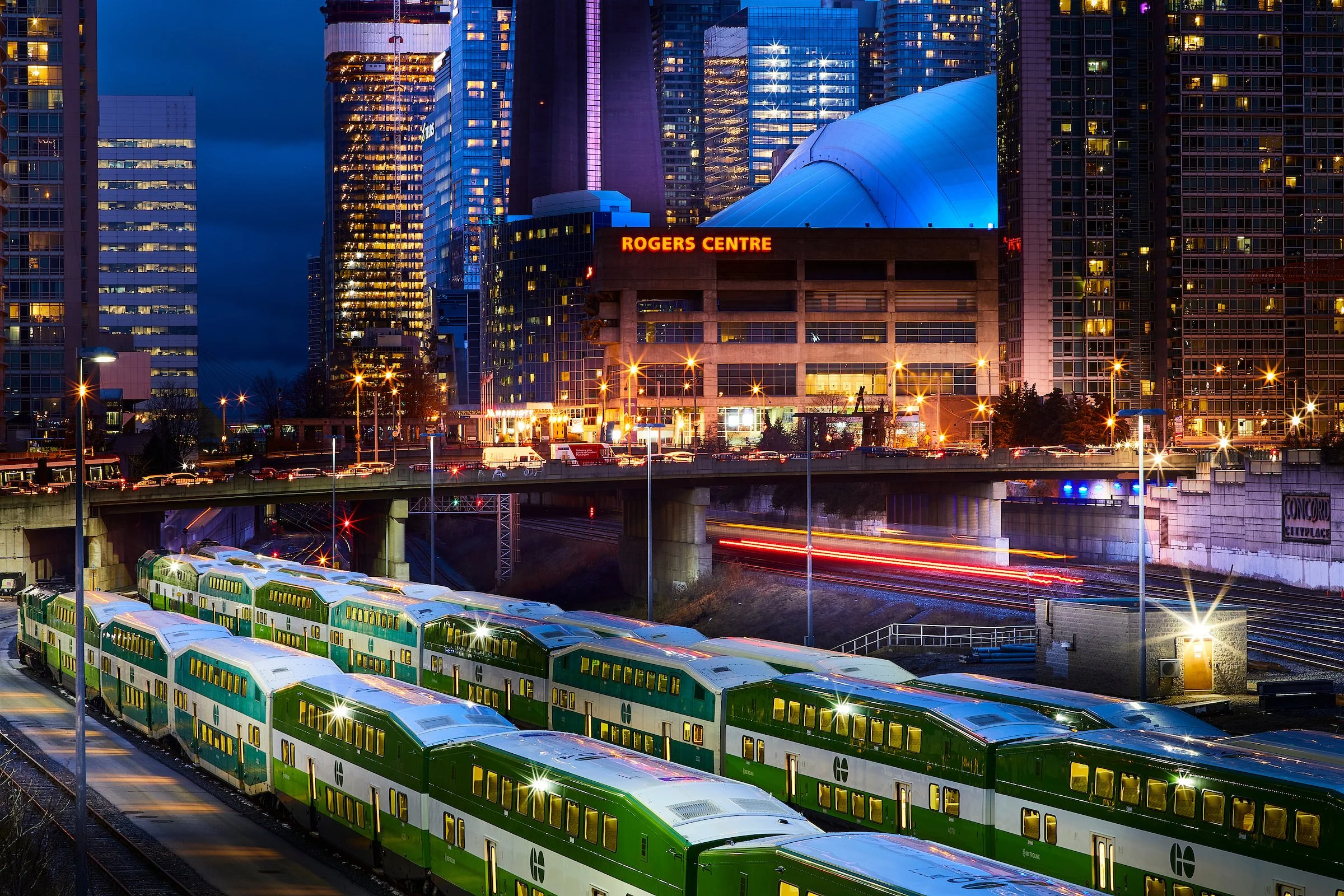
GO Transit Trains at Rogers Centre, Downtown Toronto at Night @Solomon D Crowe
GO Transit trains line the rail corridor beside Rogers Centre in downtown Toronto at night, as city traffic and illuminated high-rise buildings frame the intersection of regional rail infrastructure and the urban core. The scene reflects Toronto’s dependence on regional transit systems to support commuting, housing displacement, and after-hours city operations in Canada’s largest metropolitan area.
Toronto’s most revealing hour isn’t the morning rush, when the city performs efficiency for itself, nor the late afternoon surge, when sidewalks thicken and the streetcar platforms fill with impatience. It’s the quieter interval after the lights of spectacle have done their job—after the game, after the concert, after the last downtown dinner reservation—when the skyline keeps shining but the city’s true operating model becomes visible. In that hour, movement stops being a lifestyle and returns to what it has always been in a metropolis this large: a requirement. You can see it in the way traffic continues to stream along elevated concrete, in the way rail corridors hold their lines through the core, and in the way trains wait like coiled infrastructure, not romantic symbols but practical promises. This is the Toronto that doesn’t fit neatly into postcard narratives. It is a Toronto made of systems—housing, labor, transit, and time—and a region that now moves through the city the way blood moves through a heart: repeatedly, relentlessly, and because there is no alternative.
What the image captures, at a glance, is a modern urban truth that increasingly defines life across the Greater Toronto and Hamilton Area: Toronto is not simply a place people move within; it is a place people move through, often over distances that would have been considered absurdly far a generation ago. That shift isn’t driven by wanderlust. It’s driven by math. In a market where housing costs have restructured where families can live, and where economic uncertainty has kept both buyers and sellers cautious, the region has been forced to stretch. Even as affordability has improved in certain periods through price declines and lower borrowing costs, the underlying reality remains: many households are still making high-stakes trade-offs between space, cost, and commute time. Reuters reporting on recent Greater Toronto Area housing data underscored the continued volatility and uncertainty in the market, including month-to-month price and sales shifts and a broader climate shaped by economic confidence and external pressures. The result is not merely a longer commute. The result is a new geography of daily life in which the distance between where people earn and where they can afford to live has become normalized, and rail has become one of the only tools capable of making that normalization survivable at scale.
This is where GO Transit becomes more than transportation and starts functioning as civic scaffolding. The network is often discussed as though it is an accessory to downtown Toronto—a commuter convenience tethered to the core. But the lived reality is more consequential. GO functions as an equalizer for some and a necessity for many, compressing a wide region into timetables and platforms, turning what would be a destabilizing sprawl into something closer to a working system. Metrolinx has been explicit about the direction of travel: GO Expansion’s stated goal is to build the capacity for service every 15 minutes or better, all-day, in both directions on core routes, transforming the network from a peak-only commuter model into a regional backbone. That ambition speaks directly to the shift that Toronto now embodies: a core economy supported by a distributed workforce. The skyline is still where the brands live, where the institutions concentrate, where the spectacle gathers. But the workforce and the cost of living are increasingly distributed outward, and a functional transit spine becomes the difference between a city that grows and a city that fractures.
Ridership data supports that story in a way no editorial flourish can. In Metrolinx’s 2024–25 annual reporting, GO Transit and UP Express ridership rose to 71.8 million, a year-over-year increase of 21.6 percent, with weekend and off-peak travel showing striking strength compared to 2019 benchmarks. That matters because it signals that the network is not simply “coming back” to a pre-pandemic commuter pattern; it is evolving into something broader, with leisure and off-peak movement increasingly part of the load it must carry. Metrolinx has also highlighted that 2025 included multiple service increases, including first-ever weekend service to Kitchener, a notable marker in a region where the Kitchener line has long represented the outer edge of what “reasonable commuting” used to mean. Read plainly, this is the region voting with its feet: not just commuting to work, but moving for life—visiting family, attending events, accessing services, making the city’s cultural core usable without requiring everyone to live next to it.
Yet a network that carries more life also inherits more friction, and in Toronto the friction has often lived in the seams between agencies. For years, one of the least glamorous but most punishing barriers to transit use in the GTA has been the penalty of transferring—paying again to cross invisible jurisdictional lines. That is why the province’s One Fare program mattered immediately, not as branding but as a direct reduction of commuter pain. Beginning February 26, 2024, One Fare eliminated double fares for riders transferring between GO Transit and participating local systems, including the TTC, and was positioned by the province as a measure that could save frequent riders meaningful money over the course of a year. Metrolinx’s program detail makes the mechanics concrete: for trips connecting between TTC and GO Transit, the TTC component becomes effectively free via the fare integration discount. This is not a poetic policy change; it is a structural one. It acknowledges, in dollars and transfers, the reality that Toronto is a multi-system commute for countless riders—and that the region cannot pretend seamless mobility while charging people for the act of stitching systems together.
The long view, however, is where Toronto’s transit story becomes both ambitious and precarious. GO Expansion is not just about frequency; it is also about building the physical and electrical capacity required to run a denser schedule reliably. That means corridor works, grade separations, station modifications, and the slow, expensive, politically exposed work of electrification. Some of that progress is visible only in technical updates and utility relocations that most riders will never notice until the day service changes. For example, one utility provider’s project update tied to GO Expansion rail electrification described a phased timeline in which work began in 2024 and a next phase was tentatively scheduled to begin in April 2026. Meanwhile, municipal documents tracking GO Expansion elements have noted areas where timelines remain uncertain and where tendering and construction sequencing can shift. This is the reality of big-city infrastructure: it is never only engineering. It is procurement. It is community impact. It is political patience. It is the gap between what a region needs and what it can build quickly enough to keep up with that need.
Set against that slow churn of infrastructure is the faster, louder economy of downtown entertainment—the part of Toronto that broadcasts itself to the world. The Rogers Centre sits at the edge of that mythology, a landmark where crowds concentrate and the city’s image is staged in bright, commercial language. In recent years, that landmark itself has been rebuilt as part of a high-profile, multi-year renovation measured in the hundreds of millions of dollars, designed to modernize the venue and reshape the fan experience. This is where Toronto’s dual identities collide in the same frame: above, the city as spectacle; below, the city as system. Stadium lights, condo windows, and nightlife narratives are what people tend to remember. But the region’s daily viability depends on what happens when the event ends—when staff, fans, and workers disperse into a commuter geography that is larger than any one neighborhood, larger than any one subway line, and increasingly defined by rail corridors that must absorb surges without collapsing into gridlock.
That is why the trains waiting beside the core matter as a symbol that stays honest. They are not merely “parked.” They are staged for repetition—cleaned, checked, queued, and returned to the cycle. They represent the city’s wager that tomorrow will be possible for people who do not live close to where the city concentrates its wealth and opportunity. They are the physical infrastructure behind the abstract phrase “regional economy,” a reminder that economic centralization requires mobility to function, and that mobility requires sustained public investment even when the most visible parts of the city are doing just fine. This is the part of the urban story that rarely goes viral because it isn’t framed as crisis. But it is the story that explains, more accurately than skyline photos ever will, why so many people feel that modern city life has become an endurance sport. The region comes home each night, not in one dramatic wave, but in thousands of individual returns, distributed across lines and platforms and timetables, stitched together by a network that must perform whether the city is celebrating or simply trying to make it to morning.
If you want to understand where Toronto is heading, you do not start with the newest tower or the loudest headline. You start with the systems that must hold under pressure. You start with ridership returning and changing shape, with fare integration reducing friction at the seams, with expansion plans promising frequency that the region now demands, and with electrification and corridor works unfolding at the pace of real infrastructure, not wishful timelines. Then you look back at the skyline and the stadium and recognize them for what they are: not the whole story, but the most visible part of a much larger machine. The trains waiting in the night are not just vehicles. They are evidence of the regional contract Toronto is now living under—a contract in which distance has been normalized, mobility has become a form of affordability, and the city’s future depends on whether its infrastructure can keep up with the life it has already created.