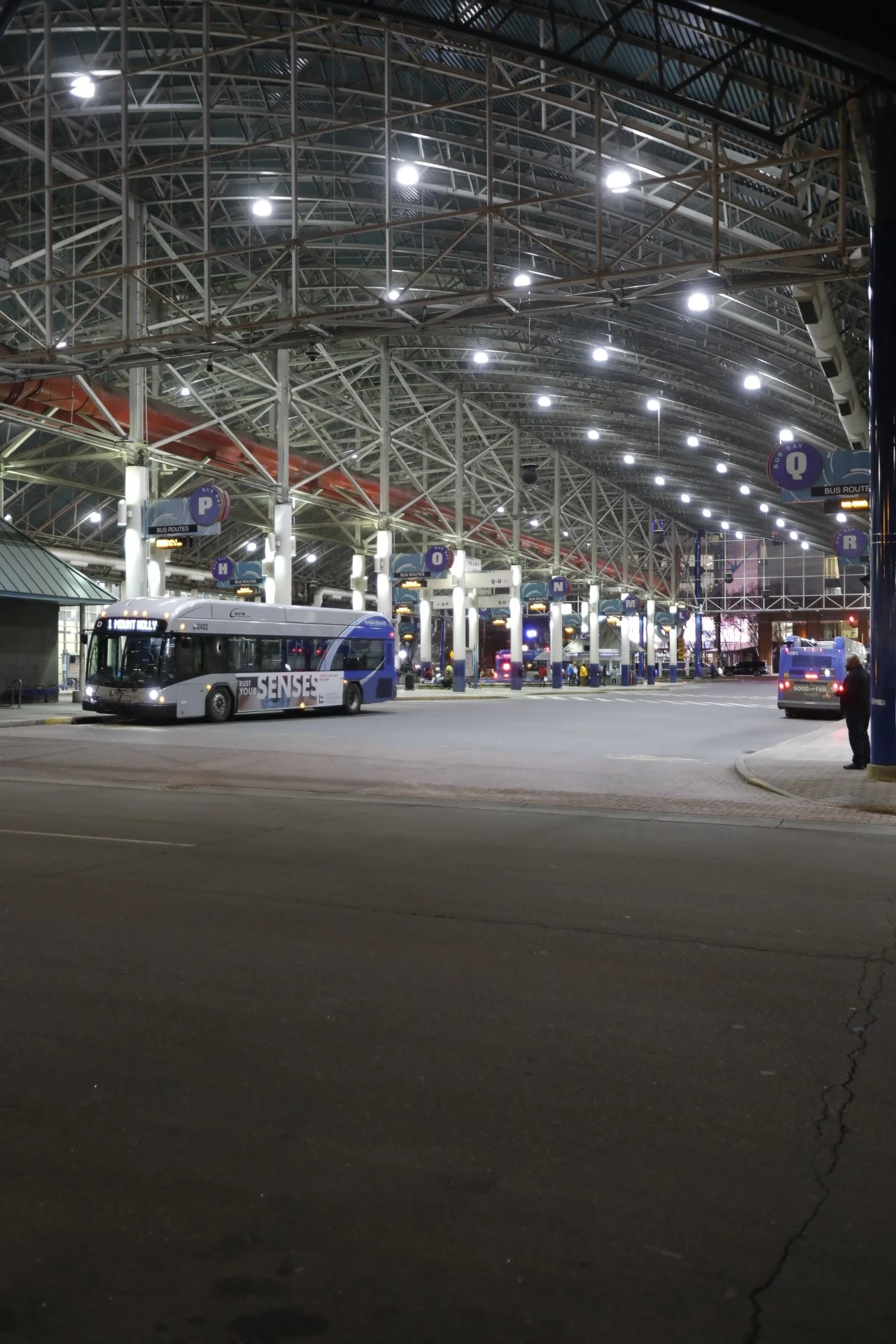
After the Last Shift — Charlotte Transportation Center @Solomn D Crowe
Late-night buses cycle through the Charlotte Transportation Center in Uptown, where public transit sustains the city after business hours, carrying essential workers across shifting routes as Charlotte continues to grow beyond the rhythms of a nine-to-five city.
On most evenings in Charlotte, the city appears to power down in an orderly way. Office towers dim floor by floor, restaurants compress into smaller footprints, and the streets that carry the momentum of daytime commerce loosen into quieter patterns. But beneath that surface calm, another city remains fully active, structured around a different clock and a different set of necessities. That city gathers each night inside the Charlotte Transportation Center on East Trade Street, an indoor terminal that functions less as a destination than as a circulatory system. Long after corporate schedules have ended and well before the next workday begins, buses arrive and depart with methodical regularity, carrying hospital staff finishing overnight shifts, service workers closing kitchens, custodial crews leaving buildings most residents never see cleaned, and early-morning labor heading toward work before the city has fully woken. This is not a place designed for comfort or spectacle. It is a place built for continuity, and the people who pass through it depend on that continuity in ways the rest of the city rarely notices.
In recent years, the role of this transit hub has grown more complex as Charlotte’s population expands and housing costs continue to push workers farther from the urban core. Public transit has shifted from convenience to necessity for a growing segment of the city’s workforce, even as national labor shortages, inflation, and post-pandemic work patterns reshape when and how people move. The Transportation Center absorbs those pressures every night, quietly revealing how a modern city actually functions once peak hours have passed. Inside, the atmosphere is not chaotic but disciplined. Routes are clearly marked, departure boards update steadily, and drivers move through pre-departure checks under lighting designed to eliminate shadow rather than mood. Riders cluster in small, subdued groups, conserving energy for commutes that often stretch an hour or more in each direction. What stands out is not congestion or disorder, but endurance — the steady repetition of movement required to keep essential systems operating.
Charlotte’s transit infrastructure, like that of many American cities, was historically designed around daytime density and commuter peaks, with off-peak service treated as secondary. That logic no longer aligns with the reality of the city’s labor force. Healthcare, logistics, food service, sanitation, and security operate continuously, and their workers move through the city on schedules that rarely align with traditional planning models. The Transportation Center exposes this mismatch without commentary. Missed connections here do not mean inconvenience; they mean lost sleep, missed childcare windows, or reduced income. Each bus departure represents a chain of labor extending outward across the city — hospital wards reopening for morning rounds, distribution centers staging shipments, office buildings being reset for another day of use. Public transit, in this context, is not an abstract civic good but an operational necessity binding disparate systems together.
These realities carry additional weight amid broader national debates about infrastructure resilience and public investment. Transit agencies across the United States are grappling with altered ridership patterns, weakened revenue models, staffing shortages, and increased responsibility for public safety and social support during hours when other services are limited. Charlotte’s Transportation Center reflects that national condition in concentrated form. Bus drivers here are not only operators of vehicles but frontline stewards of public space during the city’s quietest hours. Safety concerns, mental health crises, and housing insecurity intersect within this environment, not as isolated incidents but as ongoing conditions the system must absorb while continuing to function. What defines the space is not disorder, but persistence — a structure holding steady under pressures it was never fully designed to manage.
Urban planning conversations often emphasize walkability, aesthetics, and daytime vibrancy, but the Transportation Center offers a more revealing metric for evaluating a city’s health: whether it works when it is tired. Can people get home safely at midnight? Can they reach work before dawn? Can essential labor move without private vehicles? Those questions are answered here each night through departures logged on digital boards and buses rolling onto nearly empty streets. The image captured at the Transportation Center does not rely on drama or crisis to carry its weight. Its significance lies in its ordinariness, documenting a system in motion during hours most people never see. Charlotte will continue to grow, its skyline will change, and new transit projects will promise innovation and efficiency, but long after those announcements fade, places like this will remain indispensable. The true measure of a city is not how it performs at noon, but how it endures after the last shift, when infrastructure speaks more honestly than rhetoric ever can.