Rittenhouse Square Philadelphia at Dusk
In the hour when the city stops performing and simply exhales, Rittenhouse Square becomes a shared refuge. Lamplight, trees, and unhurried footsteps turn Center City’s pace into something softer. This feature follows the quiet emotional shift that happens at dusk—why a public park can steady you, even when it fixes nothing at all.
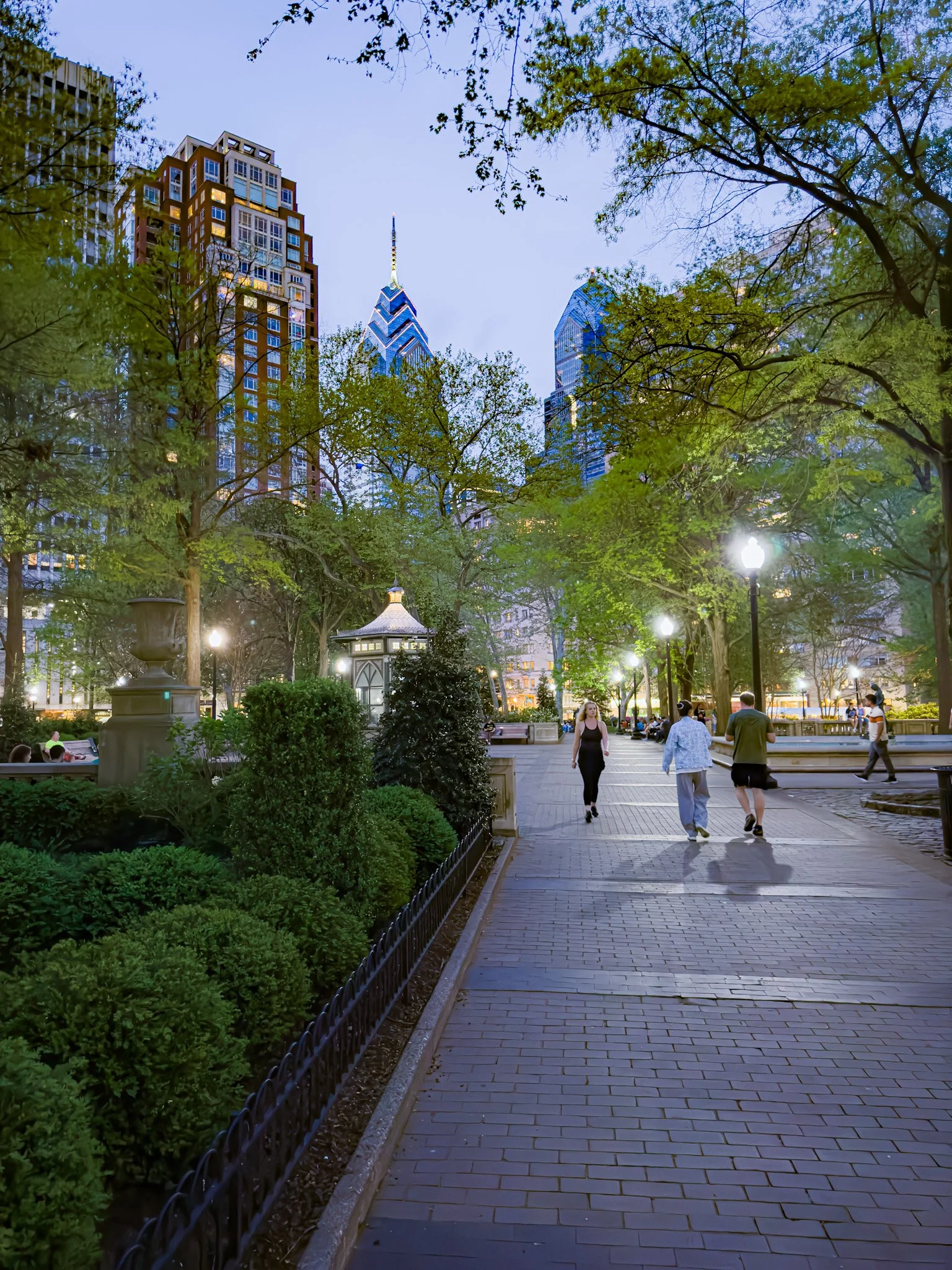
Soft Hour in Rittenhouse
Pedestrians walk along a path in Rittenhouse Square in Center City Philadelphia at dusk, with city buildings visible through the trees.
At the soft edge of evening, Rittenhouse Square Philadelphia becomes less of a destination and more of a release valve. The lamps come on along a brick path, trees hold the last blue light, and a few walkers drift forward with the skyline rising quietly beyond the canopy. That’s the whole spell: nothing monumental, nothing staged—just a public place letting people loosen their grip on the day.
Dusk is when a city shows its real face. Not the rush-hour face, not the weekend face, not the glossy “come visit” face—but the in-between expression that belongs to anyone who’s ever carried groceries home, replayed a hard conversation, or walked off a worry because walking was the only honest thing left. In Center City Philadelphia, the hours can feel like they’re priced and measured, traded and spent. In the square, time behaves differently, as if the air itself refuses to hurry. You don’t have to buy anything to be here, and that detail—simple, almost radical—changes how your shoulders sit.
Story Promise
This is a story about what dusk does to a place—and what a place can do to you. It’s about why Rittenhouse Square Philadelphia feels like a shared living room at the exact moment the day stops asking for your best performance, and the night hasn’t started demanding anything yet. Along the way, we’ll step into the square’s long memory: William Penn’s original vision for green space in a growing city, the name it carried before it was “Rittenhouse,” and the community labor—part civic, part neighborly—that keeps it tender enough to return to. And we’ll stay with the human truth beneath the history: sometimes the most important thing a city gives you is a place where you can simply exist, unremarkable and safe among strangers.
Why Rittenhouse Square Philadelphia Feels Like an Exhale at Dusk
The soft hour doesn’t arrive with fireworks. It arrives with small permissions. Permission to slow your pace because nobody’s honking behind you, permission to stop checking your phone every thirty seconds, permission to look up at the trees like you’re not late for something. At dusk, Rittenhouse Square park becomes a gentle corridor of body language—people walking as if they’re letting go of the day one step at a time. You see it in the way conversations stretch out, in the way dog leashes loosen, in the way a bench suddenly feels like an invitation instead of a pause button. Visit Philly describes the square as a place where locals and visitors gather to stroll, read, relax, and catch up—simple verbs, but they’re the verbs that keep a person from burning out.
A park at dusk is also a mirror, and it doesn’t flatter you. It shows you what you’ve been carrying by how quickly you feel the urge to set it down. Some people come in hot—fast steps, eyes forward, jaw tight—like the city’s tempo has gotten under their skin. Then the path bends, the lamps glow, and something ancient in the brain recognizes safety: trees, open space, other humans not demanding anything. That’s when the breath changes. It’s not dramatic. It’s just the quiet recalibration you didn’t know you needed.
Part of what makes this hour feel so human is that the square isn’t hidden. It isn’t a secret garden behind a gate. It sits in the middle of Center City Philadelphia, surrounded by restaurants, residences, and the constant hum of a neighborhood that never fully goes offline. And yet, inside its boundaries, the tone shifts. That contrast—busy streets outside, softer tempo inside—is the entire emotional architecture. It’s why “an evening stroll” here can feel like a reset rather than another item on a list of things to do in Rittenhouse Square.
A Square Older Than the Lives Passing Through It
It helps to know what you’re walking inside. Long before Rittenhouse was a brand name—before it was shorthand for an upscale zip code and a certain kind of dinner reservation—the square was part of a plan. In the late 17th century, William Penn and surveyor Thomas Holme laid out Philadelphia with a system of public squares meant to keep green space inside the city’s bones. The idea wasn’t just beauty; it was breathing room—space that could temper density and keep the city livable as it grew. Histories of Penn’s plan often point to his desire for a “greene countrie towne,” a city that didn’t have to choose between urban life and access to open air.
Rittenhouse Square didn’t start out with this name. It began as “Southwest Square,” and it carried that straightforward label until 1825, when Philadelphia’s City Council renamed it to honor David Rittenhouse—an astronomer, inventor, and civic figure whose work and reputation mattered enough to be etched into the city’s map. The Friends of Rittenhouse Square, the nonprofit deeply involved in the square’s upkeep today, tells that naming story plainly: a public space given a personal name as a kind of civic tribute. It’s a detail that matters because it shows what cities do when they’re healthy: they remember people, not just profits.
If you’re trying to understand the square’s intimacy, look at its shape. It’s not endless. It’s bounded—by Walnut and Locust, by 18th and 19th—stitched into a walkable grid that makes the park feel like a room rather than a wilderness. Preservation-oriented guides describe these edges clearly, because boundaries are part of what gives the place its character: the square is big enough to disappear into for a moment, small enough to cross without making it a project. That scale is one reason it works so well as a daily ritual rather than a special occasion.
And then there’s the deeper magic: a place can be old without being distant. You don’t need plaques and lectures to feel the time layered here. You feel it because the square has been a respite for generations of Philadelphians—an ordinary refuge that stayed ordinary even as the city around it evolved. The Cultural Landscape Foundation frames it as part of Penn’s original concept, a green square that shifted through uses over centuries while remaining what people needed it to be: a pause in the urban current. When you realize that, dusk takes on an added weight. You’re not just walking in a park; you’re moving through a long-held human habit: step away, breathe, return.
The Beautiful Work You Don’t See
The soft hour feels effortless, but it isn’t. A park doesn’t stay inviting by accident. Lawns don’t manicure themselves, paths don’t remain walkable by pure luck, and trees don’t thrive just because people want them to. Rittenhouse Square sits inside Philadelphia’s larger parks system, and Philadelphia Parks & Recreation describes its mission in human terms—connecting residents to the natural world, to each other, to “fun things to do and see,” while managing historic and cultural sites across the city. That’s the public backbone.
Then there’s the quieter layer: the neighborhood stewardship that turns a public park into a cared-for one. The Friends of Rittenhouse Square is explicit about this relationship—Rittenhouse Square is part of the Fairmount Park system and is operated in partnership with Philadelphia Parks & Recreation. This is not romantic language; it’s operational reality. It means a public space is kept alive through a blend of civic management and community support, the kind of collaboration most people never think about while they’re sitting on a bench. But the moment you do think about it, the square becomes even more human: it exists because people decided it should.
In 2010, the American Planning Association recognized Rittenhouse Square as one of the country’s Great Public Spaces, and local reporting emphasized why: it’s inviting, it anchors a vibrant neighborhood, and community members have repeatedly fought to keep it that way. That sentence contains the entire emotional economy of public space. Parks don’t endure because they’re pretty; they endure because people argue for them, fund them, maintain them, and return to them until returning becomes tradition. The “soft hour” at dusk is, in a sense, the dividend on all that invisible work.
But here’s the honest edge: a beloved park also carries a complicated burden. When a place becomes known as one of the best parks in Philadelphia, it attracts more than quiet walkers. It attracts attention, expectation, and competing definitions of what the space is “for.” That’s not a scandal; it’s the nature of successful public places. A square holds lunch breaks and grief walks, first dates and last conversations, tourists taking photos and locals who wish the tourists would disappear. The real achievement isn’t that everyone uses the park the same way; it’s that the park can hold many uses without collapsing into conflict.
Leaving the Square Without Losing the Calm
The truest test of a park is what happens when you leave it. Not whether it looks good on your phone, not whether it impresses an out-of-town friend, not whether it earns a glowing review. The test is whether you carry something out with you—something quieter than you arrived with. In Rittenhouse Square Philadelphia, dusk often does that work gently. It doesn’t “fix” anything. It simply interrupts the momentum long enough for you to remember your own pace.
If you’ve ever walked here after a day that felt too full, you know the strange relief of being anonymous among other humans who are also winding down. Nobody asks you to explain yourself. Nobody needs your résumé. You can be the person behind the person you’ve been performing all day. That’s why parks matter even when the city is full of more exciting options; a public square is one of the few places where presence itself is enough.
When the sky deepens and the lamps become the dominant light, you can feel the moment turning—people peeling off toward Walnut Street, toward dinner plans, toward home. The square doesn’t cling to them; it doesn’t demand loyalty. It’s there tomorrow, and that promise—quiet, nonverbal, reliable—is its greatest luxury. Near the end of the day, when everything else feels temporary, the square feels steady. You walk out, and the city resumes its speed, but you’re not quite as hurried as before.
And that’s the point. Not escape. Not fantasy. Just a pocket of steadiness inside the real world. A dusk walk through Rittenhouse Square Philadelphia is a reminder that the city still has places where you can be a person first—and everything else second.
Windows That Remember: St. Peter Catholic Church Charlotte at Night
A downtown built for speed still makes room for silence—if you know where to look. On South Tryon Street, St. Peter Catholic Church has outlasted the city’s reinventions, holding steady as glass towers rise around it. This feature explores what remains when everything else updates, and why a warm window at night can feel like a lifeline.
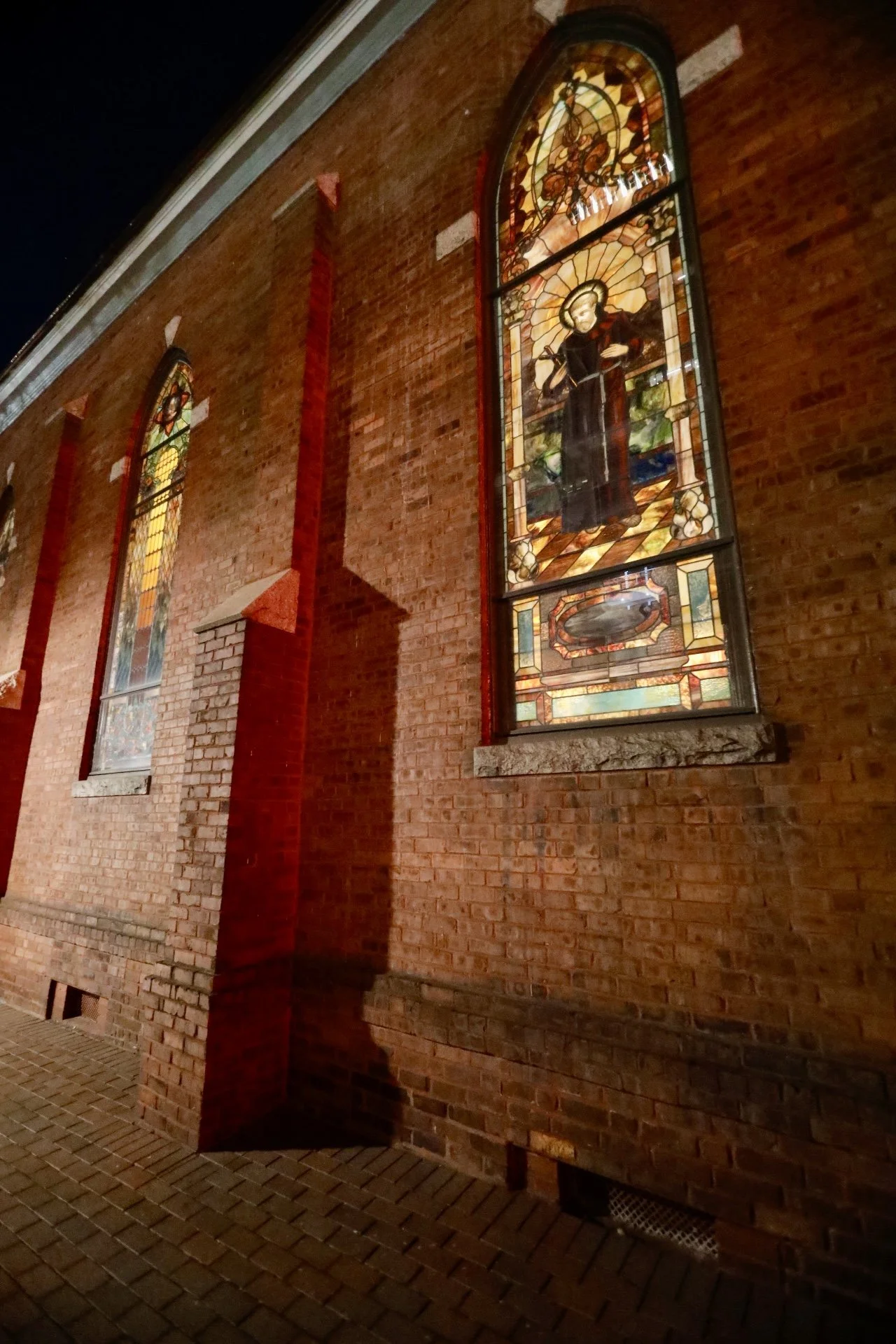
Windows That Remember
St. Peter Catholic Church on South Tryon Street in Uptown Charlotte, North Carolina, photographed at night.
On a late night in Uptown, St. Peter Catholic Church Charlotte holds its light the way some people hold their breath—quietly, on purpose. From the sidewalk on South Tryon Street, you can see brick, stained glass, and the reflective edge of newer towers behind it. The windows glow warm against the streetlamps, not asking for attention so much as refusing to vanish. In a district built for velocity—cars, calendars, quarterly goals—this is a place that doesn’t hurry. It simply stays.
Most nights, the city’s soundtrack is a layered thing: tires on wet pavement, a distant siren that never quite arrives, laughter escaping a doorway, the small electronic chirp of someone crossing when the signal says “walk.” People move through that sound carrying private cargo—grief disguised as errands, hope disguised as plans, exhaustion disguised as competence. Even when you’re not looking for anything spiritual, you’re still looking for something human: proof that you’re not just passing through a machine. Sometimes that proof shows up as a building that has outlasted the phrases the city uses to describe itself.
There’s a difference between a landmark and a lifeline. A landmark is something you point to, something you use to get somewhere else. A lifeline is something you return to, even if you don’t enter, even if you only let it steady you for a moment. At night, old churches in modern downtowns do a particular kind of work: they make space for the parts of a person that don’t fit inside a schedule. They offer a pause that feels almost rebellious.
This story isn’t really about architecture, even though architecture is the doorway. It’s about memory—how it survives in a city that constantly updates itself, and why that survival matters to people who feel updated-out. It’s about what a stained-glass window can do that a glass curtain wall can’t, and what it means when the oldest things in the center of town are still places of gathering rather than consumption. Along the way, we’ll step into the history of St. Peter—founded in the 1850s era of Charlotte—and into the present-day pressure of a downtown that rarely lets anything remain unchanged. And we’ll end where most nights begin: on the sidewalk, deciding what kind of person you want to be as you keep walking.
When a City Moves Faster Than Its Memory
Charlotte is a city that knows how to grow. If you’ve lived here long enough—or visited, left, and returned—you can feel the acceleration in the skyline itself. Comparisons of past decades to today often read like a before-and-after: the outlines are familiar, but the scale is startling, as if the city decided to think bigger and never stopped. Growth, though, has a shadow side that doesn’t always make it into the celebratory language. When newness becomes a civic reflex, older buildings don’t just age—they disappear.
The strange thing is how quickly we adapt to that disappearance. Humans are built to normalize their surroundings; we can make peace with almost anything if it happens gradually enough. A beloved corner becomes a construction fence, then a grand opening, then simply “the place you go now.” You can miss a building the way you miss a person: not in one dramatic moment, but in a series of small recognitions—I used to turn here, I used to meet them here, I used to be someone else here. Cities don’t just hold our routines; they hold our earlier selves.
In Uptown, the pressure of redevelopment can feel almost metaphysical, like the ground itself wants to be something different every decade. A university-based look at the oldest buildings in Uptown points out how few structures over a century old remain, and it names the trade-off plainly: creating a newer city has often meant destroying much of the old. That same context notes what tends to survive among the oldest structures: churches, because communities fight for them in a different way than they fight for storefronts.
And that fight isn’t only about history nerds preserving artifacts. It’s about a deeper need: continuity. Not nostalgia, not “everything used to be better,” but continuity—the sense that your life is not happening on a disposable stage. In a city of promotions and relocations, you can start to feel like even your own story is temporary. Old walls don’t solve that feeling, but they challenge it. They insist that something can be built to last longer than a marketing cycle.
St. Peter Catholic Church Charlotte and the Discipline of Staying
St. Peter’s story begins before “Uptown” became a brand. The parish traces back to the early 1850s, with the church’s own historical account describing a cornerstone laid in 1851 and a first building rising when Charlotte was still small enough to have edges you could name. In that telling, St. Peter originally stood at what was then the extreme southern limits of the city—an outpost more than a center. That detail matters, because it flips the way we usually talk about downtown churches today. They look like they’ve always been surrounded by towers, but towers came later; the church was here first.
The building people recognize now dates to another threshold moment: 1893, when the cornerstone was laid for the Victorian Gothic-style structure that still stands on South Tryon. The church’s own history describes a neighborhood that changed in waves—empty lots becoming homes, homes replaced by businesses, the city growing around the parish until the outpost became the heart. It’s a simple narrative, almost too clean—except it’s also what cities do: they swallow their outskirts and call it progress.
When you read that history, you also feel the stubbornness required to remain. St. Peter is described as the oldest edifice remaining on Tryon Street, a constant in an urban landscape that keeps rewriting itself. That’s not a sentimental statement; it’s a practical one. Remaining means paying for repairs when land values make selling tempting. Remaining means enduring seasons where membership shifts outward, when downtown empties at night, when the city’s energy moves to the next neighborhood that feels “hot.” Remaining is a discipline, and disciplines always cost something.
It’s also a discipline that sometimes requires reinvention without surrender. In 1986, St. Peter regained full parish status, and Jesuit priests began serving the growing parish and surrounding business community in a more intentional way, with daily Mass and reconciliation named as part of that continued presence. That date is more than an administrative milestone; it marks a moment when the church chose to live as a downtown church in a downtown that was becoming something else. The Jesuits’ broader ministry listing for St. Peter emphasizes the same two anchors—its founding in 1851 and Jesuit staffing since 1986—like coordinates you can navigate by.
The address itself—507 South Tryon Street—feels almost like a dare to the city: try to outgrow this, too. The Diocese of Charlotte’s parish listing places St. Peter right there in the center of the map of Catholic life, complete with a weekly schedule that reads like a quiet insistence that community is still possible in the core. A downtown parish doesn’t only serve residents; it serves the commuters, the visitors, the workers who arrive before sunrise and leave after dark. It serves the people whose lives are split into “where I live” and “where I earn.”
What Stained Glass Teaches a Glass City
There are cities built of brick, and cities built of glass. Charlotte, in its recent decades, has learned the language of glass fluently: reflective towers that mirror the sky, lobbies that feel like controlled climates, conference rooms where the day is measured in decisions. Glass is beautiful, but it has a habit of turning everything into a reflection. You see yourself in it. You see the city’s image of itself in it. And after a while, you can forget there are other ways to look.
Stained glass is not the same kind of seeing. It’s glass that refuses to be neutral. It takes light and gives it a story. It turns glare into color, and color into meaning, and meaning into a kind of patience. That patience matters downtown. Because downtown life trains your eyes to scan: signage, signals, notifications, faces, risk. Stained glass asks for a longer gaze, the kind that says, slow down; you might miss what’s true. You don’t have to be religious to understand the invitation. You only have to be tired.
The streets around St. Peter have also become a corridor of art and performance—another kind of meaning-making layered into the same blocks. The Levine Center for the Arts, completed in 2010 through a partnership of civic and philanthropic support, helped formalize this stretch of South Tryon as a cultural destination, with institutions and venues that pull people downtown for reasons other than work. Nearby listings for St. Peter in Uptown Charlotte’s visitor resources even describe it in that same ecosystem—both a church and a presence among museums, theaters, and the steady foot traffic of the district.
That context can make the church feel like an aesthetic complement—brick as a counterpoint to steel. But that’s the shallow reading. The deeper truth is that cities need more than attractions; they need interiors. They need places where you’re not performing your life, not selling your competence, not optimizing your minutes. Art can do that. So can worship. So can simple quiet. The point isn’t which door you choose; it’s that the doors still exist.
And there’s another lesson in stained glass that downtown buildings rarely teach: limitation. Stained glass windows are designed to be framed. They are beautiful precisely because they accept boundaries—lead lines, panels, shapes that hold the image together. Modern life often treats boundaries like enemies, as if the good life is limitless choice and constant access. But any honest person knows that a life without boundaries doesn’t become free; it becomes scattered. A framed window can remind you that structure isn’t the opposite of beauty. Sometimes structure is what makes beauty possible.
The Quiet Work of Doors
If you stand near a downtown church long enough, you’ll notice something subtle: people behave differently as they pass. Not everyone, not dramatically, but enough to feel the shift. Voices lower a notch. Steps slow, almost unconsciously. Some people glance up as if checking their bearings against something older than themselves. It’s not superstition; it’s recognition. A church is one of the few remaining public signals that a person is more than a consumer moving between transactions.
St. Peter’s, specifically, carries the Jesuit imprint in the way it describes its mission. Uptown Charlotte’s guide to the church highlights it as the only Jesuit parish and emphasizes a spirituality shaped by Ignatian language—finding God in all things, discernment, service, community. Even if you’re not part of that tradition, you can hear the human version underneath it: pay attention, live deliberately, don’t let your life become accidental. That message lands differently when delivered by a building that has watched the neighborhood change from lots to homes to businesses to skyscrapers.
There’s also something important about a church that stays downtown: it refuses to outsource the soul of the city to the suburbs. In many American cities, spiritual life migrates outward with families and housing, leaving the core to commerce and nightlife. But a downtown parish says: the center still deserves care. It says: the worker matters as much as the resident, the weekday matters as much as the weekend, the noon hour matters as much as Sunday morning. The Diocese’s schedule listing is ordinary on paper—times, days, consistency—but ordinary is exactly the miracle in a place built to be exceptional.
And memory, real memory, is always tethered to ordinary repetition. You don’t remember the one glamorous night as clearly as you remember the thousand small routines that formed your life. That’s why “windows that remember” is more than a poetic phrase. It’s a description of how places carry us: by being there when we return, by offering the same light through different seasons of our own changing faces. In a city where so much is designed to be replaced, the refusal to be replaced becomes its own kind of testimony.
So you keep walking. You pass the doors, maybe you enter, maybe you don’t. But you leave with a different interior weather than you arrived with—slower, steadier, less convinced that speed is the same thing as purpose. And if you find yourself back on South Tryon another night, you’ll notice the same stubborn warmth holding its ground. St. Peter Catholic Church Charlotte will still be there, doing what it has done for generations: letting light mean something, and letting the city remember it has a heart.