When Distance Was Medicine: Roosevelt Island’s Smallpox Hospital and the Architecture of Quarantine
A Gothic Revival ruin across the East River preserves a blunt truth: New York engineered distance long before it named it—and the ethics of quarantine still echo in stone.
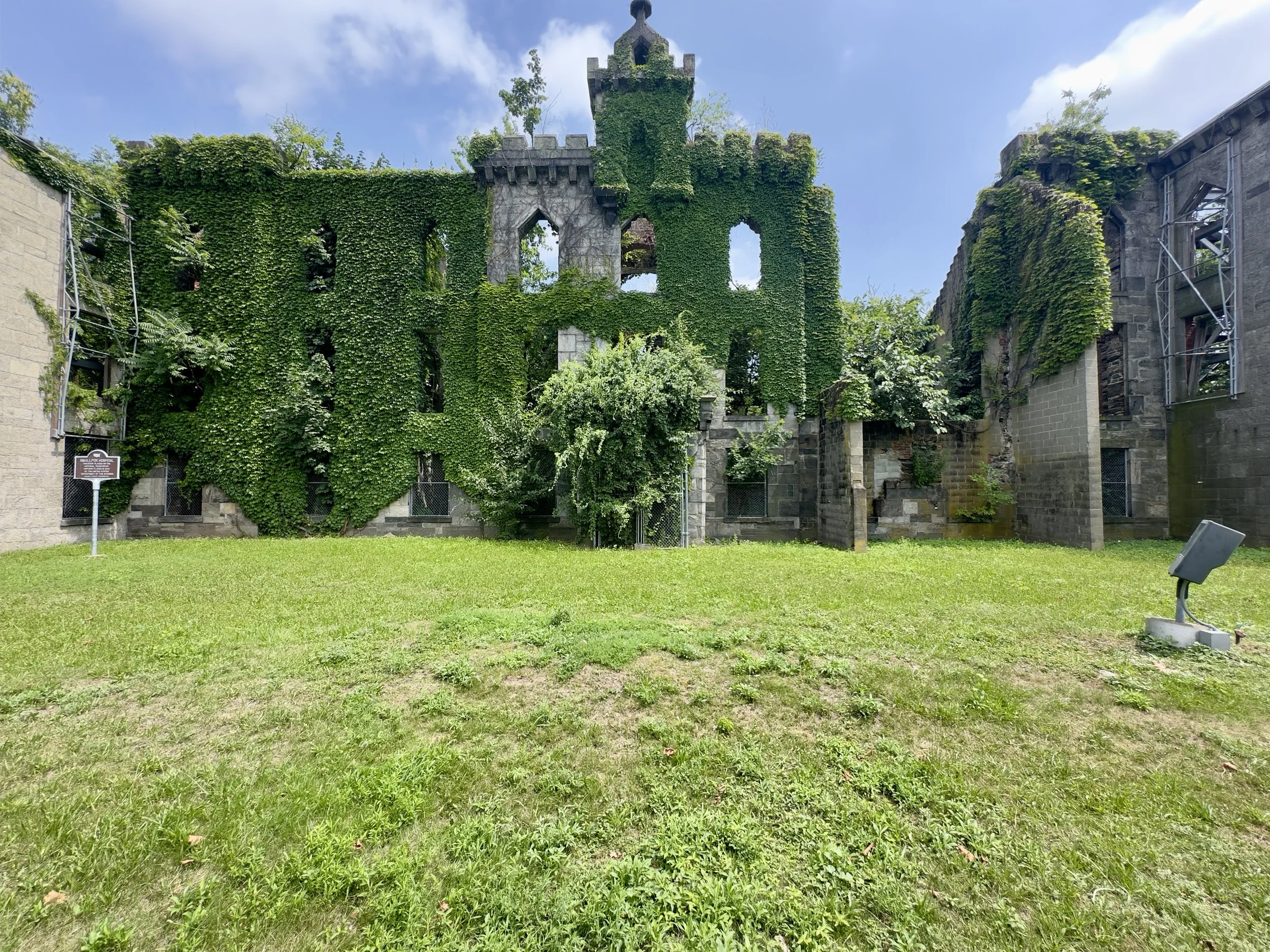
The Renwick Ruin: Smallpox Hospital, Roosevelt Island @Solomon D Crowe
Ivy-covered Gothic Revival ruins of New York City’s former Smallpox Hospital on Roosevelt Island—an 1856 quarantine landmark that still asks what “distance” costs a city.
A stone shell sits on the edge of the East River, its windows hollowed out, its arches softened by ivy and time. Across the water, Manhattan keeps moving—lights, traffic, ambition—while this quiet façade holds its position like a witness who refuses to leave the stand. It is beautiful in the way ruins often are: not because they are broken, but because they tell the truth about what a city chooses to remember, and what it tries to forget.
New York did not invent “social distance” in 2020. Long before the phrase became a daily instruction, the city built distance into its geography—water as a moat, an island as a boundary, an institution as a container for fear. On what was once called Blackwell’s Island and is now Roosevelt Island, the ruins of the Smallpox Hospital—often referred to as the Renwick Ruin—trace back to a purpose-built place that opened in 1856 to isolate people infected with one of the nineteenth century’s most dreaded diseases. The decision was both practical and symbolic: keep contagion away from the dense city, and keep the sight of suffering out of everyday street life.
Blackwell’s Island: where New York sent what it couldn’t hold
Before this was a “view,” it was a system. New York City purchased the East River island in 1828. In 1832, a penitentiary was built there, physically separating prisoners from the city; over time, the island accumulated a network of institutions—workhouses, a general hospital, an almshouse, a hospital for “incurables,” and, for a time, a smallpox hospital. By the early twentieth century, New Yorkers were nicknaming it “Welfare Island,” a shorthand that revealed how deeply the place had become associated with the people the city didn’t know how (or didn’t want) to integrate. The island was officially renamed Welfare Island in 1921, and later renamed Roosevelt Island in 1973, a move the National Park Service connects to disability history in light of Franklin D. Roosevelt’s life with polio. The names are not trivia; they are a moral biography written in municipal lettering.
If that sounds harsh, it’s because the island’s history is harsh. It received national attention when journalist Nellie Bly went undercover in the Women’s Lunatic Asylum and reported abuses and inhumane conditions, helping force a public reckoning. In the nineteenth century, distance did not simply mean “health.” Distance also meant “control,” “containment,” and “out of sight.” Blackwell’s Island made the city’s hierarchy physical: the poor and the sick were moved to the edge, and the river did what walls could not.
This is the context in which the Smallpox Hospital matters. Its ruins are not isolated in meaning; they are part of an island designed to absorb the city’s overflow—disease, poverty, incarceration, disability. When the city built a quarantine hospital here, it was leveraging the same geography it used for prisons and asylums: water as an administrative tool.
Why smallpox demanded distance
Smallpox was not simply another illness. It was terrifying, often deadly, and culturally loaded with fear. Even as vaccination entered the historical timeline, outbreaks and panic persisted. In dense nineteenth-century cities, contagion wasn’t abstract—it was a practical terror that could empty streets, shut businesses, and turn neighbors into suspicious strangers. Isolation, then, became one of the few tools officials could deploy quickly: separate the sick, limit contact, and try to protect the “many” from the “few.”
A National Library of Medicine account describes the hospital’s early purpose plainly: it opened in 1856 to isolate and quarantine patients with smallpox on Blackwell’s Island, at a remove from the rest of New York. By around 1875, the same account notes, it closed as a smallpox hospital, reflecting how public health infrastructure shifts when a crisis changes shape. That is the first lesson the ruin teaches: emergency architecture rarely stays “emergency.” Cities repurpose, downgrade, abandon, and forget.
An architecture that tried to dignify the feared
The second lesson is more surprising: the building was not utilitarian in the way people often imagine quarantine structures. It was designed in the Gothic Revival style by James Renwick Jr.—an architect associated with major cultural and religious landmarks, including St. Patrick’s Cathedral and the Smithsonian Institution Building. If you wanted authority in stone, you hired Renwick. That the city commissioned an architect of this caliber for a contagious-disease hospital suggests something more complicated than mere disposal: even in an age of stigma, there was an attempt—however imperfect—to give the sick a setting that signaled seriousness, order, and a kind of dignity.
Gothic Revival architecture carries a visual language that’s almost impossible not to feel. Arches, vertical lines, and stone ornamentation create a sense of ritual. In the context of a smallpox hospital, that atmosphere could have meant many things at once: a warning to outsiders, a reassurance to staff, and a fragile promise to patients that they had not been reduced to a public nuisance. The ruins we see now are not only the remains of a building; they are the remains of an argument. The argument was that the city could separate people for public safety without erasing their humanity.
But architecture cannot guarantee ethics. Isolation is a form of care, and it can also become a form of punishment when the isolating institution is underfunded, understaffed, or culturally treated as a dumping ground. Every quarantine story carries both possibilities at once. The river boundary protected New York. It also made it easier for New York to look away.
From hospital to ruin to landmark: how a crisis becomes a relic
After the Smallpox Hospital stopped functioning in its original role, it entered the long afterlife that so many institutional buildings inherit: repurposing, neglect, and slow decay. The National Library of Medicine account notes that the structure was abandoned in the mid-1950s. Exposure, weather, and fire left the building hollowed out. And then—an unexpected turn—the city and nation began to treat the ruins as historically significant, not merely as derelict.
The National Park Service notes the ruins of the Smallpox Hospital, which opened in 1856, were added to the National Register of Historic Places on March 16, 1972. This matters for more than bureaucratic reasons. It means the country recognized that a quarantine hospital—an infrastructure of fear and care—was part of the national story worth protecting. The National Park Service also notes that the dilapidated structures on the island are listed as a New York City landmark and are the only ruins in New York City to hold that local landmark designation. A ruin, in other words, became officially meaningful—not despite its brokenness, but because the brokenness is the point.
That designation shifts how the ruin is read. It is not a romantic European relic; it is a modern city’s self-portrait. It says: this is how we built safety. This is what we did with illness. This is where we placed the people who scared us.
The ruin as a modern mirror
In the 2020s, the Renwick Ruin reads differently than it did in the 1970s. After COVID-19, many people carry a new vocabulary for contagion: outbreaks, ventilation, distancing. But the deeper shift is emotional. We have re-learned, at scale, what it means to be told to stay away from one another for safety. We have felt the friction between community and containment. We have also watched how rules are not experienced equally: distance is easier for those with space, money, flexible work, and reliable care. For everyone else, “distance” can feel like a luxury instruction delivered to a life that cannot afford it.
That is why this ruin matters beyond its architectural pedigree. It is a physical reminder that epidemics are not only biological events; they are social events that reconfigure who belongs where. When the city built a smallpox hospital on an island, it was not just building a ward. It was building a map of moral priorities: protect the many, isolate the few, and do it quickly. The logic is understandable. It is also perilous, because once a society gets comfortable isolating certain bodies for the safety of others, the boundary can harden into habit.
This is the uncomfortable truth the ruin holds. A quarantine can be compassionate. It can also become a template for stigma and neglect. The architecture cannot guarantee which one it will be. The architecture can only reveal the choice.
Stabilization, pauses, and the question of what comes next
The future of the Renwick Ruin is still being negotiated. The Roosevelt Island Operating Corporation (RIOC) describes the structure as “now… stabilized” and anticipates it being surrounded by a new park concept called “Wild Gardens, Green Rooms.” Separately, RIOC-linked material connected to a proposed “Public Health Memorial” frames the site as uniquely suited for reflection and describes a phased approach tied to fundraising, stabilization drawings, and eventual public opening.
At the same time, public-facing financial documentation and preservation advocates have described continuing needs for stabilization and restoration, reflecting the complexity and cost of working with a fragile landmark on a constrained, weather-exposed site. Like so many urban preservation efforts, the story is not simply “saved” or “lost”; it is “phased,” “engineered,” and “budgeted,” with public interest and technical reality tugging in different directions.
A 2017 set of schematic design and cost documents for stabilization work illustrates that reality in numbers, outlining a multi‑million‑dollar scope. Even without drilling into every line item, the takeaway is clear: keeping a ruin standing is not romantic; it is infrastructure work. It requires engineering, materials science, and long-term funding—especially when the site is exposed to river weather and seasonal freeze–thaw cycles.
Whether the final outcome looks like a garden, a memorial, an educational site, or a carefully managed “standing ruin,” the underlying question is the same: what should a city do with the physical remains of a public health emergency?
This is not a small question. In the United States, memorials have traditionally leaned toward war, presidents, and triumphal narratives. Public health is harder to memorialize because it is both intimate and collective. It is carried in bodies, in grief, in invisible losses, in the lives that continued because someone else did the work of prevention. A smallpox hospital ruin is an unusually honest artifact for that kind of remembrance. It refuses triumphalism. It asks for humility.
Standing at the edge of the story
To encounter the Renwick Ruin is to stand at a seam—between boroughs and between eras. The site is close enough to Manhattan to feel the city’s pulse, far enough to sense how water changes the atmosphere. It shares an island with contemporary development and everyday domestic life, which makes the contrast sharper: a place built for separation now sits inside a neighborhood built for normalcy.
That contrast is what gives the location its travel power. This is not escapism. It is a kind of urban pilgrimage. You don’t come only for aesthetics; you come for perspective. The ruin invites you to think about how cities build their ethics: where they place their hospitals, whom they protect first, and how they treat those who become inconvenient.
The lesson the stones still offer
Smallpox is, in one of modern history’s rare unambiguous victories, considered eradicated globally through vaccination. But the social mechanics that surrounded smallpox are not eradicated. Fear still moves faster than nuance. Institutions still struggle to balance individual dignity with collective safety. And public trust—always the most important infrastructure in a crisis—still fractures under pressure.
That is why the Renwick Ruin is not just a relic of the nineteenth century. It is a civic mirror for the twenty-first. It reminds us that “distance” can be a medical tool, but it is never morally neutral. It can protect. It can isolate. It can heal. It can hide. The city that built a hospital on an island was making a decision about what kind of community it wanted to be under stress.
In the end, the ruin does not offer a simple verdict on that decision. Instead, it offers something rarer: a place to hold the question. In a culture that moves quickly past discomfort, that may be the most valuable form of preservation there is.
What is the Renwick Ruin?
It’s the remains of the former Smallpox Hospital on Roosevelt Island (formerly Blackwell’s Island), a Gothic Revival structure that opened in 1856 as an isolation hospital.
Who designed the Roosevelt Island Smallpox Hospital?
James Renwick Jr., associated with major projects including St. Patrick’s Cathedral and the Smithsonian Institution Building.
Why is the Smallpox Hospital historically significant?
It represents how New York built quarantine into the city’s geography—using islands and institutions to manage disease and social anxiety—and it is recognized on historic registers.
When did Roosevelt Island change names?
NYC purchased the island in 1828; it was nicknamed “Welfare Island” in the early 1900s, renamed Welfare Island in 1921, and renamed Roosevelt Island in 1973.