A Small Light in a Big City: The Comfort of the Familiar
In the middle of a big city, familiarity becomes its own kind of shelter. This Toronto editorial uses one glowing sign, rising steam, and a civic landmark to explore why the smallest comforts often make the boldest travel possible.
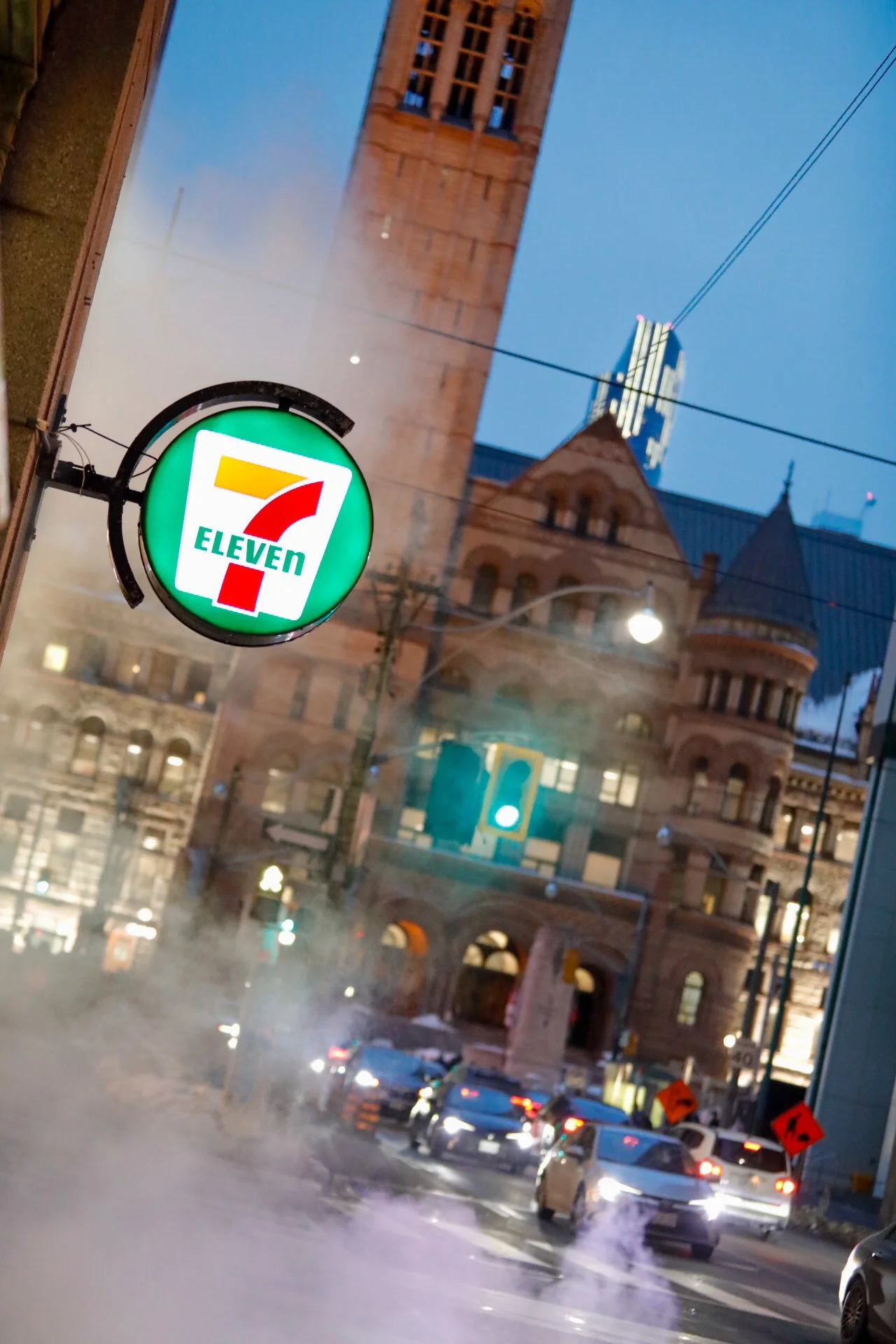
A Small Light in a Big City — Sankofa Square, Toronto @Solomon D Crowe
A familiar 7‑Eleven sign glows near Sankofa Square as sidewalk steam rises and Old City Hall anchors the background—three layers of Toronto in a single blue-hour moment.
There’s a particular shade of blue that only shows up when a city is switching shifts—when daylight has surrendered but night hasn’t fully taken control. It’s the hour when glass towers turn into aquariums, when streetlights feel like punctuation, and when the pavement starts to look like it’s holding its own heat. In downtown Toronto, near Sankofa Square and the civic spine that runs through the core, that blue hour makes everything look slightly unreal—like the city is pausing to decide which version of itself it’s going to be for the next twelve hours.
And then there’s the sign.
Not a landmark. Not a cathedral. Not a museum. Just a bright, familiar circle of color that reads instantly, without translation, without context, without a guidebook. It hangs there with the confidence of something that doesn’t need to be introduced. Under it, the sidewalk breathes. Steam rises from a vent in the concrete—an exhale from the underground infrastructure that keeps the city warm, moving, running. Behind it, the old stone of City Hall sits in the background like a memory that refuses to be overwritten. Three layers of modern life in one glance: the quick stop, the hidden system, the long history.
It’s an image that looks simple until you realize how many people it applies to.
Because the truth about big cities—especially when you’re traveling, especially when you’re tired—is that novelty is expensive. Not financially, necessarily, but mentally. New streets require decisions. New restaurants require courage. New neighborhoods require attention. Every “authentic experience” is another tiny leap into the unknown. That’s what makes travel thrilling. It’s also what makes it exhausting.
So at some point, even the most adventurous person reaches for something familiar—not because they’ve failed at discovery, but because they’re human. They want a small light in the big city. Something that says: You’re fine. You can solve this in five minutes. You can reset here.
That’s the unspoken role of places like this. They are the safety rails of travel.
The city sells itself on its highlights—icons, festivals, skyline views, perfect plates on perfect patios. But the city actually functions on dependable nodes: convenience stores, transit stops, late-night counters, bright signs that stay awake when everything else feels uncertain. Those are the places where you watch the real story move through: the visitor who doesn’t know the neighborhood; the worker ending a shift; the couple debating where to go next; the person who just needs a bottle of water, a receipt, a moment to breathe.
In travel writing, we don’t always admit how much these nodes matter because they don’t photograph like romance. But they are romance of another kind: a city’s quiet willingness to provide for you without asking who you are.
The most dramatic part of this scene isn’t the architecture or the neon. It’s the emotion behind it—the fact that a familiar sign can lower your heart rate. That it can turn an unfamiliar block into a manageable one. That it can make a city feel less like a test and more like a place you can live inside.
If you’ve traveled enough, you know the feeling. It’s not about craving processed snacks or needing a brand name. It’s about the instant relief of recognition. The comfort of a shared language. The way a predictable place gives you back your attention so you can spend it on what matters: the streets, the culture, the people, the wonder.
And that’s where Toronto excels, whether it’s trying to or not.
Toronto is a city of layers—of old stone and new glass, of civic buildings and quick commerce, of underground systems that hum beneath the surface while street-level life keeps reinventing itself above. It’s a destination that can feel “easy” in the best sense: navigable, legible, safe enough to explore, alive enough to surprise you. It is also a city that can overwhelm quickly if you demand that every moment be exceptional.
The smartest travelers don’t demand that. The smartest travelers build in recovery. They let the city be ordinary sometimes. They accept that a “great night” often begins with something small and unglamorous: a quick stop for water, a snack for the walk, a pause to regroup, a moment to decide what happens next. They understand that the best travel isn’t a nonstop highlight reel; it’s a rhythm—intensity, stillness, intensity again.
This is where the steam matters—not as a special effect, but as a reminder that cities have bodies. Toronto has a circulatory system: heat, power, water, transit, service corridors, maintenance schedules, invisible workers doing invisible work. The steam rising up is the city’s breath escaping into the night air, a visible reminder that comfort is built, not accidental. Travelers experience the surface—restaurants, attractions, nightlife—but the surface is only possible because the below-ground systems are functioning.
There’s a reason that breath feels comforting, too.
It suggests continuity. It suggests that someone is keeping the lights on.
When you put that next to the old civic building in the background, the story deepens. You start to feel the contrast between “fast” and “lasting.” Between places built to serve you now and structures built to outlast you. Between the night’s quick decisions and the city’s longer memory. This is what makes downtown Toronto photogenic beyond aesthetics: it’s a place where eras are visibly stacked, where the modern city doesn’t hide its past—it simply builds around it.
There is an argument that global brands flatten cities, turning every destination into a familiar loop of the same signs. That argument isn’t wrong. If all you do is chase familiarity, you miss the soul of a place. You miss the local. You miss the strange, the specific, the unrepeatable. You miss the very point of going.
But there’s another truth that rarely gets equal airtime: familiarity can be a doorway, not a destination. A traveler doesn’t stop at a bright sign because they want the city to be the same everywhere; they stop because they want the city to be survivable enough to keep exploring.
Familiarity is how many people stay brave.
It’s how a visitor who’s never navigated a dense downtown at night convinces themselves to keep walking. It’s how someone who is alone in a city still feels part of something. It’s how a newcomer finds a foothold. It’s how a tired person gives themselves permission to keep going.
Cities that offer those footholds feel generous. Cities that don’t can feel punishing.
Toronto—especially around its busiest intersections and squares—offers footholds everywhere: signs, lights, late hours, easy access to basics. It’s a city where you can wander without feeling like you’re gambling with your safety or your time at every turn. That matters. Not as a marketing slogan, but as a real travel advantage. You don’t have to be a “hardcore” traveler to enjoy it. You don’t have to be brave all the time. You can just be curious.
And that is where an editorial like this becomes less about a convenience sign and more about modern travel itself.
Because travel culture often glorifies the extreme: the remote, the rugged, the “hidden gem” that requires an algorithm-proof level of effort to reach. That’s one kind of travel, and it’s legitimate. But for many people—especially the ones who return to a destination again and again—the best travel is the kind that doesn’t demand constant performance. It’s the kind that lets you take a breath. It’s the kind that holds you when you’re tired.
Sometimes the most valuable part of a destination is that it feels doable.
That it has a rhythm you can step into.
That it has small lights.
The irony is that these small lights often appear most clearly against big backdrops. A bright sign feels more like comfort when the building behind it looks old and serious. Steam feels more like warmth when the air feels sharp. Traffic feels more like life when the city seems to stretch beyond your field of view. The scene becomes a reminder that cities aren’t just collections of attractions. They are environments—emotional as much as physical.
A city can welcome you without speaking to you.
A city can calm you without knowing your name.
That’s why the most viral travel stories—the ones that spread, the ones people share and say “this is exactly it”—often aren’t about the top-ten list. They’re about recognition. A reader sees themselves in the moment. They remember the feeling: being somewhere new, wanting to be adventurous, but needing one familiar anchor to keep the courage alive.
And suddenly the editorial isn’t just about Toronto.
It’s about every person who has ever stepped out of a hotel lobby, looked down a busy street, and felt the simultaneous thrill and fatigue of being out of place. It’s about the quiet psychology of travel: the way the mind constantly negotiates risk, comfort, curiosity, and energy. It’s about the truth that you can love discovery and still crave something known.
In that sense, the 7‑Eleven sign isn’t the subject. It’s the symbol. It’s a short sentence in a longer story about modern movement.
The steam is not the subject either. It’s the reminder that the city is alive, breathing through the cracks, powered by systems that rarely get photographed but always get felt. Old City Hall isn’t the subject. It’s the witness—a stone anchor reminding you that cities have long memories, even if the streets feel like they change every year.
Put them together, and you get a travel editorial with a point: the most important part of a destination isn’t always what’s unique. Sometimes it’s what makes you feel steady enough to go looking for what’s unique.
Because the truth is, no one travels on inspiration alone. People travel on a combination of wonder and reassurance. They travel on the idea that they will be safe enough to enjoy the unfamiliar. They travel on the expectation that there will be water when they’re thirsty and light when they’re lost. They travel on the belief that the city will hold them, even briefly, even casually.
And if you want to understand a destination, pay attention to what stays open late. Pay attention to what glows. Pay attention to what people orbit when the plans fall apart or the night runs long. Those are the places that reveal a city’s real hospitality—not the curated hospitality, but the functional kind.
In downtown Toronto, near Sankofa Square and the civic heart, the small lights are everywhere. They aren’t glamorous. They aren’t trying to be. They’re simply doing their job: keeping the city legible, keeping people moving, keeping the night from becoming too big.
That’s what this scene holds, and why it works. It’s not just “Toronto at blue hour.” It’s modern travel in one glance: a familiar sign, a breathing street, a historic backdrop, and the unspoken relief of knowing that even in a big city, you can still find something small that understands you.
Editorial licensing note: This story and the accompanying images are available for editorial licensing and publication.