A Small Light in a Big City: The Comfort of the Familiar
In the middle of a big city, familiarity becomes its own kind of shelter. This Toronto editorial uses one glowing sign, rising steam, and a civic landmark to explore why the smallest comforts often make the boldest travel possible.
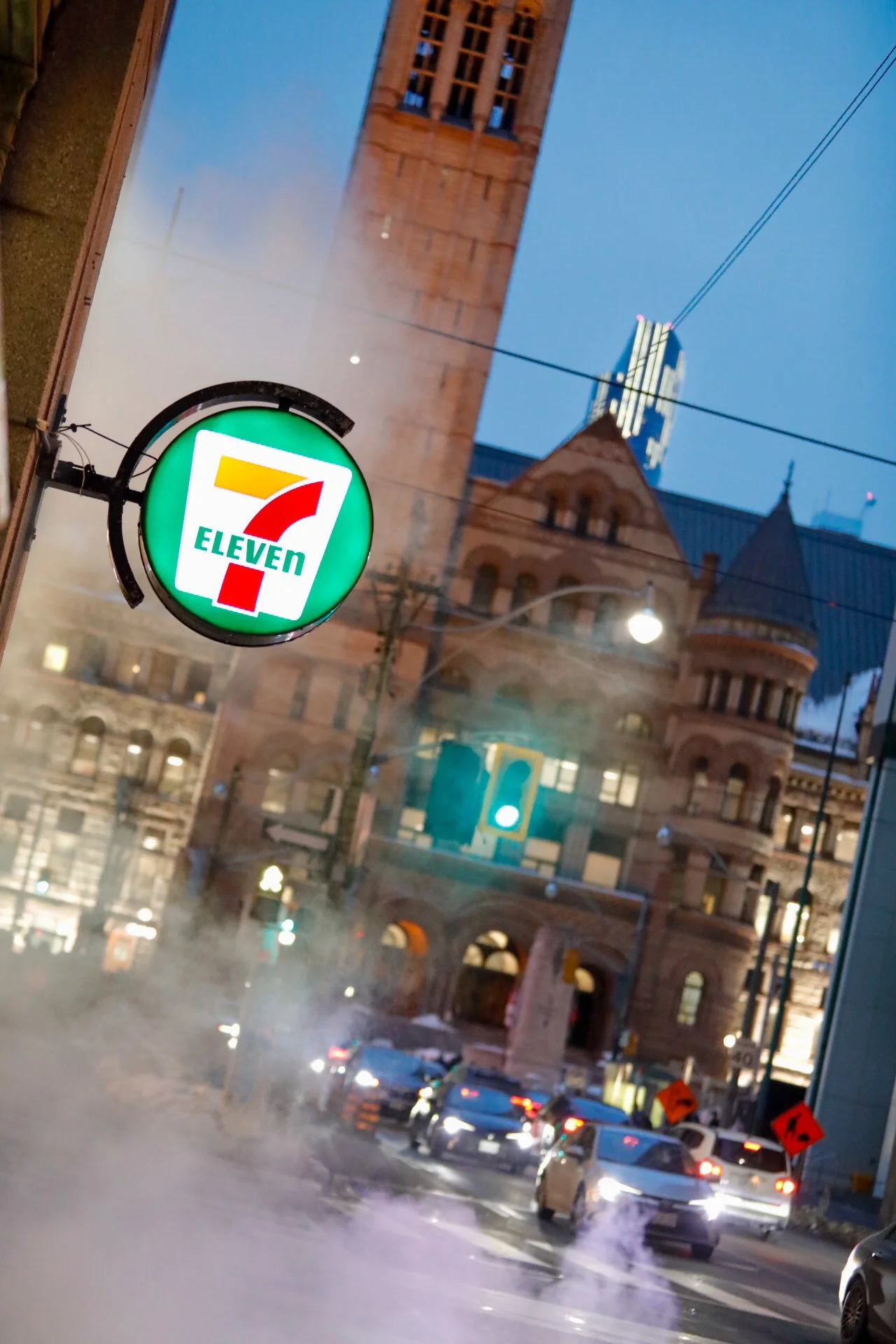
A Small Light in a Big City — Sankofa Square, Toronto @Solomon D Crowe
A familiar 7‑Eleven sign glows near Sankofa Square as sidewalk steam rises and Old City Hall anchors the background—three layers of Toronto in a single blue-hour moment.
There’s a particular shade of blue that only shows up when a city is switching shifts—when daylight has surrendered but night hasn’t fully taken control. It’s the hour when glass towers turn into aquariums, when streetlights feel like punctuation, and when the pavement starts to look like it’s holding its own heat. In downtown Toronto, near Sankofa Square and the civic spine that runs through the core, that blue hour makes everything look slightly unreal—like the city is pausing to decide which version of itself it’s going to be for the next twelve hours.
And then there’s the sign.
Not a landmark. Not a cathedral. Not a museum. Just a bright, familiar circle of color that reads instantly, without translation, without context, without a guidebook. It hangs there with the confidence of something that doesn’t need to be introduced. Under it, the sidewalk breathes. Steam rises from a vent in the concrete—an exhale from the underground infrastructure that keeps the city warm, moving, running. Behind it, the old stone of City Hall sits in the background like a memory that refuses to be overwritten. Three layers of modern life in one glance: the quick stop, the hidden system, the long history.
It’s an image that looks simple until you realize how many people it applies to.
Because the truth about big cities—especially when you’re traveling, especially when you’re tired—is that novelty is expensive. Not financially, necessarily, but mentally. New streets require decisions. New restaurants require courage. New neighborhoods require attention. Every “authentic experience” is another tiny leap into the unknown. That’s what makes travel thrilling. It’s also what makes it exhausting.
So at some point, even the most adventurous person reaches for something familiar—not because they’ve failed at discovery, but because they’re human. They want a small light in the big city. Something that says: You’re fine. You can solve this in five minutes. You can reset here.
That’s the unspoken role of places like this. They are the safety rails of travel.
The city sells itself on its highlights—icons, festivals, skyline views, perfect plates on perfect patios. But the city actually functions on dependable nodes: convenience stores, transit stops, late-night counters, bright signs that stay awake when everything else feels uncertain. Those are the places where you watch the real story move through: the visitor who doesn’t know the neighborhood; the worker ending a shift; the couple debating where to go next; the person who just needs a bottle of water, a receipt, a moment to breathe.
In travel writing, we don’t always admit how much these nodes matter because they don’t photograph like romance. But they are romance of another kind: a city’s quiet willingness to provide for you without asking who you are.
The most dramatic part of this scene isn’t the architecture or the neon. It’s the emotion behind it—the fact that a familiar sign can lower your heart rate. That it can turn an unfamiliar block into a manageable one. That it can make a city feel less like a test and more like a place you can live inside.
If you’ve traveled enough, you know the feeling. It’s not about craving processed snacks or needing a brand name. It’s about the instant relief of recognition. The comfort of a shared language. The way a predictable place gives you back your attention so you can spend it on what matters: the streets, the culture, the people, the wonder.
And that’s where Toronto excels, whether it’s trying to or not.
Toronto is a city of layers—of old stone and new glass, of civic buildings and quick commerce, of underground systems that hum beneath the surface while street-level life keeps reinventing itself above. It’s a destination that can feel “easy” in the best sense: navigable, legible, safe enough to explore, alive enough to surprise you. It is also a city that can overwhelm quickly if you demand that every moment be exceptional.
The smartest travelers don’t demand that. The smartest travelers build in recovery. They let the city be ordinary sometimes. They accept that a “great night” often begins with something small and unglamorous: a quick stop for water, a snack for the walk, a pause to regroup, a moment to decide what happens next. They understand that the best travel isn’t a nonstop highlight reel; it’s a rhythm—intensity, stillness, intensity again.
This is where the steam matters—not as a special effect, but as a reminder that cities have bodies. Toronto has a circulatory system: heat, power, water, transit, service corridors, maintenance schedules, invisible workers doing invisible work. The steam rising up is the city’s breath escaping into the night air, a visible reminder that comfort is built, not accidental. Travelers experience the surface—restaurants, attractions, nightlife—but the surface is only possible because the below-ground systems are functioning.
There’s a reason that breath feels comforting, too.
It suggests continuity. It suggests that someone is keeping the lights on.
When you put that next to the old civic building in the background, the story deepens. You start to feel the contrast between “fast” and “lasting.” Between places built to serve you now and structures built to outlast you. Between the night’s quick decisions and the city’s longer memory. This is what makes downtown Toronto photogenic beyond aesthetics: it’s a place where eras are visibly stacked, where the modern city doesn’t hide its past—it simply builds around it.
There is an argument that global brands flatten cities, turning every destination into a familiar loop of the same signs. That argument isn’t wrong. If all you do is chase familiarity, you miss the soul of a place. You miss the local. You miss the strange, the specific, the unrepeatable. You miss the very point of going.
But there’s another truth that rarely gets equal airtime: familiarity can be a doorway, not a destination. A traveler doesn’t stop at a bright sign because they want the city to be the same everywhere; they stop because they want the city to be survivable enough to keep exploring.
Familiarity is how many people stay brave.
It’s how a visitor who’s never navigated a dense downtown at night convinces themselves to keep walking. It’s how someone who is alone in a city still feels part of something. It’s how a newcomer finds a foothold. It’s how a tired person gives themselves permission to keep going.
Cities that offer those footholds feel generous. Cities that don’t can feel punishing.
Toronto—especially around its busiest intersections and squares—offers footholds everywhere: signs, lights, late hours, easy access to basics. It’s a city where you can wander without feeling like you’re gambling with your safety or your time at every turn. That matters. Not as a marketing slogan, but as a real travel advantage. You don’t have to be a “hardcore” traveler to enjoy it. You don’t have to be brave all the time. You can just be curious.
And that is where an editorial like this becomes less about a convenience sign and more about modern travel itself.
Because travel culture often glorifies the extreme: the remote, the rugged, the “hidden gem” that requires an algorithm-proof level of effort to reach. That’s one kind of travel, and it’s legitimate. But for many people—especially the ones who return to a destination again and again—the best travel is the kind that doesn’t demand constant performance. It’s the kind that lets you take a breath. It’s the kind that holds you when you’re tired.
Sometimes the most valuable part of a destination is that it feels doable.
That it has a rhythm you can step into.
That it has small lights.
The irony is that these small lights often appear most clearly against big backdrops. A bright sign feels more like comfort when the building behind it looks old and serious. Steam feels more like warmth when the air feels sharp. Traffic feels more like life when the city seems to stretch beyond your field of view. The scene becomes a reminder that cities aren’t just collections of attractions. They are environments—emotional as much as physical.
A city can welcome you without speaking to you.
A city can calm you without knowing your name.
That’s why the most viral travel stories—the ones that spread, the ones people share and say “this is exactly it”—often aren’t about the top-ten list. They’re about recognition. A reader sees themselves in the moment. They remember the feeling: being somewhere new, wanting to be adventurous, but needing one familiar anchor to keep the courage alive.
And suddenly the editorial isn’t just about Toronto.
It’s about every person who has ever stepped out of a hotel lobby, looked down a busy street, and felt the simultaneous thrill and fatigue of being out of place. It’s about the quiet psychology of travel: the way the mind constantly negotiates risk, comfort, curiosity, and energy. It’s about the truth that you can love discovery and still crave something known.
In that sense, the 7‑Eleven sign isn’t the subject. It’s the symbol. It’s a short sentence in a longer story about modern movement.
The steam is not the subject either. It’s the reminder that the city is alive, breathing through the cracks, powered by systems that rarely get photographed but always get felt. Old City Hall isn’t the subject. It’s the witness—a stone anchor reminding you that cities have long memories, even if the streets feel like they change every year.
Put them together, and you get a travel editorial with a point: the most important part of a destination isn’t always what’s unique. Sometimes it’s what makes you feel steady enough to go looking for what’s unique.
Because the truth is, no one travels on inspiration alone. People travel on a combination of wonder and reassurance. They travel on the idea that they will be safe enough to enjoy the unfamiliar. They travel on the expectation that there will be water when they’re thirsty and light when they’re lost. They travel on the belief that the city will hold them, even briefly, even casually.
And if you want to understand a destination, pay attention to what stays open late. Pay attention to what glows. Pay attention to what people orbit when the plans fall apart or the night runs long. Those are the places that reveal a city’s real hospitality—not the curated hospitality, but the functional kind.
In downtown Toronto, near Sankofa Square and the civic heart, the small lights are everywhere. They aren’t glamorous. They aren’t trying to be. They’re simply doing their job: keeping the city legible, keeping people moving, keeping the night from becoming too big.
That’s what this scene holds, and why it works. It’s not just “Toronto at blue hour.” It’s modern travel in one glance: a familiar sign, a breathing street, a historic backdrop, and the unspoken relief of knowing that even in a big city, you can still find something small that understands you.
Editorial licensing note: This story and the accompanying images are available for editorial licensing and publication.
Decew Falls as Mirror: Morningstar Mill, the Bruce Trail, and the Price of Wonder in St. Catharines
Decew Falls isn’t just a scenic stop—it’s a mirror. In St. Catharines, the waterfall, the mill above it, and the footpaths that lead in reveal a modern truth: the way we move through beautiful places shapes what those places become. This feature follows the thin line between access and preservation—where wonder is abundant, and responsibility is the quiet cost.
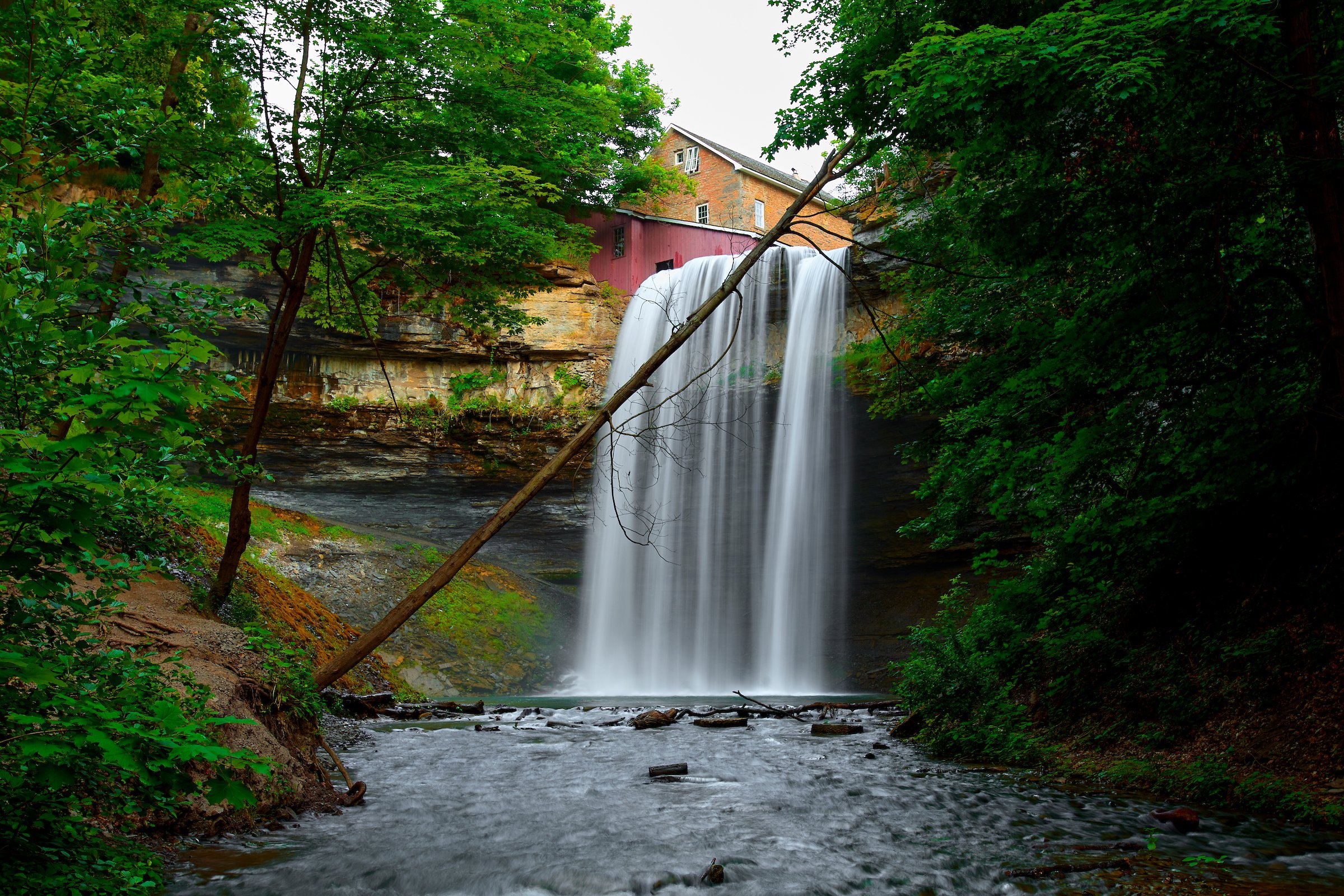
Decew Falls and Morningstar Mill, St. Catharines @Solomon D Crowe
Decew Falls drops over the Niagara Escarpment below Morningstar Mill in St. Catharines, Ontario—where heritage restoration and public access meet the modern demand for wonder.
There are places that don’t ask for much—no ticket booth, no velvet rope, no timed entry—just a turn off a familiar road and a short walk into the green. Decew Falls is one of those places, which is exactly why it has become a test of who we are right now. In an age when attention is currency and the map in your pocket can route you to anything worth seeing, Decew Falls offers a kind of “free” wonder that feels almost out of place. Yet the first thing a visitor learns in this season is that wonder is never truly free. The Morningstar Mill site—home to the restored water-powered mill perched above the falls—has been closed for a major construction and restoration project, with no on-site parking, and the closure has stretched beyond its original end date as work continues. The trail still runs along the side of the property, but the site itself is paused, mid-sentence, while the scaffolding and planning catch up to the promise we all make when we say we love a place.
It’s tempting to treat a waterfall like a photograph: fixed, reliable, always ready. But a waterfall is more like a living agreement between water, rock, access, and restraint—an agreement the modern world keeps renegotiating without reading the fine print. Decew Falls sits along the Niagara Escarpment, one of Ontario’s great natural thresholds, where geography does what good stories do: it forces a change in pace. People arrive with different reasons tucked inside them. Some come for the straightforward pleasure of a day outdoors, the kind that makes the lungs feel bigger than the calendar. Some come to show their kids what “real” looks like, beyond screens and schedules. Some come with a tripod, chasing the long exposure and that silky ribbon of falling water. And some come because the internet promised a shortcut to awe. The falls don’t care which category anyone falls into, but the place does keep score—through worn footpaths, strained parking shoulders, rescue calls, and the quiet resentment that can build when locals feel their backyard turning into someone else’s backdrop.
If Decew Falls works as a mirror, it’s because the reflection is never just of water. It’s of our habits. The way we arrive. The way we take. The way we leave. Modern travel—especially the “micro-adventure,” the quick-hit day trip that feels like a reset—has trained us to believe we can collect experiences the way we collect tabs on a browser: open, skim, close, move on. Decew Falls resists that rhythm. It asks for the humility of a walk. It asks for attention that isn’t monetized. And it asks for patience in a moment when patience is increasingly rare. The closure at Morningstar Mill isn’t simply a logistical note; it’s an accidental metaphor. A place can be beautiful and still need time off. A landmark can be iconic and still require maintenance, funding, and unpopular decisions like closing gates and removing parking. It’s the sort of reality that makes a destination feel less like content and more like community.
To understand why this particular waterfall matters, it helps to remember what the water used to do here—what it was built to do. Before “heritage” became an aesthetic, the escarpment’s falling water was a practical force, harnessed to make things move: wheels, belts, saws, stones, livelihoods. Historical accounts of Morningstar Mill describe how water was directed through a penstock to drive a turbine that powered the machinery inside the mill—an elegant conversion of gravity into work, long before most of us had ever thought about electricity as something delivered invisibly through a wall. The modern Morningstar Mill is a living museum precisely because it doesn’t treat that history as a plaque; it treats it as a motion. Restoration is not nostalgia here. It’s mechanics, carpentry, upkeep—an insistence that the past is only meaningful if it can still do what it was made to do, even if only as demonstration. And when a site like that closes for restoration, it’s not just an attraction pausing; it’s a whole chain of memory and craft being protected from the slow erosion that comes for everything unattended.
Then there’s another chapter—less visible to casual visitors, but arguably more world-changing—that unfolded at Decew Falls in the late nineteenth century. In 1898, the Decew Falls hydro-electric plant transmitted electrical power at high voltage over a distance of 56 kilometers to Hamilton, a milestone in Canadian engineering and early long-distance power transmission. Multiple historical summaries note the technical specifics with a kind of reverence: 22,500 volts; 66 2/3 Hz; two-phase; a distance that, at the time, was extraordinary. It’s easy to read that as a trivia fact, the kind of thing you file away as “interesting.” But stand with that for a second. This water—falling in the Niagara Region—helped make distance irrelevant. It helped prove that energy could be generated here and used there, changing the geometry of industry, labor, and the modern city. Decew Falls isn’t only a scenic detour; it’s part of the infrastructure story of Canada becoming Canada: connected, electrified, accelerated. In that sense, the falls are not a retreat from modern life. They are one of the reasons modern life looks the way it does.
That is where the mirror sharpens. We live in a time when the systems that power our lives are increasingly invisible—energy arrives with a flick of a switch, groceries appear at the door, a ride shows up because an algorithm decided it should. We experience “convenience” as if it were a natural feature of the world, rather than a chain of engineering, maintenance, and human labor. Decew Falls punctures that illusion in two directions at once. First, it reminds you that nature is not a static wallpaper; it’s a force. Second, it reminds you that the human structures built around nature—mills, trails, interpretive sites, fences, parking lots, rescue protocols—are not automatic. They’re choices. The Morningstar Mill closure, the lack of parking, the continued access to the Bruce Trail along the side of the property: all of it is the visible edge of governance and stewardship, the kind of behind-the-scenes work that rarely goes viral but determines whether a place survives its own popularity.
And popularity is not neutral. Decew Falls is braided into the Bruce Trail network—Canada’s oldest and longest marked footpath—threading along the Niagara Escarpment with hundreds of kilometers of main trail and side trails that keep pulling people into landscapes they might otherwise never enter on foot. The Bruce Trail Conservancy describes the trail not only as a recreational asset, but as part of preserving and protecting the escarpment—a place recognized by UNESCO as a biosphere reserve, with striking ecological variety across elevations, coastlines, wetlands, woodlands, and cliff edges. “Access” and “protection” are held together here like two hands that sometimes strain against each other. The better the trail is, the more people come. The more people come, the more the land needs to be defended from love that behaves like consumption. Decew Falls lives inside that tension. It’s a destination, yes—but it’s also a pressure point where Ontario’s appetite for the outdoors collides with the reality that sensitive landscapes have limits.
When the mirror turns toward risk, it turns hard. Waterfalls attract boundary-testing the way cliffs attract climbers: there is something in the human brain that mistakes proximity for permission. Over the years, incidents at Decew Falls have prompted public reminders about waterfall safety, precisely because some visitors attempt routes that have nothing to do with hiking and everything to do with bravado—scrambling where they shouldn’t, scaling where the rock and water do not forgive. It’s not necessary to sensationalize that reality to understand it. The modern world trains people to chase intensity in small doses—an adrenaline spike, a dramatic shot, a moment that can be translated into a story people will react to. But nature doesn’t run on reaction. It runs on consequence. A place like Decew Falls is a reminder that the line between “epic” and “avoidable” can be one bad decision, and that emergency response—often volunteer-heavy, always resource-heavy—becomes the unseen cost of the attention economy. The mirror doesn’t just show us our wonder. It shows us our impatience.
So what does Decew Falls say about today, if the story isn’t “a waterfall is pretty,” and it isn’t a lecture about industry? It says this: our relationship with places has changed, and we are still learning the terms. We used to travel primarily for distance—going far to feel different. Now we travel for contrast—going anywhere that can interrupt the monotony of work, screens, and routine. In that world, Decew Falls becomes a kind of local pilgrimage site, a place that promises the reset without the airfare. That promise is powerful, and it’s why places like this are increasingly crowded, increasingly regulated, and increasingly forced to choose between openness and survival. The Morningstar Mill restoration project is one of those choices made in public. Closing a beloved site, removing parking, extending timelines into the next year—none of that wins applause in the short term. But it signals something worth noticing: the people responsible for this place are trying to keep it from becoming a “used-up” landscape, a casualty of its own fame. The mirror, in other words, is not only reflective; it’s corrective. It asks whether we want destinations that exist for our consumption, or places that endure for the next generation to discover with fresh eyes.
The most useful way to leave Decew Falls—mentally, not just physically—is with a new definition of what it means to “visit.” To visit is not to extract. To visit is to participate, even if quietly, in the ongoing health of a place. That doesn’t require grand gestures; it requires a shift in posture. It means respecting closures and understanding that “no parking” is not an inconvenience but a management tool. It means staying on trails and treating fences like boundaries rather than challenges. It means recognizing that the Bruce Trail is not just a line on a map but a maintained, protected corridor that exists because organizations and volunteers fight for land, signage, and safe access year after year. It means admitting that some of the best travel stories are not the ones that prove how close you got to danger, but the ones that prove you were attentive enough to leave a place intact. Decew Falls will keep falling long after the current restoration is finished and the mill welcomes visitors again. The question—quiet but relentless—is what kind of people will be standing there when it does.