Rittenhouse Square Philadelphia at Dusk
In the hour when the city stops performing and simply exhales, Rittenhouse Square becomes a shared refuge. Lamplight, trees, and unhurried footsteps turn Center City’s pace into something softer. This feature follows the quiet emotional shift that happens at dusk—why a public park can steady you, even when it fixes nothing at all.
Soft Hour in Rittenhouse
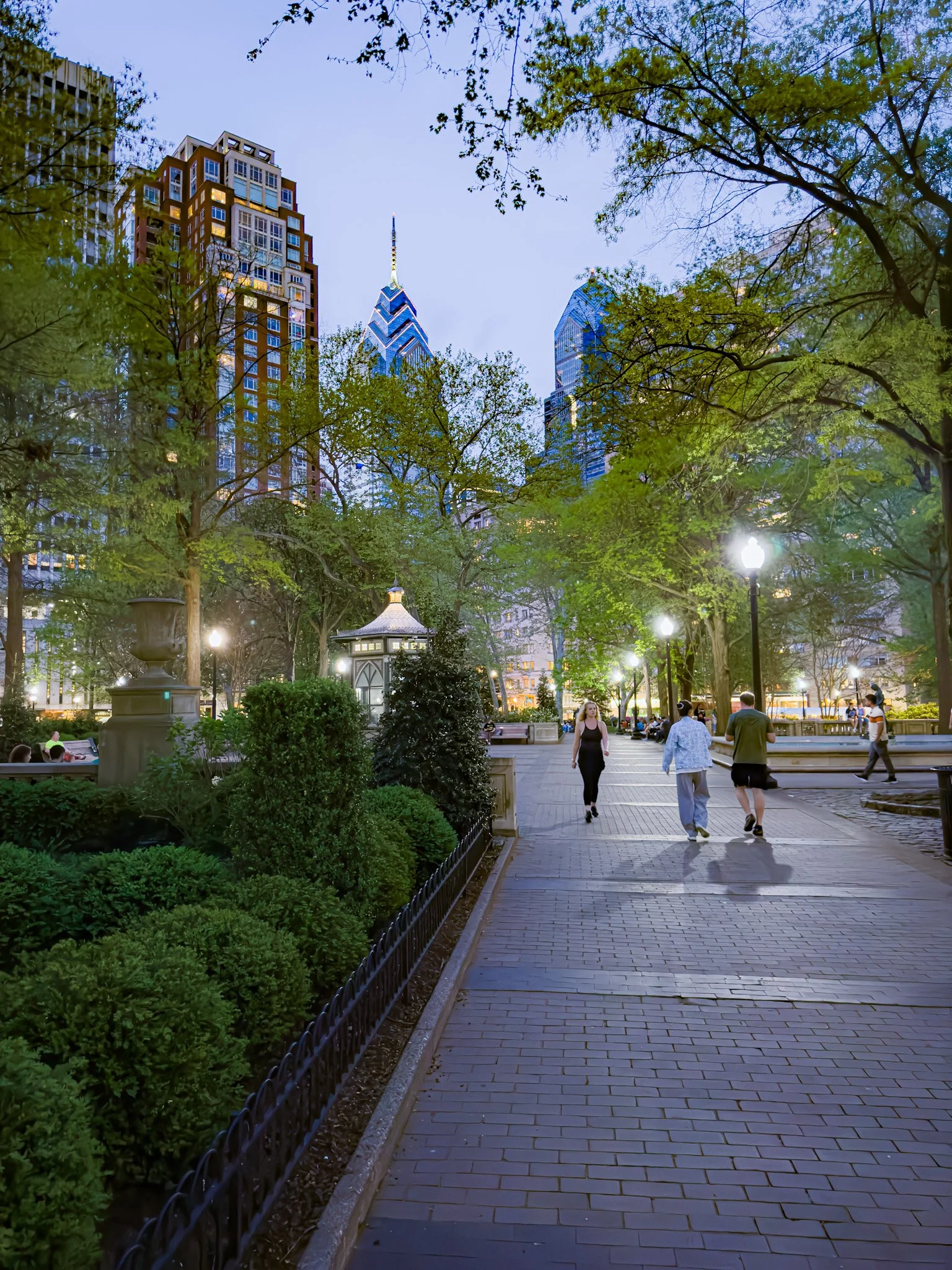
Pedestrians walk along a path in Rittenhouse Square in Center City Philadelphia at dusk, with city buildings visible through the trees.
At the soft edge of evening, Rittenhouse Square Philadelphia becomes less of a destination and more of a release valve. The lamps come on along a brick path, trees hold the last blue light, and a few walkers drift forward with the skyline rising quietly beyond the canopy. That’s the whole spell: nothing monumental, nothing staged—just a public place letting people loosen their grip on the day.
Dusk is when a city shows its real face. Not the rush-hour face, not the weekend face, not the glossy “come visit” face—but the in-between expression that belongs to anyone who’s ever carried groceries home, replayed a hard conversation, or walked off a worry because walking was the only honest thing left. In Center City Philadelphia, the hours can feel like they’re priced and measured, traded and spent. In the square, time behaves differently, as if the air itself refuses to hurry. You don’t have to buy anything to be here, and that detail—simple, almost radical—changes how your shoulders sit.
Story Promise
This is a story about what dusk does to a place—and what a place can do to you. It’s about why Rittenhouse Square Philadelphia feels like a shared living room at the exact moment the day stops asking for your best performance, and the night hasn’t started demanding anything yet. Along the way, we’ll step into the square’s long memory: William Penn’s original vision for green space in a growing city, the name it carried before it was “Rittenhouse,” and the community labor—part civic, part neighborly—that keeps it tender enough to return to. And we’ll stay with the human truth beneath the history: sometimes the most important thing a city gives you is a place where you can simply exist, unremarkable and safe among strangers.
Why Rittenhouse Square Philadelphia Feels Like an Exhale at Dusk
The soft hour doesn’t arrive with fireworks. It arrives with small permissions. Permission to slow your pace because nobody’s honking behind you, permission to stop checking your phone every thirty seconds, permission to look up at the trees like you’re not late for something. At dusk, Rittenhouse Square park becomes a gentle corridor of body language—people walking as if they’re letting go of the day one step at a time. You see it in the way conversations stretch out, in the way dog leashes loosen, in the way a bench suddenly feels like an invitation instead of a pause button. Visit Philly describes the square as a place where locals and visitors gather to stroll, read, relax, and catch up—simple verbs, but they’re the verbs that keep a person from burning out.
A park at dusk is also a mirror, and it doesn’t flatter you. It shows you what you’ve been carrying by how quickly you feel the urge to set it down. Some people come in hot—fast steps, eyes forward, jaw tight—like the city’s tempo has gotten under their skin. Then the path bends, the lamps glow, and something ancient in the brain recognizes safety: trees, open space, other humans not demanding anything. That’s when the breath changes. It’s not dramatic. It’s just the quiet recalibration you didn’t know you needed.
Part of what makes this hour feel so human is that the square isn’t hidden. It isn’t a secret garden behind a gate. It sits in the middle of Center City Philadelphia, surrounded by restaurants, residences, and the constant hum of a neighborhood that never fully goes offline. And yet, inside its boundaries, the tone shifts. That contrast—busy streets outside, softer tempo inside—is the entire emotional architecture. It’s why “an evening stroll” here can feel like a reset rather than another item on a list of things to do in Rittenhouse Square.
A Square Older Than the Lives Passing Through It
It helps to know what you’re walking inside. Long before Rittenhouse was a brand name—before it was shorthand for an upscale zip code and a certain kind of dinner reservation—the square was part of a plan. In the late 17th century, William Penn and surveyor Thomas Holme laid out Philadelphia with a system of public squares meant to keep green space inside the city’s bones. The idea wasn’t just beauty; it was breathing room—space that could temper density and keep the city livable as it grew. Histories of Penn’s plan often point to his desire for a “greene countrie towne,” a city that didn’t have to choose between urban life and access to open air.
Rittenhouse Square didn’t start out with this name. It began as “Southwest Square,” and it carried that straightforward label until 1825, when Philadelphia’s City Council renamed it to honor David Rittenhouse—an astronomer, inventor, and civic figure whose work and reputation mattered enough to be etched into the city’s map. The Friends of Rittenhouse Square, the nonprofit deeply involved in the square’s upkeep today, tells that naming story plainly: a public space given a personal name as a kind of civic tribute. It’s a detail that matters because it shows what cities do when they’re healthy: they remember people, not just profits.
If you’re trying to understand the square’s intimacy, look at its shape. It’s not endless. It’s bounded—by Walnut and Locust, by 18th and 19th—stitched into a walkable grid that makes the park feel like a room rather than a wilderness. Preservation-oriented guides describe these edges clearly, because boundaries are part of what gives the place its character: the square is big enough to disappear into for a moment, small enough to cross without making it a project. That scale is one reason it works so well as a daily ritual rather than a special occasion.
And then there’s the deeper magic: a place can be old without being distant. You don’t need plaques and lectures to feel the time layered here. You feel it because the square has been a respite for generations of Philadelphians—an ordinary refuge that stayed ordinary even as the city around it evolved. The Cultural Landscape Foundation frames it as part of Penn’s original concept, a green square that shifted through uses over centuries while remaining what people needed it to be: a pause in the urban current. When you realize that, dusk takes on an added weight. You’re not just walking in a park; you’re moving through a long-held human habit: step away, breathe, return.
The Beautiful Work You Don’t See
The soft hour feels effortless, but it isn’t. A park doesn’t stay inviting by accident. Lawns don’t manicure themselves, paths don’t remain walkable by pure luck, and trees don’t thrive just because people want them to. Rittenhouse Square sits inside Philadelphia’s larger parks system, and Philadelphia Parks & Recreation describes its mission in human terms—connecting residents to the natural world, to each other, to “fun things to do and see,” while managing historic and cultural sites across the city. That’s the public backbone.
Then there’s the quieter layer: the neighborhood stewardship that turns a public park into a cared-for one. The Friends of Rittenhouse Square is explicit about this relationship—Rittenhouse Square is part of the Fairmount Park system and is operated in partnership with Philadelphia Parks & Recreation. This is not romantic language; it’s operational reality. It means a public space is kept alive through a blend of civic management and community support, the kind of collaboration most people never think about while they’re sitting on a bench. But the moment you do think about it, the square becomes even more human: it exists because people decided it should.
In 2010, the American Planning Association recognized Rittenhouse Square as one of the country’s Great Public Spaces, and local reporting emphasized why: it’s inviting, it anchors a vibrant neighborhood, and community members have repeatedly fought to keep it that way. That sentence contains the entire emotional economy of public space. Parks don’t endure because they’re pretty; they endure because people argue for them, fund them, maintain them, and return to them until returning becomes tradition. The “soft hour” at dusk is, in a sense, the dividend on all that invisible work.
But here’s the honest edge: a beloved park also carries a complicated burden. When a place becomes known as one of the best parks in Philadelphia, it attracts more than quiet walkers. It attracts attention, expectation, and competing definitions of what the space is “for.” That’s not a scandal; it’s the nature of successful public places. A square holds lunch breaks and grief walks, first dates and last conversations, tourists taking photos and locals who wish the tourists would disappear. The real achievement isn’t that everyone uses the park the same way; it’s that the park can hold many uses without collapsing into conflict.
Leaving the Square Without Losing the Calm
The truest test of a park is what happens when you leave it. Not whether it looks good on your phone, not whether it impresses an out-of-town friend, not whether it earns a glowing review. The test is whether you carry something out with you—something quieter than you arrived with. In Rittenhouse Square Philadelphia, dusk often does that work gently. It doesn’t “fix” anything. It simply interrupts the momentum long enough for you to remember your own pace.
If you’ve ever walked here after a day that felt too full, you know the strange relief of being anonymous among other humans who are also winding down. Nobody asks you to explain yourself. Nobody needs your résumé. You can be the person behind the person you’ve been performing all day. That’s why parks matter even when the city is full of more exciting options; a public square is one of the few places where presence itself is enough.
When the sky deepens and the lamps become the dominant light, you can feel the moment turning—people peeling off toward Walnut Street, toward dinner plans, toward home. The square doesn’t cling to them; it doesn’t demand loyalty. It’s there tomorrow, and that promise—quiet, nonverbal, reliable—is its greatest luxury. Near the end of the day, when everything else feels temporary, the square feels steady. You walk out, and the city resumes its speed, but you’re not quite as hurried as before.
And that’s the point. Not escape. Not fantasy. Just a pocket of steadiness inside the real world. A dusk walk through Rittenhouse Square Philadelphia is a reminder that the city still has places where you can be a person first—and everything else second.
Between Stops, the City Decides
A city reveals its values not in motion, but in waiting. Through Berlin’s transit system, movement becomes a collective agreement—shaped by trust, strain, and the quiet politics of getting from one place to another.
Berlin, Between Stops
Berlin, Between Stops @Solomon D Crowe
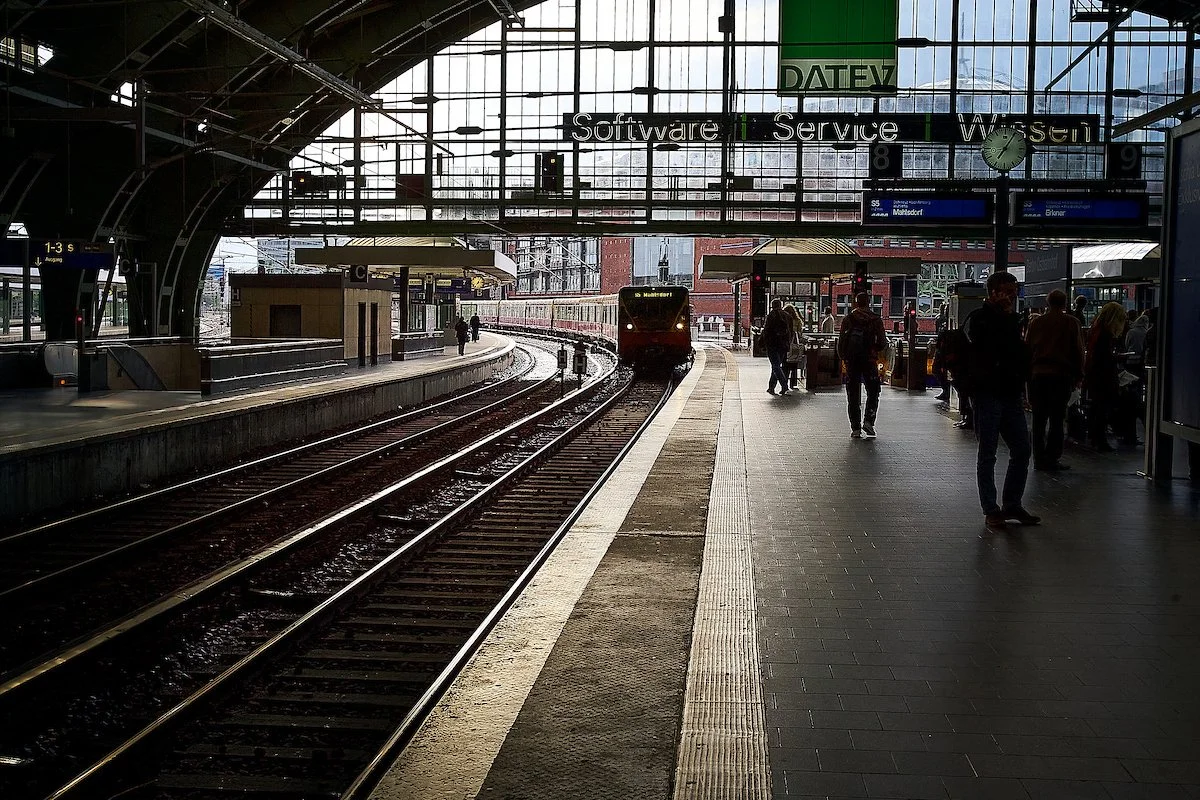
A regional train approaches the platform inside Berlin’s central rail network, where commuters move through layered tracks, glass canopies, and digital signage in one of Europe’s busiest transit systems. The scene captures the everyday rhythm of urban mobility in the German capital, where rail infrastructure anchors both daily life and cross-border travel.
A photograph from 2009 catches a familiar transit moment: a train rounding into view, the platform edge drawing a clean boundary, an analog clock holding time above people who have already arranged their bodies into waiting. Light lands on the concrete in a long strip, as if the building is marking out where the day will move.
The scene feels calm because the system is doing what systems are supposed to do—reducing uncertainty. Not eliminating it, never that. Just shrinking it enough that a city can function without constant negotiation.
What the image cannot show is what Berlin’s transportation network actually is: not a place, but a promise repeated. Underground and overhead. Rail and rubber. Schedules and improvisation. A city’s daily agreement to move large numbers of strangers without requiring them to trust one another personally.
The Network as a Civic Habit
Berlin’s transit is less a “system” than a set of practiced behaviors. People learn where to stand on platforms, when to let others exit first, how to read the small differences between lines, directions, and end stations. These are not rules imposed from above so much as habits formed through repetition.
In 2009, that repetition still belonged largely to paper and memory. Station boards, printed maps, announcements that demanded attention. Miss a detail and the penalty was simple: waiting. Today, the city’s movement is mediated by devices—real‑time countdowns, route planners, notifications that promise a better transfer if the next one is missed. The change is not only technological; it’s psychological. The old system asked for patience. The new one sells the feeling of control.
Yet the deeper truth remains the same: public transportation works when people believe it will. When belief weakens—through delays, strikes, inconsistent service—private alternatives rush in to fill the gap. Cars return. Rideshares grow. The city becomes louder, costlier, and more unequal, one decision at a time.
Berlin’s network is also a map of social life. Trams stitch through neighborhoods that grew under different rules than those shaped by the U‑Bahn. The S‑Bahn reaches outward into the commuter belt where housing is cheaper and time is the real currency. The system doesn’t just move people; it quietly shapes what counts as livable distance.
When the Promise Slips
Punctuality is not a personality trait. It’s an infrastructure outcome. And across Germany—Berlin included—the strain has become harder to ignore. Deutsche Bahn’s own reporting shows long‑distance punctuality sitting in the low‑60% range in the first half of 2024 (depending on the measure), a level that would have been unthinkable when “German trains run on time” was treated like a natural law.
The public conversation around rail has shifted accordingly. Delays are no longer framed as anomalies; they’re framed as symptoms—of congested networks, aging signaling, construction backlogs, and political decisions that deferred maintenance until the bill became unavoidable.
For passengers, the lived experience is quieter than headlines suggest. It’s the extra ten minutes built into every trip. The cautious transfer. The small recalculations that slowly teach people to expect less. A system can keep moving while trust erodes—until it can’t.
And Berlin sits at the intersection of that tension. Its local transit may carry a person across town reliably, but the larger rail network feeds into it. When regional and long‑distance services falter, the pressure shows up on the same platforms: more crowded waits, missed connections, an atmosphere that feels slightly more brittle than it used to.
The Ticket That Changed the Map
One of the most meaningful shifts since 2009 isn’t a new train model or a rebuilt platform. It’s a policy decision that changes who gets to treat mobility as normal. As of January 2026, the Deutschland‑Ticket is set at €63 per month, nationwide for local and regional public transport—agreed by federal and state transport ministers.
The ticket matters because it makes an argument: movement should be simpler than it is. It turns a fragmented fare landscape into something closer to a utility—pay once, ride widely, stop thinking about zones unless you need to. The fact that the price has risen—and may continue to rise via an indexing approach—also reveals the vulnerability of the idea: public transport is popular, but it is expensive to run well, and political consensus is never guaranteed.
In Berlin, the appetite for public transport is measurable. BVG reported roughly 1.109 billion passenger journeys in 2024 and noted growth in subscriptions—signals that the “return to transit” after the pandemic era wasn’t just temporary.
But popularity can be a strain as much as a success. A cheaper, simpler ticket can increase ridership faster than fleets, staffing, and maintenance cycles can expand. The system becomes a victim of its own usefulness unless investment and operations keep pace.
Climate Goals, Electric Buses, and the Human Factor
Berlin’s climate conversation often treats transit as an obvious solution: put more people into shared vehicles, reduce car dependence, lower emissions. Much of the rail backbone is already electric. The harder part has always been the surface—buses, service coverage, and the last kilometer between a stop and a front door.
That shift is underway. BVG states that it currently has 227 electric buses in operation and expects the number to grow substantially in the next few years. Orders and framework contracts for large batches of articulated electric buses reinforce that this is not symbolic—it’s logistical, expensive, and slow by necessity.
Yet the environmental impact of transit is not only a technology story. It’s a habit story. Broader mobility surveys in German cities show the car’s share dropping over the long term while public transport, cycling, and walking hold or rise—changes that happen not through slogans, but through years of service decisions and street design.
And then there is labor—the component climate plans rarely photograph. In early February 2026, tens of thousands of public transport workers across Germany walked off the job, disrupting bus and tram services in major cities including Berlin. The reasons weren’t abstract: working conditions, pay, rest time, and the sustainability of the workforce itself. A transit system can be electrified and still fail, if the people required to operate it are treated as expendable.
The platform photo from 2009 holds a quiet confidence: a train will arrive; people will board; the city will keep its word. That confidence is not nostalgia. It’s the product of maintenance, staffing, funding, planning, and public trust—all of which must be renewed continuously.
Berlin’s transit system today still carries the shape of that confidence, but with new weight added to every link in the chain: climate responsibility, affordability debates, infrastructure backlogs, and a workforce asked to do more with less. The story is not whether Berlin moves. It does. The story is whether the promise stays believable—and what a city becomes when it doesn’t.
This visual essay explores Berlin’s transportation system through the tension between trust and strain—tracking how affordability, climate commitments, and reliability shape the lived experience of movement from 2009 to today.