Faces in the Alley: Why Portrait Murals Stop People Cold
In Graffiti Alley, lettering can be ignored—but faces don’t let you pass so easily. On a winter night, portrait murals turn Toronto’s most famous laneway into a public encounter: eye contact in paint, emotion on brick, and the strange intimacy of being “seen” in a place built for back doors and shortcuts.
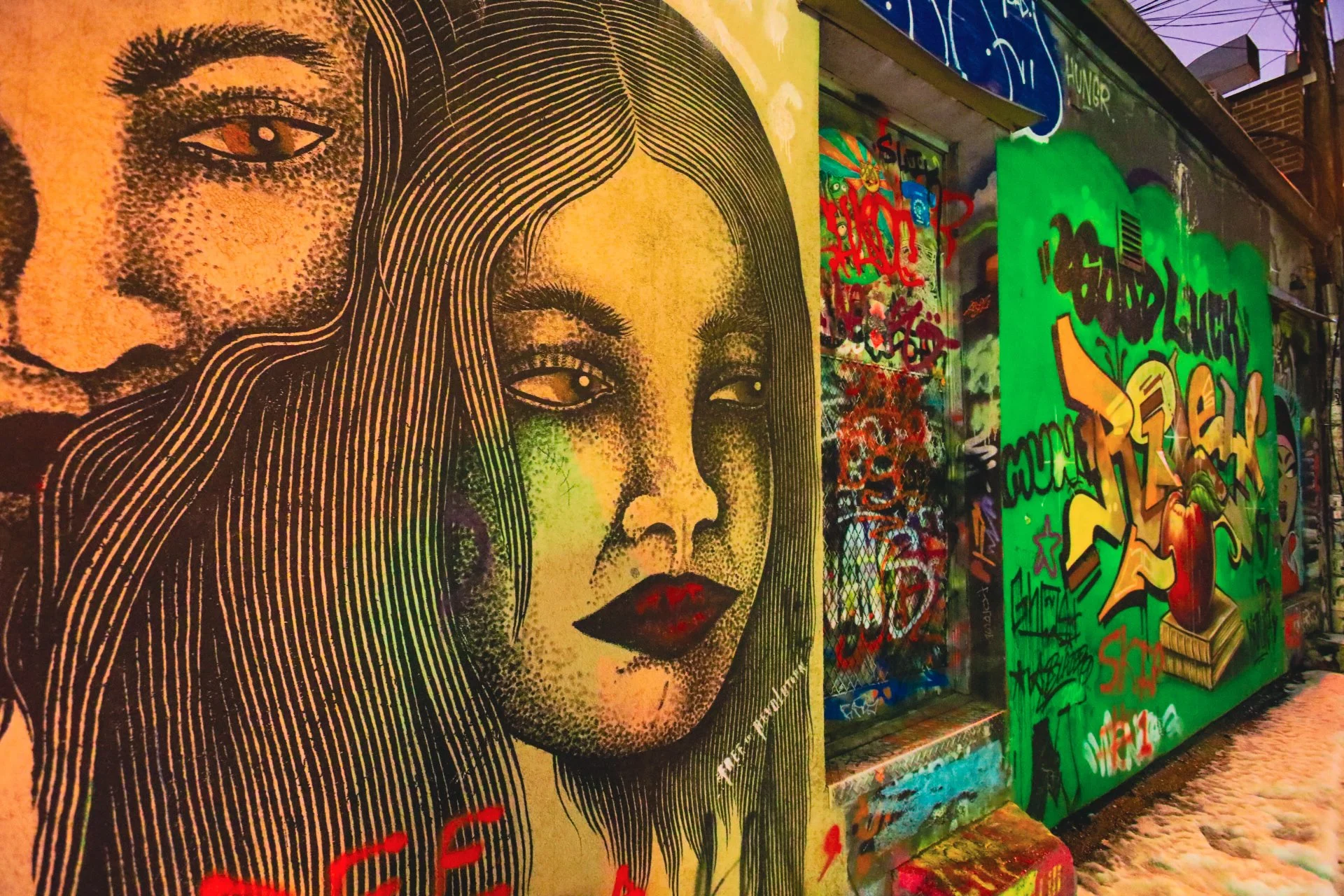
During Toronto's winter months, the city is reduced to its basic components. Sound is muffled as snow absorbs it, and colour becomes muted due to the amount of salt that has been spread throughout the city. Street corners become more useful in nature versus serving as entertainment, so that people are moving along with specific purposes; with their shoulders raised and looking ahead to where the next patch of cleared sidewalk is located. However, if you look just off of Queen Street West and the Fashion District, you'll find that Graffiti Alley (which is also known as Rush Lane), has retained its colour through the winter months like an unyielding flame.
The walkway does not have an extravagant feel to it nor does it attempt to be ostentatious. From its inception it served as a service road, where trash receptacles, deliveries and locked doors made up most of the landscape (along with forgetting some of the doors after the fact). Once artists started to see the blank walls as no longer blank, but rather blank canvases awaiting their claim, the lane began to take on a different meaning. Over time, as more layers of paint were added to this space by different artists, Graffiti Alley became a living record rather than an exhibit behind glass. The records were not arranged in any particular order nor did they receive the blessings of curatorial committees. They continued to evolve through the hands of ordinary people who believe that public spaces still possess a greater purpose than just their aesthetic appearance.
Another aspect of the alley becomes clear during winter. In winter, the ground is pale, and the sky has a heavy feel about it. The alley is not only colour but also faces, faces looking at you from the brick, and faces that do not blink. These faces remain with the same expression for every night the city passes by — usually not quite paying attention and usually missing the point. The portrait murals do something in addition to what abstract tags and letters do; they stop people. With these types of faces, a viewer can recognise the subject more than with abstract tags and letters; it is more challenging to dismiss as a simple background. A viewer will want to question themselves about who belongs in that area (of the city) and will be able to do so easily because of the use of a face in the image. The question about who belongs and who gets seen and who gets ignored is the question of street photography and urban living.
The portrait photo is the correct starting point for this article. This mural’s gaze isn’t friendly; rather, it’s real. This mural has the emotional heaviness of someone physically standing in an alley; however, it will also be there the next day, and the following day, and when it snows again. In a city that has an extremely high level of impermanence—leases, pop-ups, condos climbing higher into yesterday’s skyline—this painted face will serve as a sort of groundwork for future segments of the city. It is not permanent in a museum-type way; but it has longevity in the only way that street art can have longevity: it is being constantly re-invitalized, challenged, replaced, and answered.
The Alley of Graffiti is frequently termed “the” destination; an urban landmark, it is also regarded as a must-stop location for visitors wanting to see texture and authenticity. However, tourism is not what provides the value for an editorial on Graffiti Alley—rather, it is because of its function as an outdoor gallery of portraits with no entry fee, no hours of operation, and no assurance that what is there will still be there next month. The uncertainty is not baggage; it is the source of the engine that keeps the alley alive—because each time a new piece appears there, it acts as both a statement and an invitation to respond, remix, repaint, or outdo that piece.
The winter photographs capture how creativity constantly reinvents itself through an old Toronto experience of extreme winter coldness; snow accumulates at the edges of the street, while ice covers the ruts left behind by both cars and pedestrians as they leave their marks and then return. Thus, the alley becomes a chaotic record—of who walked in, slipped over, or turned around, of each person's passage through. Against the backdrop of snow and ice, the murals seem more pronounced; colours used in the murals become methods to combat the washing out of colours that occur during the winter months due to the lack of sunlight. The overall result of how these murals are utilized is as if we are witnessing a film; the narrow lane illuminated in a golden hue from the streetlight and the walls emitting brightly-hued paint create a visual representation of the breath of the city at wintertime.
There is also a more profound conflict in this place that provides so much exposure on social media – is it legal? Is it permitted? Is it ‘vandalism’ or ‘art’? Graffiti Alley lies in the ambiguous middle area of this discussion: there is recognition of it as graffiti, even within its own right, however it isn’t a fully recognised illegal graffiti wall; rather, its existence is based on a level of tolerance that feels unformalised like there is just an understanding and not an actual law or statute. This ambiguity of legality and its equals is the character of this space; it is essentially the place where the rules of the city and the realities of the city are played out every day in private.
Toronto is attempting to formalize the negotiation with various programs offered by the city to support mural and street art in public areas. One of these programs is StreetARToronto (StART), managed by the City of Toronto and utilized as part of the City’s overall approach to graffiti management. One component of this program is to establish initiatives and provide opportunities for artists to create art in an effort to enhance the attractiveness and vibrancy of urban spaces. In many cases, the context in which a wall exists will help define whether that wall falls under a formal program or not; however, in general, the shift that has taken place has changed the conversation between the city and the public. "How do we remove the marks?" is no longer the only question that officials are asking themselves. There now exists the need to ask, "What are we going to replace them with, and how will that replacement impact the street?"
This is when the art moves beyond 'cool' aesthetics and instead become a statement of humanity in a building designed to conceal the human labor of a city. The laneways are the lungs of buildings: they exhale (through vents), the backs of buildings (through back doors), and the loading bays of buildings (as well as being the underside of cities). Once an artist paints a face, particularly one with emotion, complexity, and authenticity, the laneway no longer serves a purely functional purpose and starts to have psychological implications for the viewer. The laneway now becomes one of the few places where cities acknowledge their avoidance of the fact that human stories do not only take place on major streets.
Then there's the audience—there's a multitude of different eyes on this spot as it attracts many types of viewers. For example, locals use the alley like an everyday shortcut (because it is familiar). There will also be photographers that use it for its colour & texture. Couples will also use it for their engagement photos. And lastly, there will be a multitude of visitors that find it via travel lists or social media. The combination of groups makes the alley an attractive place to be; e.g., within a ten-minute period, you will see one person walking through the alley without looking up from their staring at their phone; then you may see someone else standing in the same location filming themselves as the curator is just out of the camera's line of sight whilst taking a picture of themselves with their guests present.
This coexistence of dashes and ticking clocks is the modern city in microcosm but the modern world moves at warp speed and the spaces in which we inhabit are designed to accommodate that speed. Graffiti Alley disrupts that rhythm with its narrowness, texture and density of visuals; it compels one to slow down while viewing a wall. The walls themselves are not easily understood with a single glance; they require multiple scans to understand the pattern of the original paint, the layering of the tags, and where painted areas reveal older paint. The weathering effects left by the environment on these walls also contribute to the story. In winter, the effects of weathering are exaggerated by salt mist dulling the lower parts and the snow accumulating at the base of the wall. In essence, the city acts as an editor of the art that exists within it.
Thus we arrive at the kernel of the good editorial on street art: how long does the public space have for any given message? With a billboard, it simply purchases visibility. A mural earns visibility and then must continually earn to stay visible. While a billboard will be kept maintained, a mural remains visible by embracing change — having it painted over, written over, or responded to in some way. This is part of the reason why Graffiti Alley in Toronto is one of the most photographed streets in the entire city. It provides an established position consistently with constantly changing surfaces and therefore creates an evolving relationship between the setting and its occupants through these changes to surface and thus to content.
Street art has a way of bringing with it the pain and imperfections that are inherent in the medium itself. Unlike the polished and commercialized styles of many other types of visual content, street art isn’t meant to be neutral. Rather, it communicates a mood and attitude, and is open for interpretation. With so many other types of visual media being produced today with a clean look, street art is refreshing and authentic in nature, which is why it is becoming such an important aspect of Toronto at this time.
From the viewpoint of a winter scene, the alley can also be viewed as a study of contrast, with opposite colours, feelings and temperature. The snow creates more light but also creates a harsher environment. In the cold weather, people usually will not stay very long unless they have a purpose. One of those purposes could be to view artwork. When you look at a painted face, it represents a small fire - not in the physical sense because of no heat but from the perspective of where it draws your attention. Focus has become an uncommon occurrence. Most people perceive urban images while in motion. Graffiti Alley creates a need for someone to be still in order to truly perceive what they are viewing.
In addition to its travel writing component, the editorial angle has a life outside of travel writing. By relating to larger themes—without lecturing—such as: Public Space; Identity; The Need for Humans to be Seen; The Difference Between Decorating and Expressing Yourself; and how Cities Deal With Or Resist Creating Uncontrolled Creative Spaces, these themes resonate with readers because of "real-life" experiences. For example, if you walk through a North American city in the wintertime, most of us would appreciate something visually stimulating. If you have ever felt anonymous in a crowd, you know the impact of coming face-to-face with a stranger, even if they are painted. All of these thoughts connect with one another through shared experiences.
Lastly, we must speak of the impermanence of Graffiti Alley: The honest truth regarding Graffiti Alley as it relates to this series of events will continue to evolve as long as the year 2023 exists. The portrait that serves as the foundation for this narrative could change or no longer be maintained in the future. This aspect of graffitied alleyways can therefore be perceived as an unfortunate loss by someone who sees this artistic style as a "museum artefact"; however, it should be understood that alleyways do not serve as museums; they serve as an ongoing and fluid dialogue between those people leaving pieces of art and those who appreciate or have yet to appreciate these forms of expression found throughout the city.
There’s no better way to leave this alley than knowing what you have actually experienced is not simply ‘visiting’ attraction(s), but actually experiencing an ongoing ‘living’ process that continues to operate through Toronto’s street art, living through the ‘cold’ of winter and keeping alive through memory, continuing to remain present. You will have experienced this ‘living’ part of Toronto while experiencing different aspects of the city’s art, but you won’t have experienced its ‘living’ aspect unless you have had a visual memory of one of the city’s many faces as you will undoubtedly remember them all.
And that is the power of Graffiti Alley in winter. The cold strips the city down. The alley builds it back up—one wall at a time.
When Public Conversations Had a Place
An old public phone booth still stands in downtown Kingston, Ontario—no longer essential, but not yet forgotten. Inside its narrow walls, two young women encounter an object from a different rhythm of life, revealing how quickly everyday systems disappear, and how quietly time moves on.
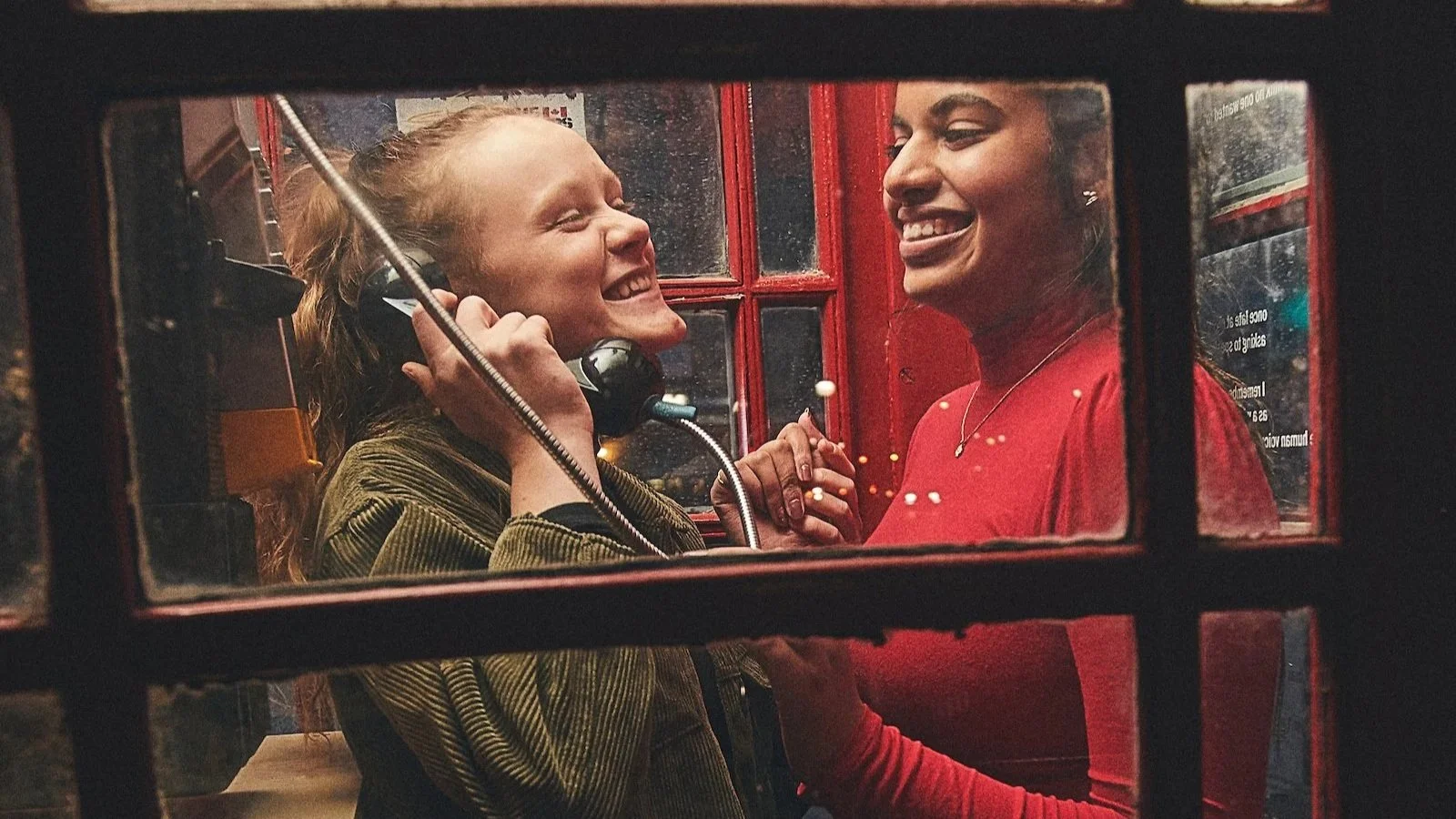
When Public Conversations Had a Place @solomon D Crowe
Two young women share a moment inside a traditional red telephone box, laughing as one holds the receiver — a reminder of when public communication required presence, patience, and proximity. Framed through weathered glass, the scene reflects the tactile, face-to-face rituals of connection that once defined urban streets before digital immediacy replaced them.
Like many cities, downtown Kingston is continuing to move along with the other smaller urban areas—without shouting about it, but moving on quietly. The sidewalks carry the typical mixture of walking errands and walking detours. Traffic should maintain a moderate flow, turning frequently and in short bursts throughout the day. The wind should also find its way to the streets between buildings off the water. Therefore, while the light may indicate that the streets are not sharp, the wind will do so to the contrary.
Next, there is the bright colored telephone booth in red; enough to notice but too old for anybody to pay any attention anymore. This does not fit the speed of the area around it. This is the type of local activity to which it does belong—the expectation that one would arrive at this type of facility if an individual wanted to contact someone, and will stay there until the contact with the person needed is completed.
The frame for everything is already in place due to glass. The window grid separates everything into rectangles, just like a contact sheet refuses to be a swipe. Two young women enter the narrow space; the booth becomes something more than just a relic for a brief period of time. It becomes what was intended; a small room for a voice to move through and whose body must stay.
A Public Room for Private Words
Telephone booths weren't romantic by nature. They were practical, and at times uncomfortable but did have the remnants of public use stuck to their surfaces. They were built by municipalities to provide links within cities without ownership required by the user. You did not need a contract, a charger or a monthly payment for service. All you needed was some change (or a calling card) and enough patience to wait for the line to clear.
Their strength lay not in their technology, but rather in what they designed. The booth invited users to act in an uncommon manner, in that modern day society hardly encourages us to commit to any one place. By using a booth, users are agreeing to be limited by this one space; although their conversation happens in the booth, there is a much larger city that is located just outside the glass. While you could talk from the booth (and you can chat), you could not run away while you were sending/receiving your message.
In addition, the booth also represented equality among people. No matter who you were, it treated all equally, regardless of mobile device, data plan, or battery level. All people were provided with the same limited degree of privacy once انہوں your other inside io yet? All transactions for utilize the booth were conducted via a common form for payment - billable time as well as by atomic denominational units. When any calls made in the booth and therefore new associated will end as do all public calls, in finality; there is no flexibility about adjusting call amount before they have reached end point.
The fact that older logic continues to exist in the material world and the receiver is present in the material world, and a cord continues to limit an individual’s ability to move, proves that booth space demands a common choreography even before someone has spoken into the handset. Ultimately, prior to any discussion having occurred, the physical space is demonstrating that connection used to require something beyond a desire for it; it required a structure through which the connection was made.
The Muscle Memory That Disappears
Instead of revering the booth, the two young women express curiosity. This shows both their honesty and the importance of the moment. Their laughter isn't a way of recreating nostalgia, but rather an honest response to something they didn't have prior knowledge of.
The weight of the receiver is significant when held; it is a bulkier, more clunky item than the phone but lacks an interactive display that can help determine the next move. The receiver creates pressure for the user, the user must support the receiver, and position themself correctly between the receiver and the mouthpiece. The phone line that connects the receiver and the wall is rigid enough to ensure the call takes place where it is intended. The booth provides no special provisions for adaptation to you; rather, your adaptation to the booth must occur.
They move gently through their space, as if exploring the edges of the boundaries. One of them is leaning against the wall in a relaxed manner, like he is performing on a small stage. The other is moving his arm to see how big the space is, and where he might start the phone call. Their faces show an expression of wonder as well as focus; it is the expression of someone finding out something that used to be normal.
For those familiar with these phone booths, this will evoke a much different feeling than from someone who has never seen a phone before: The entire sequence of events (e.g. picking up the receiver, waiting for the dial tone, intentionally entering the phone number) has been remembered through the muscle memory of your hand movement; however, you must now re-learn this sequence as if it were a foreign language because the city has left the booth unchanged but so much time has passed and no one knows how to read it anymore.
After Everything Became Portable
The movement away from booths did not occur as a result of people not requiring each other, but rather as the change in connection from a public place (a booth) to a personal piece of property (the cell phone). As connection became available to people through their own individual form of connection, the responsibility of each city had diminished as the responsibility of an individual had expanded. If your telephone is out of service, that is a problem for you; if you do not have enough money to purchase one, nobody in the world will help you obtain one.
Convenience is the new normal; we can connect with others from virtually any place in the world at virtually any time. However, this new level of accessibility dramatically impacts how we interact socially — if all calls may occur while on-the-go (including walking), waiting (at any location), travelling (commuting), working or otherwise — there aren’t any longer instances where we actually stop what we are doing for a telephone call to take place. We’re constantly “on the go”; therefore we’ll never really “arrive” anywhere, both at once!
In addition to that, a booth signified a temporary nature of the call – after one call ended, it would naturally disappear within the air, mostly because no one remembers the contents anymore. In contrast, many phone calls are recorded, stored and synchronized; although an individual may have felt the conversation took place privately with another individual – these types of conversations now are recorded in systems. Similarly, portability is allowed via an invisible system of recording mechanisms and platforms. However, these trade-offs are usually unrecognized because of the extreme convenience associated with them.
The red telephone booth in Kingston is a relic of when cities were intended to provide some sort of telephone connection for everyone; everyone could use the telephone with no special arrangement necessary. It is a testament to how the designer envisioned that people would use the telephone for making a call in an emergency or because they had lost a train or because they had broken their plans.
The Look Through the Glass
The most revealing moment isn't in the laughing itself, but in looking back after laughing. At some point in the play there will be a point where there is no longer any motion and both faces will look toward the audience and to the outside world; they are now aware that they are being observed.
A grid will serve as a grid structure for this booth, but it also serves as a metaphor for how we see and experience public life. The glass provides privacy from those outside, while allowing those on the outside to have their own view inside the booth; however, it does so at the same time by allowing those outside the booth to know they can see you in the booth and also have the ability to stand outside of it and wait for you to exit. The line dividing what happens inside of it from what happens outside of it is extremely thin—however, it is also a very honest line.
The end image is a combination of what is now (i.e. our current reality as influenced by culture) and what was (i.e. the time period when these young women lived) without emotion. Young Women Neither Are - Nor Were - Just "In the History." They Are An Example Of An Object That Has Been Used (Or Lived) And Now Does Not Have Its Original Manual. The Expression On Their Faces Is Beyond Nostalgia (Reminiscing) For How Things Used To Be, And Are Today, In Addition To Recognizing That Time Does Not Announce/Signify Its Variable Departures; Time Only Minimizes The Use Of A Skill Until It No Longer Exists.
The city centre stretches from one side of the image to the other. More pedestrians are walking past this booth as well. The booth appears to be decidedly out of place. Calm and anchored to a time when people wanted to interact via tactile or physical means. At some point in the future, this booth may be removed or merely used for decoration. But the booth does provide something unique; an environment in which to communicate that is not environmentally generated, or continual, or randomly floating. The booth provides a communication environment that is based upon a specific place.
The strength of the image lies not so much in the obsolescence of a phone. Rather, it's that connection once meant having a place, touching the void with time and the patience to wait until your voice could reach where you were trying to get to!
This visual essay explores how public communication, generational memory, and the loss of shared infrastructure surface inside a phone booth in downtown Kingston, Ontario.