When Public Conversations Had a Place @solomon D Crowe
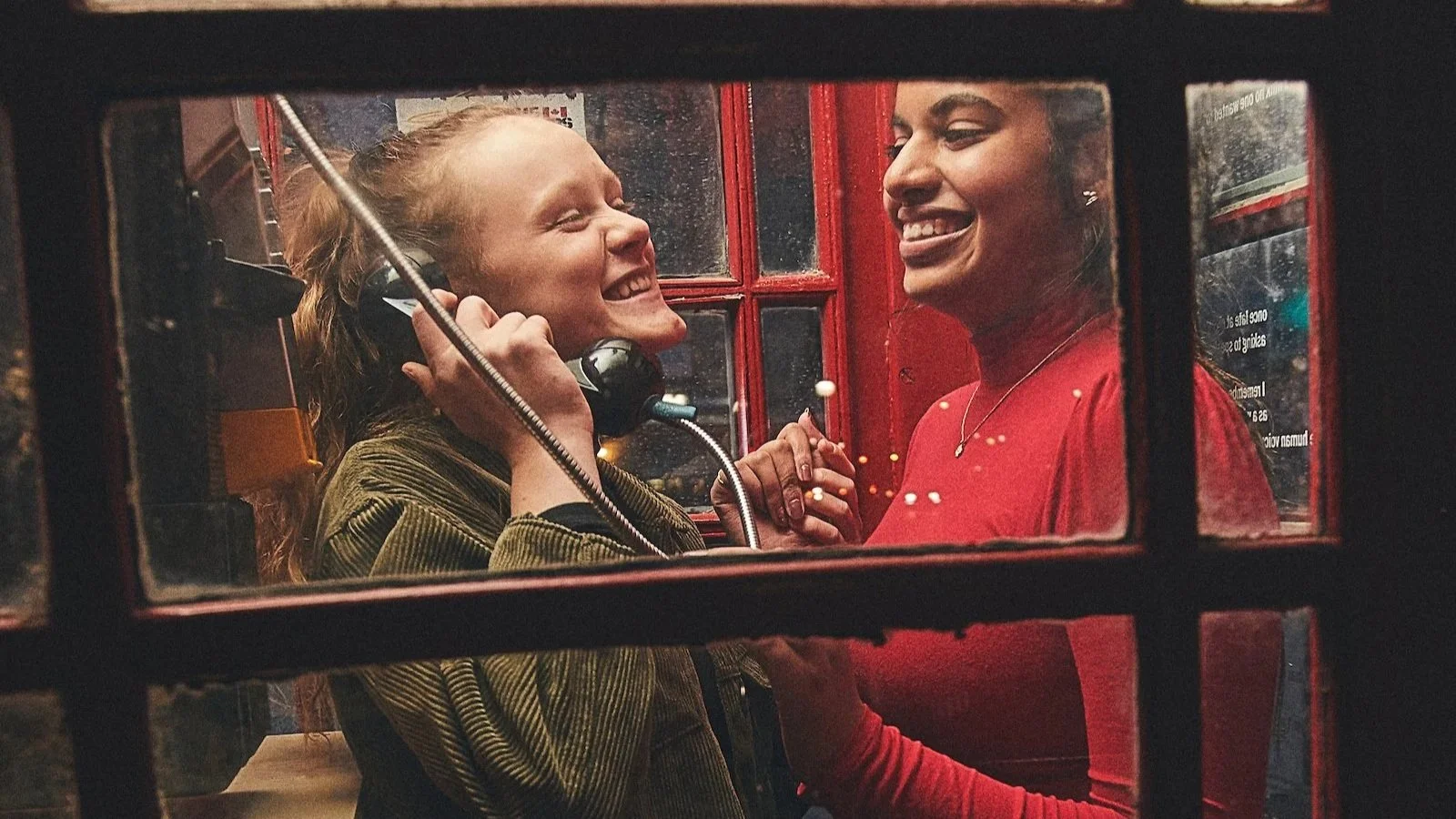
Two young women share a moment inside a traditional red telephone box, laughing as one holds the receiver — a reminder of when public communication required presence, patience, and proximity. Framed through weathered glass, the scene reflects the tactile, face-to-face rituals of connection that once defined urban streets before digital immediacy replaced them.
Like many cities, downtown Kingston is continuing to move along with the other smaller urban areas—without shouting about it, but moving on quietly. The sidewalks carry the typical mixture of walking errands and walking detours. Traffic should maintain a moderate flow, turning frequently and in short bursts throughout the day. The wind should also find its way to the streets between buildings off the water. Therefore, while the light may indicate that the streets are not sharp, the wind will do so to the contrary.
Next, there is the bright colored telephone booth in red; enough to notice but too old for anybody to pay any attention anymore. This does not fit the speed of the area around it. This is the type of local activity to which it does belong—the expectation that one would arrive at this type of facility if an individual wanted to contact someone, and will stay there until the contact with the person needed is completed.
The frame for everything is already in place due to glass. The window grid separates everything into rectangles, just like a contact sheet refuses to be a swipe. Two young women enter the narrow space; the booth becomes something more than just a relic for a brief period of time. It becomes what was intended; a small room for a voice to move through and whose body must stay.
A Public Room for Private Words
Telephone booths weren't romantic by nature. They were practical, and at times uncomfortable but did have the remnants of public use stuck to their surfaces. They were built by municipalities to provide links within cities without ownership required by the user. You did not need a contract, a charger or a monthly payment for service. All you needed was some change (or a calling card) and enough patience to wait for the line to clear.
Their strength lay not in their technology, but rather in what they designed. The booth invited users to act in an uncommon manner, in that modern day society hardly encourages us to commit to any one place. By using a booth, users are agreeing to be limited by this one space; although their conversation happens in the booth, there is a much larger city that is located just outside the glass. While you could talk from the booth (and you can chat), you could not run away while you were sending/receiving your message.
In addition, the booth also represented equality among people. No matter who you were, it treated all equally, regardless of mobile device, data plan, or battery level. All people were provided with the same limited degree of privacy once انہوں your other inside io yet? All transactions for utilize the booth were conducted via a common form for payment - billable time as well as by atomic denominational units. When any calls made in the booth and therefore new associated will end as do all public calls, in finality; there is no flexibility about adjusting call amount before they have reached end point.
The fact that older logic continues to exist in the material world and the receiver is present in the material world, and a cord continues to limit an individual’s ability to move, proves that booth space demands a common choreography even before someone has spoken into the handset. Ultimately, prior to any discussion having occurred, the physical space is demonstrating that connection used to require something beyond a desire for it; it required a structure through which the connection was made.
The Muscle Memory That Disappears
Instead of revering the booth, the two young women express curiosity. This shows both their honesty and the importance of the moment. Their laughter isn't a way of recreating nostalgia, but rather an honest response to something they didn't have prior knowledge of.
The weight of the receiver is significant when held; it is a bulkier, more clunky item than the phone but lacks an interactive display that can help determine the next move. The receiver creates pressure for the user, the user must support the receiver, and position themself correctly between the receiver and the mouthpiece. The phone line that connects the receiver and the wall is rigid enough to ensure the call takes place where it is intended. The booth provides no special provisions for adaptation to you; rather, your adaptation to the booth must occur.
They move gently through their space, as if exploring the edges of the boundaries. One of them is leaning against the wall in a relaxed manner, like he is performing on a small stage. The other is moving his arm to see how big the space is, and where he might start the phone call. Their faces show an expression of wonder as well as focus; it is the expression of someone finding out something that used to be normal.
For those familiar with these phone booths, this will evoke a much different feeling than from someone who has never seen a phone before: The entire sequence of events (e.g. picking up the receiver, waiting for the dial tone, intentionally entering the phone number) has been remembered through the muscle memory of your hand movement; however, you must now re-learn this sequence as if it were a foreign language because the city has left the booth unchanged but so much time has passed and no one knows how to read it anymore.
After Everything Became Portable
The movement away from booths did not occur as a result of people not requiring each other, but rather as the change in connection from a public place (a booth) to a personal piece of property (the cell phone). As connection became available to people through their own individual form of connection, the responsibility of each city had diminished as the responsibility of an individual had expanded. If your telephone is out of service, that is a problem for you; if you do not have enough money to purchase one, nobody in the world will help you obtain one.
Convenience is the new normal; we can connect with others from virtually any place in the world at virtually any time. However, this new level of accessibility dramatically impacts how we interact socially — if all calls may occur while on-the-go (including walking), waiting (at any location), travelling (commuting), working or otherwise — there aren’t any longer instances where we actually stop what we are doing for a telephone call to take place. We’re constantly “on the go”; therefore we’ll never really “arrive” anywhere, both at once!
In addition to that, a booth signified a temporary nature of the call – after one call ended, it would naturally disappear within the air, mostly because no one remembers the contents anymore. In contrast, many phone calls are recorded, stored and synchronized; although an individual may have felt the conversation took place privately with another individual – these types of conversations now are recorded in systems. Similarly, portability is allowed via an invisible system of recording mechanisms and platforms. However, these trade-offs are usually unrecognized because of the extreme convenience associated with them.
The red telephone booth in Kingston is a relic of when cities were intended to provide some sort of telephone connection for everyone; everyone could use the telephone with no special arrangement necessary. It is a testament to how the designer envisioned that people would use the telephone for making a call in an emergency or because they had lost a train or because they had broken their plans.
The Look Through the Glass
The most revealing moment isn't in the laughing itself, but in looking back after laughing. At some point in the play there will be a point where there is no longer any motion and both faces will look toward the audience and to the outside world; they are now aware that they are being observed.
A grid will serve as a grid structure for this booth, but it also serves as a metaphor for how we see and experience public life. The glass provides privacy from those outside, while allowing those on the outside to have their own view inside the booth; however, it does so at the same time by allowing those outside the booth to know they can see you in the booth and also have the ability to stand outside of it and wait for you to exit. The line dividing what happens inside of it from what happens outside of it is extremely thin—however, it is also a very honest line.
The end image is a combination of what is now (i.e. our current reality as influenced by culture) and what was (i.e. the time period when these young women lived) without emotion. Young Women Neither Are - Nor Were - Just "In the History." They Are An Example Of An Object That Has Been Used (Or Lived) And Now Does Not Have Its Original Manual. The Expression On Their Faces Is Beyond Nostalgia (Reminiscing) For How Things Used To Be, And Are Today, In Addition To Recognizing That Time Does Not Announce/Signify Its Variable Departures; Time Only Minimizes The Use Of A Skill Until It No Longer Exists.
The city centre stretches from one side of the image to the other. More pedestrians are walking past this booth as well. The booth appears to be decidedly out of place. Calm and anchored to a time when people wanted to interact via tactile or physical means. At some point in the future, this booth may be removed or merely used for decoration. But the booth does provide something unique; an environment in which to communicate that is not environmentally generated, or continual, or randomly floating. The booth provides a communication environment that is based upon a specific place.
The strength of the image lies not so much in the obsolescence of a phone. Rather, it's that connection once meant having a place, touching the void with time and the patience to wait until your voice could reach where you were trying to get to!
This visual essay explores how public communication, generational memory, and the loss of shared infrastructure surface inside a phone booth in downtown Kingston, Ontario.