Windows That Remember: St. Peter Catholic Church Charlotte at Night
A downtown built for speed still makes room for silence—if you know where to look. On South Tryon Street, St. Peter Catholic Church has outlasted the city’s reinventions, holding steady as glass towers rise around it. This feature explores what remains when everything else updates, and why a warm window at night can feel like a lifeline.
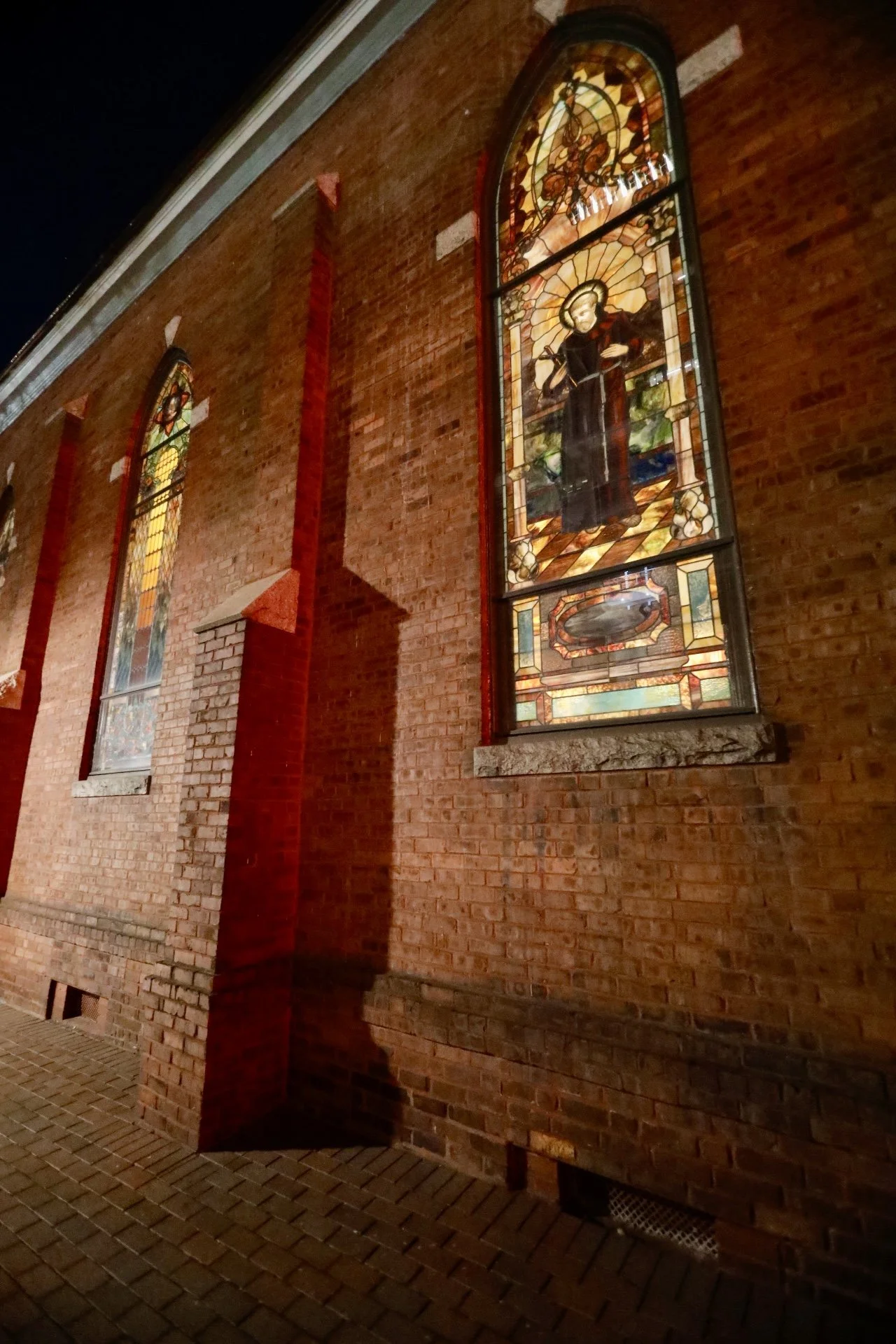
Windows That Remember
St. Peter Catholic Church on South Tryon Street in Uptown Charlotte, North Carolina, photographed at night.
On a late night in Uptown, St. Peter Catholic Church Charlotte holds its light the way some people hold their breath—quietly, on purpose. From the sidewalk on South Tryon Street, you can see brick, stained glass, and the reflective edge of newer towers behind it. The windows glow warm against the streetlamps, not asking for attention so much as refusing to vanish. In a district built for velocity—cars, calendars, quarterly goals—this is a place that doesn’t hurry. It simply stays.
Most nights, the city’s soundtrack is a layered thing: tires on wet pavement, a distant siren that never quite arrives, laughter escaping a doorway, the small electronic chirp of someone crossing when the signal says “walk.” People move through that sound carrying private cargo—grief disguised as errands, hope disguised as plans, exhaustion disguised as competence. Even when you’re not looking for anything spiritual, you’re still looking for something human: proof that you’re not just passing through a machine. Sometimes that proof shows up as a building that has outlasted the phrases the city uses to describe itself.
There’s a difference between a landmark and a lifeline. A landmark is something you point to, something you use to get somewhere else. A lifeline is something you return to, even if you don’t enter, even if you only let it steady you for a moment. At night, old churches in modern downtowns do a particular kind of work: they make space for the parts of a person that don’t fit inside a schedule. They offer a pause that feels almost rebellious.
This story isn’t really about architecture, even though architecture is the doorway. It’s about memory—how it survives in a city that constantly updates itself, and why that survival matters to people who feel updated-out. It’s about what a stained-glass window can do that a glass curtain wall can’t, and what it means when the oldest things in the center of town are still places of gathering rather than consumption. Along the way, we’ll step into the history of St. Peter—founded in the 1850s era of Charlotte—and into the present-day pressure of a downtown that rarely lets anything remain unchanged. And we’ll end where most nights begin: on the sidewalk, deciding what kind of person you want to be as you keep walking.
When a City Moves Faster Than Its Memory
Charlotte is a city that knows how to grow. If you’ve lived here long enough—or visited, left, and returned—you can feel the acceleration in the skyline itself. Comparisons of past decades to today often read like a before-and-after: the outlines are familiar, but the scale is startling, as if the city decided to think bigger and never stopped. Growth, though, has a shadow side that doesn’t always make it into the celebratory language. When newness becomes a civic reflex, older buildings don’t just age—they disappear.
The strange thing is how quickly we adapt to that disappearance. Humans are built to normalize their surroundings; we can make peace with almost anything if it happens gradually enough. A beloved corner becomes a construction fence, then a grand opening, then simply “the place you go now.” You can miss a building the way you miss a person: not in one dramatic moment, but in a series of small recognitions—I used to turn here, I used to meet them here, I used to be someone else here. Cities don’t just hold our routines; they hold our earlier selves.
In Uptown, the pressure of redevelopment can feel almost metaphysical, like the ground itself wants to be something different every decade. A university-based look at the oldest buildings in Uptown points out how few structures over a century old remain, and it names the trade-off plainly: creating a newer city has often meant destroying much of the old. That same context notes what tends to survive among the oldest structures: churches, because communities fight for them in a different way than they fight for storefronts.
And that fight isn’t only about history nerds preserving artifacts. It’s about a deeper need: continuity. Not nostalgia, not “everything used to be better,” but continuity—the sense that your life is not happening on a disposable stage. In a city of promotions and relocations, you can start to feel like even your own story is temporary. Old walls don’t solve that feeling, but they challenge it. They insist that something can be built to last longer than a marketing cycle.
St. Peter Catholic Church Charlotte and the Discipline of Staying
St. Peter’s story begins before “Uptown” became a brand. The parish traces back to the early 1850s, with the church’s own historical account describing a cornerstone laid in 1851 and a first building rising when Charlotte was still small enough to have edges you could name. In that telling, St. Peter originally stood at what was then the extreme southern limits of the city—an outpost more than a center. That detail matters, because it flips the way we usually talk about downtown churches today. They look like they’ve always been surrounded by towers, but towers came later; the church was here first.
The building people recognize now dates to another threshold moment: 1893, when the cornerstone was laid for the Victorian Gothic-style structure that still stands on South Tryon. The church’s own history describes a neighborhood that changed in waves—empty lots becoming homes, homes replaced by businesses, the city growing around the parish until the outpost became the heart. It’s a simple narrative, almost too clean—except it’s also what cities do: they swallow their outskirts and call it progress.
When you read that history, you also feel the stubbornness required to remain. St. Peter is described as the oldest edifice remaining on Tryon Street, a constant in an urban landscape that keeps rewriting itself. That’s not a sentimental statement; it’s a practical one. Remaining means paying for repairs when land values make selling tempting. Remaining means enduring seasons where membership shifts outward, when downtown empties at night, when the city’s energy moves to the next neighborhood that feels “hot.” Remaining is a discipline, and disciplines always cost something.
It’s also a discipline that sometimes requires reinvention without surrender. In 1986, St. Peter regained full parish status, and Jesuit priests began serving the growing parish and surrounding business community in a more intentional way, with daily Mass and reconciliation named as part of that continued presence. That date is more than an administrative milestone; it marks a moment when the church chose to live as a downtown church in a downtown that was becoming something else. The Jesuits’ broader ministry listing for St. Peter emphasizes the same two anchors—its founding in 1851 and Jesuit staffing since 1986—like coordinates you can navigate by.
The address itself—507 South Tryon Street—feels almost like a dare to the city: try to outgrow this, too. The Diocese of Charlotte’s parish listing places St. Peter right there in the center of the map of Catholic life, complete with a weekly schedule that reads like a quiet insistence that community is still possible in the core. A downtown parish doesn’t only serve residents; it serves the commuters, the visitors, the workers who arrive before sunrise and leave after dark. It serves the people whose lives are split into “where I live” and “where I earn.”
What Stained Glass Teaches a Glass City
There are cities built of brick, and cities built of glass. Charlotte, in its recent decades, has learned the language of glass fluently: reflective towers that mirror the sky, lobbies that feel like controlled climates, conference rooms where the day is measured in decisions. Glass is beautiful, but it has a habit of turning everything into a reflection. You see yourself in it. You see the city’s image of itself in it. And after a while, you can forget there are other ways to look.
Stained glass is not the same kind of seeing. It’s glass that refuses to be neutral. It takes light and gives it a story. It turns glare into color, and color into meaning, and meaning into a kind of patience. That patience matters downtown. Because downtown life trains your eyes to scan: signage, signals, notifications, faces, risk. Stained glass asks for a longer gaze, the kind that says, slow down; you might miss what’s true. You don’t have to be religious to understand the invitation. You only have to be tired.
The streets around St. Peter have also become a corridor of art and performance—another kind of meaning-making layered into the same blocks. The Levine Center for the Arts, completed in 2010 through a partnership of civic and philanthropic support, helped formalize this stretch of South Tryon as a cultural destination, with institutions and venues that pull people downtown for reasons other than work. Nearby listings for St. Peter in Uptown Charlotte’s visitor resources even describe it in that same ecosystem—both a church and a presence among museums, theaters, and the steady foot traffic of the district.
That context can make the church feel like an aesthetic complement—brick as a counterpoint to steel. But that’s the shallow reading. The deeper truth is that cities need more than attractions; they need interiors. They need places where you’re not performing your life, not selling your competence, not optimizing your minutes. Art can do that. So can worship. So can simple quiet. The point isn’t which door you choose; it’s that the doors still exist.
And there’s another lesson in stained glass that downtown buildings rarely teach: limitation. Stained glass windows are designed to be framed. They are beautiful precisely because they accept boundaries—lead lines, panels, shapes that hold the image together. Modern life often treats boundaries like enemies, as if the good life is limitless choice and constant access. But any honest person knows that a life without boundaries doesn’t become free; it becomes scattered. A framed window can remind you that structure isn’t the opposite of beauty. Sometimes structure is what makes beauty possible.
The Quiet Work of Doors
If you stand near a downtown church long enough, you’ll notice something subtle: people behave differently as they pass. Not everyone, not dramatically, but enough to feel the shift. Voices lower a notch. Steps slow, almost unconsciously. Some people glance up as if checking their bearings against something older than themselves. It’s not superstition; it’s recognition. A church is one of the few remaining public signals that a person is more than a consumer moving between transactions.
St. Peter’s, specifically, carries the Jesuit imprint in the way it describes its mission. Uptown Charlotte’s guide to the church highlights it as the only Jesuit parish and emphasizes a spirituality shaped by Ignatian language—finding God in all things, discernment, service, community. Even if you’re not part of that tradition, you can hear the human version underneath it: pay attention, live deliberately, don’t let your life become accidental. That message lands differently when delivered by a building that has watched the neighborhood change from lots to homes to businesses to skyscrapers.
There’s also something important about a church that stays downtown: it refuses to outsource the soul of the city to the suburbs. In many American cities, spiritual life migrates outward with families and housing, leaving the core to commerce and nightlife. But a downtown parish says: the center still deserves care. It says: the worker matters as much as the resident, the weekday matters as much as the weekend, the noon hour matters as much as Sunday morning. The Diocese’s schedule listing is ordinary on paper—times, days, consistency—but ordinary is exactly the miracle in a place built to be exceptional.
And memory, real memory, is always tethered to ordinary repetition. You don’t remember the one glamorous night as clearly as you remember the thousand small routines that formed your life. That’s why “windows that remember” is more than a poetic phrase. It’s a description of how places carry us: by being there when we return, by offering the same light through different seasons of our own changing faces. In a city where so much is designed to be replaced, the refusal to be replaced becomes its own kind of testimony.
So you keep walking. You pass the doors, maybe you enter, maybe you don’t. But you leave with a different interior weather than you arrived with—slower, steadier, less convinced that speed is the same thing as purpose. And if you find yourself back on South Tryon another night, you’ll notice the same stubborn warmth holding its ground. St. Peter Catholic Church Charlotte will still be there, doing what it has done for generations: letting light mean something, and letting the city remember it has a heart.
When Public Conversations Had a Place
An old public phone booth still stands in downtown Kingston, Ontario—no longer essential, but not yet forgotten. Inside its narrow walls, two young women encounter an object from a different rhythm of life, revealing how quickly everyday systems disappear, and how quietly time moves on.
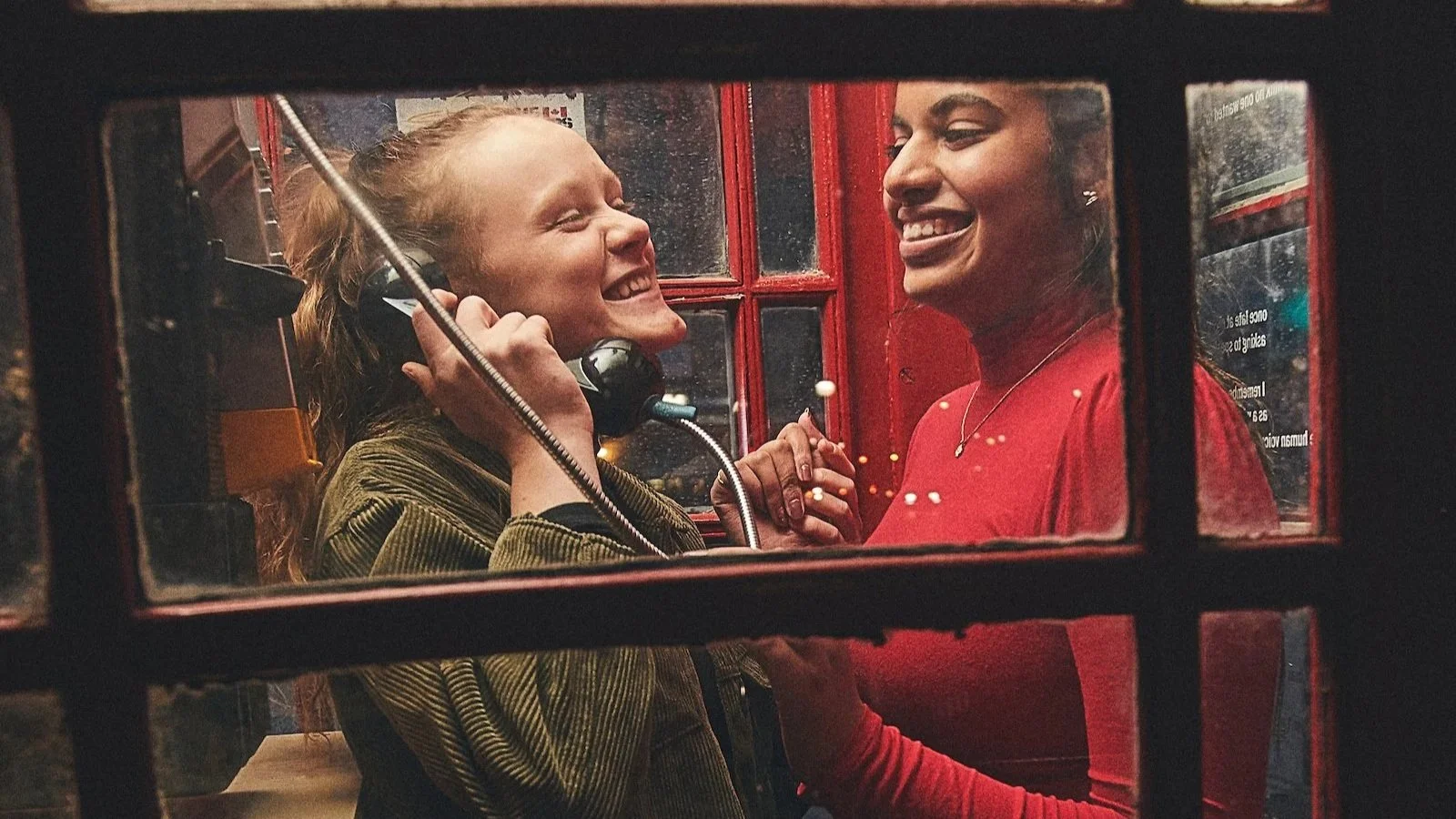
When Public Conversations Had a Place @solomon D Crowe
Two young women share a moment inside a traditional red telephone box, laughing as one holds the receiver — a reminder of when public communication required presence, patience, and proximity. Framed through weathered glass, the scene reflects the tactile, face-to-face rituals of connection that once defined urban streets before digital immediacy replaced them.
Like many cities, downtown Kingston is continuing to move along with the other smaller urban areas—without shouting about it, but moving on quietly. The sidewalks carry the typical mixture of walking errands and walking detours. Traffic should maintain a moderate flow, turning frequently and in short bursts throughout the day. The wind should also find its way to the streets between buildings off the water. Therefore, while the light may indicate that the streets are not sharp, the wind will do so to the contrary.
Next, there is the bright colored telephone booth in red; enough to notice but too old for anybody to pay any attention anymore. This does not fit the speed of the area around it. This is the type of local activity to which it does belong—the expectation that one would arrive at this type of facility if an individual wanted to contact someone, and will stay there until the contact with the person needed is completed.
The frame for everything is already in place due to glass. The window grid separates everything into rectangles, just like a contact sheet refuses to be a swipe. Two young women enter the narrow space; the booth becomes something more than just a relic for a brief period of time. It becomes what was intended; a small room for a voice to move through and whose body must stay.
A Public Room for Private Words
Telephone booths weren't romantic by nature. They were practical, and at times uncomfortable but did have the remnants of public use stuck to their surfaces. They were built by municipalities to provide links within cities without ownership required by the user. You did not need a contract, a charger or a monthly payment for service. All you needed was some change (or a calling card) and enough patience to wait for the line to clear.
Their strength lay not in their technology, but rather in what they designed. The booth invited users to act in an uncommon manner, in that modern day society hardly encourages us to commit to any one place. By using a booth, users are agreeing to be limited by this one space; although their conversation happens in the booth, there is a much larger city that is located just outside the glass. While you could talk from the booth (and you can chat), you could not run away while you were sending/receiving your message.
In addition, the booth also represented equality among people. No matter who you were, it treated all equally, regardless of mobile device, data plan, or battery level. All people were provided with the same limited degree of privacy once انہوں your other inside io yet? All transactions for utilize the booth were conducted via a common form for payment - billable time as well as by atomic denominational units. When any calls made in the booth and therefore new associated will end as do all public calls, in finality; there is no flexibility about adjusting call amount before they have reached end point.
The fact that older logic continues to exist in the material world and the receiver is present in the material world, and a cord continues to limit an individual’s ability to move, proves that booth space demands a common choreography even before someone has spoken into the handset. Ultimately, prior to any discussion having occurred, the physical space is demonstrating that connection used to require something beyond a desire for it; it required a structure through which the connection was made.
The Muscle Memory That Disappears
Instead of revering the booth, the two young women express curiosity. This shows both their honesty and the importance of the moment. Their laughter isn't a way of recreating nostalgia, but rather an honest response to something they didn't have prior knowledge of.
The weight of the receiver is significant when held; it is a bulkier, more clunky item than the phone but lacks an interactive display that can help determine the next move. The receiver creates pressure for the user, the user must support the receiver, and position themself correctly between the receiver and the mouthpiece. The phone line that connects the receiver and the wall is rigid enough to ensure the call takes place where it is intended. The booth provides no special provisions for adaptation to you; rather, your adaptation to the booth must occur.
They move gently through their space, as if exploring the edges of the boundaries. One of them is leaning against the wall in a relaxed manner, like he is performing on a small stage. The other is moving his arm to see how big the space is, and where he might start the phone call. Their faces show an expression of wonder as well as focus; it is the expression of someone finding out something that used to be normal.
For those familiar with these phone booths, this will evoke a much different feeling than from someone who has never seen a phone before: The entire sequence of events (e.g. picking up the receiver, waiting for the dial tone, intentionally entering the phone number) has been remembered through the muscle memory of your hand movement; however, you must now re-learn this sequence as if it were a foreign language because the city has left the booth unchanged but so much time has passed and no one knows how to read it anymore.
After Everything Became Portable
The movement away from booths did not occur as a result of people not requiring each other, but rather as the change in connection from a public place (a booth) to a personal piece of property (the cell phone). As connection became available to people through their own individual form of connection, the responsibility of each city had diminished as the responsibility of an individual had expanded. If your telephone is out of service, that is a problem for you; if you do not have enough money to purchase one, nobody in the world will help you obtain one.
Convenience is the new normal; we can connect with others from virtually any place in the world at virtually any time. However, this new level of accessibility dramatically impacts how we interact socially — if all calls may occur while on-the-go (including walking), waiting (at any location), travelling (commuting), working or otherwise — there aren’t any longer instances where we actually stop what we are doing for a telephone call to take place. We’re constantly “on the go”; therefore we’ll never really “arrive” anywhere, both at once!
In addition to that, a booth signified a temporary nature of the call – after one call ended, it would naturally disappear within the air, mostly because no one remembers the contents anymore. In contrast, many phone calls are recorded, stored and synchronized; although an individual may have felt the conversation took place privately with another individual – these types of conversations now are recorded in systems. Similarly, portability is allowed via an invisible system of recording mechanisms and platforms. However, these trade-offs are usually unrecognized because of the extreme convenience associated with them.
The red telephone booth in Kingston is a relic of when cities were intended to provide some sort of telephone connection for everyone; everyone could use the telephone with no special arrangement necessary. It is a testament to how the designer envisioned that people would use the telephone for making a call in an emergency or because they had lost a train or because they had broken their plans.
The Look Through the Glass
The most revealing moment isn't in the laughing itself, but in looking back after laughing. At some point in the play there will be a point where there is no longer any motion and both faces will look toward the audience and to the outside world; they are now aware that they are being observed.
A grid will serve as a grid structure for this booth, but it also serves as a metaphor for how we see and experience public life. The glass provides privacy from those outside, while allowing those on the outside to have their own view inside the booth; however, it does so at the same time by allowing those outside the booth to know they can see you in the booth and also have the ability to stand outside of it and wait for you to exit. The line dividing what happens inside of it from what happens outside of it is extremely thin—however, it is also a very honest line.
The end image is a combination of what is now (i.e. our current reality as influenced by culture) and what was (i.e. the time period when these young women lived) without emotion. Young Women Neither Are - Nor Were - Just "In the History." They Are An Example Of An Object That Has Been Used (Or Lived) And Now Does Not Have Its Original Manual. The Expression On Their Faces Is Beyond Nostalgia (Reminiscing) For How Things Used To Be, And Are Today, In Addition To Recognizing That Time Does Not Announce/Signify Its Variable Departures; Time Only Minimizes The Use Of A Skill Until It No Longer Exists.
The city centre stretches from one side of the image to the other. More pedestrians are walking past this booth as well. The booth appears to be decidedly out of place. Calm and anchored to a time when people wanted to interact via tactile or physical means. At some point in the future, this booth may be removed or merely used for decoration. But the booth does provide something unique; an environment in which to communicate that is not environmentally generated, or continual, or randomly floating. The booth provides a communication environment that is based upon a specific place.
The strength of the image lies not so much in the obsolescence of a phone. Rather, it's that connection once meant having a place, touching the void with time and the patience to wait until your voice could reach where you were trying to get to!
This visual essay explores how public communication, generational memory, and the loss of shared infrastructure surface inside a phone booth in downtown Kingston, Ontario.